
 Store
Store


Tags Africa
Tag: Africa
Canada and Justin Trudeau in Africa
Will the recent election results in Canada have an effect on the other side of the Atlantic? Canada is the world’s mining superpower and its mining corporations are aggressively engaged on the African continent, which contains much of the world’s remaining mineral wealth. KPFA’s Ann Garrison spoke to Yves Engler, the author of “Canada in Africa: 300 Years of Aid and Exploitation.”

From Ghetto to Goddess: Iminah Ahmad speaks
I have known Iminah, the renaissance woman who works under the brand name “From Ghetto to Goddess,” for a few years, and I continue to be inspired by how she serves the Black community. Since moving back to Oakland from Atlanta where she went to college, Iminah has been involved with speaking to at-risk youth, writing and recording an album, and dancing in everything from plays and dance shows to music videos.
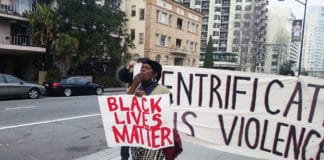
California: For rich people only?
Thousands of families, elders and babies across the state are under attack by the concerted forces of gentrification and removal by the white-supremacist nation that would like to remove us all. From police terror to the acts of elder and child abuse caused by eviction to the endless building of prisons and militarizing of these colonizer created borders leaves us all asking who is this shiny state being built for?
Manager PK remembers the Jacka
PK is known around the Bay as the hardest working manager there is to have in Northern Cali Hip Hop. He manages many of the Mob Figaz and their affiliates in the music industry, but he is most famous for his work behind the scenes with the career of the Jacka, whose loss has hit people in much the same way as the assassination of Tupac.
Wanda’s Picks for January 2015
Happy New Year! Happy Birthday to my granddaughter Brianna, niece Wilda and friend Fred T. I am still smiling about America’s new relationship with Cuba and the freed Cuban 5. If you are in New Orleans (NOLA), don’t miss “Prospect 3: Notes for Now,” the biennial there being celebrated throughout the city through Jan. 25.

Wanda’s Picks for December 2014
As we move into the next solar return, there is much to look forward to despite the stasis that seems to infect this nation with the disease of white supremacy or racial domination. OK OK, perhaps the silver lining is a bit too buried to find Osumare’s twinkle beyond any pots of gold you’ve stumbled upon recently. The knowledge that no matter how it looks, the Creator is in charge and the bad guys just look like they are always winning is what sustains us.
Wanda’s Picks for October 2014
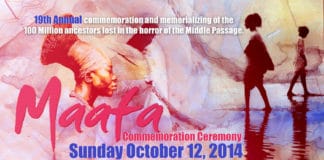
Sunday, Oct. 12, marks our 19th Annual Maafa Commemoration. This is a time when we gather to remember our African ancestors, especially those who endured the transatlantic slave trade or the Middle Passage, the Black Holocaust. It is a time for Pan Africans to gather and celebrate life and recommit ourselves to the work of liberation: spiritual, psychological, economic and political.

SF community newspapers featured at Commonwealth Club forum
The San Francisco Neighborhood Newspaper Association and the impact of community journalism was the featured topic last week at a forum sponsored by San Francisco’s prestigious Commonwealth Club. Four local publishers, Earl Adkins (Marina Times), Juan Gonzales (El Tecolate), Willie Ratcliff (SF Bay View) and moderator Glenn Gullmes (West Portal Monthly) represented the neighborhood news collective.
Why Ferguson is the Congo
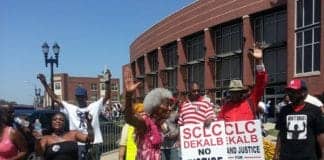
For those who are looking at us, as if we were in a cage like Patrice Lumumba said, there is no difference between a Black African and an African-American. We are the ones making this difference because we think that for the white man there are good Blacks and there are bad Blacks. We don’t look at ourselves through our own eyes but through the eyes of another person who has defined us as not human.
Free Imam Jamil Al-Amin! His wife, attorney Karima Al-Amin, tells of...
The fiery H. Rap Brown, chairperson of SNCC, minister of justice for the Black Panther Party and one of the original four targets of the FBI’s infamous COINTELPRO to neutralize Black power, is presently entombed in the federal prison at Florence, Colorado, one of the world’s 10 worst prisons. Pursued relentlessly since the ‘60s, he was wrongfully convicted in 2002 – the prosecutor bragging that they finally got him after trying for 24 years. His wife, attorney Karima Al-Amin, tells his story on the Block Report.
Africa’s betrayal by African leaders
Africa’s elite and the elite internationally have concluded the African Development Bank’s 50th anniversary celebrations and annual meeting under the theme: “The Next 50 Years: The Africa We Want.” Over 3,500 delegates, seven African heads of state, the governor of the Central Bank of China and the U.S. deputy secretary of treasury were among the dignitaries. Beneath the confident calm, Africa is on edge, and the participants in Kigali were aware.
KCSM’s ‘Announcer of the Year’ Greg Bridges in his own words
Greg Bridges is one of the Black broadcasting giants on the airwaves of the Bay Area. He was recently named “Announcer of the Year” by KCSM, yet ironically his show, Transitions on Traditions, faces an uncertain future at KPFA and Pacifica Radio, which has been mired in racism and discriminatory towards Black and other broadcasters of color from coast to coast.
New Year’s message from Muammar Al Qaddafi
In 1989, the following message was released to the Christian world in the form of an open letter by the revolutionary Muslim leader and martyr Muammar Qaddafi. Qaddafi is one of the few Muslim leaders who truly understood the revolutionary doctrine of Tawheed, recognizing the oneness of God and God’s creation. In this New Year’s message, Qaddafi invites all believers to enter into reflection and dialogue to solve the crisis confronting humanity.
Mandela, America, Israel and systems of oppression
In the 23 years since Nelson Mandela walked from his notorious Robben Island prison cell, leaving behind the rotting corpse of South Africa’s system of racial and economic oppression known as apartheid, a new generation has grown into adulthood there, literally unaware of the cruel exploitation and indignities the tiny White minority population inflicted on the masses of that country’s people.
Wanda’s Picks for December 2013
This season we have lost two pillars of our San Francisco Bay Area community, Samuel Fredericks and Upesi Mtambuzi. Cedar Walton, pianist, also made his transition this year, along with Donald Duck Bailey, drummer, both men beautiful human beings. Upesi, Samuel, Cedar and Donald all brightened our world. Their unique hues and shapes and sounds will be missed ... that last live jam.

Kev Choice produces Jennifer Johns’ ‘The Chronicles of the Aquarian Mind’
Since we last caught up with Kev Choice, he has been in the lab creating the soundscape for the new Jennifer Johns’ “Chronicles of the Aquarian Mind” album, which will see the light of day in mid-October. This is a very unique match of Oakland talent, be it that she is a strong vocalist and at times rapper and Kev is definitely production savvy. Check out Kev Choice in his own words ...
Wanda’s Picks for September 2013
On the 20th anniversary of the demise of my father, Fred Ali Batin Sr., the 18th anniversary of the Maafa Commemoration San Francisco Bay Area – the Ritual Sunday is Oct. 13, 2013; see http://maafasfbayarea.com/ – and approximately the 60th day of the hunger strike to end the inhuman conditions in California’s Security Housing Units or SHUs, I just want to pause and reflect.
Beyond the dream: Martin Luther King Jr. and Africa
When discussing the legacy of Martin Luther King Jr., especially his “I Have a Dream Speech,” what is often missed is his concern for global justice, particularly in Africa. While Dr. King’s outspokenness about the Vietnam War toward the end of his life has been well documented and discussed, his views about the need to support anti-colonialism and anti-Apartheid in Africa is less so.
Mexico City hunger strikers demanding justice for Malcolm Shabazz attacked by...
Urgent alert! Police have attacked, beaten numerous protesters who are holding a peaceful vigil to call attention to the brutal death of Malcolm X’ grandson. Among those known to be physically and badly assaulted are Metelus Wilner and Jah Zakah from Haiti. We ask you to forward this and are looking for assistance in this matter urgently.
African unity at 50: Integration is the only way – Samia...
By rejecting continental unity, Africa is depriving itself of wealth and autonomy, says Kwame Nkrumah’s daughter. The main objective of linking up with the African diaspora is to restore the dignity of Africans that was diminished after slavery and colonialism. We came to realize that our very survival socially, economically and politically depends on that unity.