
 Store
Store


Tags California Department of Corrections and Rehabilitation (CDCR)
Tag: California Department of Corrections and Rehabilitation (CDCR)

The four California prisoner class representatives call for solidarity and change
Collectively, we are an empowered, mighty force that can positively change this entire corrupt system into a system that actually benefits prisoners and thereby the public as a whole.

Liberate the Caged Voices: Free Sitawa!
Sitawa, along with three other strong and principled leaders of the Pelican Bay Short Corridor Collective, inspired 30,000 courageous prisoners, who, in their struggle for freedom from the torture of solitary confinement – or the threat of it – chose to shun violence and rather embrace a peaceful strategy in order to bring about much needed change.

California prisoners say videos show ‘gladiator fights’ at Soledad State Prison
California prisoners released video recordings of two prisoner fights they say were set up by officials at the Correctional Training Facility in Soledad, California. It is now the second facility to report so-called “gladiator fights” after prisoners spoke out about similar incidents at the state prison in Corcoran.

Court finds systemic constitutional violations by California Department of Corrections
Late Friday, a federal judge found that the California Department of Corrections and Rehabilitation (CDCR) is systemically violating the due process rights of prisoners. The judge ruled that CDCR is violating the Constitution by repeatedly relying on unreliable and even fabricated confidential information to send California prisoners to solitary confinement. The court also found CDCR is using constitutionally flawed gang validations to deny people in prison a fair opportunity for parole.

Black August: The power of prisoner-led organizing
“Settle your quarrels, come together, understand the reality of our situation, understand that fascism is already here, that people are dying who could be saved, that generations more will die or live poor butchered half-lives if you fail to act. Do what must be done, discover your humanity and your love of Revolution. Pass on the torch. Join us, give your life for the people.” – George Jackson

Ongoing isolation in California prisons not governed by settlement, judge rules
A federal judge in a March 28 ruling declined to order the CDCR to move prisoners previously held in SHUs into legitimate general population conditions. Under a landmark class action settlement that was intended to effectively end indefinite solitary confinement in California prisons, nearly 1,500 prisoners were released into the general prison population, many to Level IV prisons, which is the highest security level in general population.
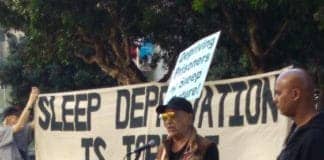
Rally, press conference and court solidarity to end sleep deprivation
On Feb 8, 2018, Northern District Judge Vince Chhabria held a hearing on a motion by the California Department of Corrections and Rehabilitation (CDCR) to dismiss civil rights lawsuits brought by two prisoners, Christopher Lipsey and Maher Suarez, who are suing CDCR for violation of their Eighth Amendment rights against cruel and unusual punishment. Specifically, they have brought their lawsuits to put an end to the sleep deprivation of prisoners caused by “security/welfare checks.”

Two years after historic settlement ending indefinite solitary confinement in California,...
Two years after the historic settlement of Ashker v. Governor of California marked the end of indefinite solitary confinement in California, the Center for Constitutional Rights and co-counsel filed a motion to extend the terms of the settlement by one year, noting that substantial reforms are still needed and the California Department of Corrections and Rehabilitation (CDCR) continues to violate the constitutional rights of Ashker class members.

Don’t let CDCR reverse our hunger strike-won legal victory: Statement of...
The Oct. 14, 2015, victory was achieved through three hunger strikes and the non-violent legal and political action of thousands of California prisoners, their families, supporters and their attorneys. Now, however, we believe that CDCR is still engaged in constitutional violations that deny prisoners due process and seeks to put us back in the hole – for many, indeterminately under the guise of Administrative SHU.

Free Speech Society emergency bulletin: We refuse to fall prey to...
It is no secret that CDCr’s counterintelligence units have been plotting revenge on the class members of Ashker v. Brown to have us returned to indefinite solitary confinement. Therefore, it is reasonable to conclude that it wasn’t a matter of coincidence, as we embark upon the first anniversary of Brotha Hugo “Yogi Bear” Pinell's assassination, that the media began leaking fraudulent reports to the public generated by IGI, ISU, OCS and the FBI about the BGF plotting to avenge the death of Hugo Pinell.
Gov. Brown’s parole initiative could free 30-40,000
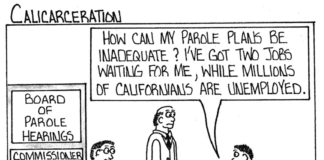
The California State Supreme Court has re-affirmed its decision allowing Gov. Jerry Brown’s proposed initiative for changing California’s parole system to begin gathering signatures for the November ballot. The March 9 decision was the second time the court kept Brown’s crime initiative alive by rejecting a request by state prosecutors to halt signature-gathering for the measure.

California prisoners win historic gains with settlement against solitary confinement
Today, California prisoners locked in isolation achieved a groundbreaking legal victory in their ongoing struggle against the use of solitary confinement. A settlement was reached in the federal class action suit Ashker v. Brown, originally filed in 2012, effectively ending indefinite long-term solitary confinement and greatly limiting the prison administration’s ability to use the practice, widely seen as a form of torture.

Death Row prisoners challenge torturous conditions in San Quentin’s ‘Adjustment Center’
Six condemned men living in extreme isolation in San Quentin’s Adjustment Center filed a class action lawsuit today seeking to end the inhumane and degrading conditions in which they are confined and challenging the complete absence of meaningful procedures by which they are placed and retained in those conditions.

‘Mariposa and the Saint: From solitary confinement, a play through letters’...
A fundraiser for California Coalition for Women Prisoners, Sara (Mariposa) Fonseca and Julia Steele Allen’s “Mariposa and the Saint” is a play created from correspondence between an inmate in solitary confinement and a volunteer with a CCWP visiting team who became Mariposa’s friend. The prison will not let Steele Allen in to see Mariposa since the play was written.

Prisoners and advocates commemorate the one-year anniversary of the hunger strike...
A year ago on July 8, over 30,000 people inside California prisons began a hunger strike to bring an end to the state’s use of indefinite solitary confinement. On the one-year anniversary of the largest prisoner hunger strike in California history, the Center for Human Rights and Constitutional Law today is filing a lawsuit charging CDCR with illegally refusing to publicly disclose information, data and studies regarding its solitary confinement rules, policies and practices.

Opposition to new prison censorship rules comes from The Netherlands
CDCR has proposed regulations that could permanently ban any documents it defines as “contraband,” including political publications and correspondence that should be protected by First Amendment constitutional rights. Why are prison officials attempting to increase the political, mental and emotional isolation of people in solitary confinement struggling to resist an already crushing physical isolation?
Major law firm opposes new rules that could ban the Bay...
This letter, from attorney Leila Knox of Bryan Cave LLP, one of the world’s largest law firms, has been submitted to the California Department of Corrections. “Under this regulatory scheme,” she writes, “publications such as the Bay View could be impermissibly banned from within state prisons.” Readers are encouraged to submit their own comments from their own perspective. Comments are being accepted until Tuesday, June 17, at 5 p.m., and can be easily submitted until that time at http://prisonerhungerstrikesolidarity.wordpress.com/.
SB 892 and AB 1652: Pelican Bay prisoner representatives speak to...
We are writing to offer our position on the two bills pending before the Assembly and the Senate – SB 892 and AB 1652 – dealing with the solitary confinement and gang validation policies of the California Department of Corrections and Rehabilitation (CDCR). The narrower and more focused (and less costly) AB 1652 would far better serve the public safety, prison security and the humane treatment of prisoners.
New proposed censorship rules mean more torture for California prisoners in...
Our torture would be magnified under these new proposed rules that Stainer and his cronies are introducing by attempting to silence prisoners and publishers whose voices have been prominent in waging struggle against our perpetual suffering. CDCr wants to stifle our truths and disconnect us from society at large. Prisoners would no longer be able to write to the media outlets that allow us to speak to our suffering.
Prisoners and advocacy groups oppose Sen. Loni Hancock’s prison reform bill,...
California prisoners, who suspended their 2013 hunger strike, the largest such strike in history, after two legislative leaders promised bills addressing the strikers' demands, are now opposing one of those bills. Sen. Loni Hancock's Senate Bill 892 would give prison regulations on “gang validation” and the new step-down program the force of law. And it would leave California with the largest population of prisoners in solitary confinement of any country in the world or state in the United States at enormous cost to the taxpayers.