
 Store
Store


Tags Friends of the Congo
Tag: Friends of the Congo

Allimadi: The U.S. is not interested in going after the LRA
An AP newswire posted to outlets all over the world said that the Democratic Republic of the Congo has sent 500 troops to join a Uganda-led military effort to hunt down Joseph Kony, the fugitive head of the Lord’s Resistance Army, or LRA rebel group, bringing the number of African soldiers deployed against the LRA up to 3,350, assisted by U.S. Special Forces.
Obama administration official provides insights on U.S. Congo policy
On Monday, Feb. 11, outgoing Assistant Secretary of State for African Affairs Johnnie Carson presented an outline of the Obama administration’s policy position on the situation in the Democratic Republic of the Congo. The purpose of Ambassador Carson’s presentation was twofold: discussing why efforts should be redoubled to bring stability to the Congo and laying out a framework for “moving forward.”
Sanctions on top Rwandans, not drones over the DRC
The United States says it’s ready to send surveillance drones to the Democratic Republic of Congo to help the United Nations peacekeeping mission in the African state despite the government of Rwanda’s objections from its new rotating seat on the U.N. Security Council. The U.S. also supports the plan to use drones to increase surveillance capacity in other African countries.
Susan Rice’s defense of Kagame in Congo puts Obama State Department...
The Obama administration was on the defensive about the U.S. relationship with Rwanda and its U.N. Ambassador Susan Rice at the Dec. 11, 2012, U.S. House Foreign Affairs Committee hearing on the conflict in the eastern Democratic Republic of Congo. Two days after the hearing, Rice withdrew her name from consideration to become secretary of state. In President Obama’s statement on Susan Rice, issued the same day, he praised her work but did not mention Rwanda, Uganda or Congo.
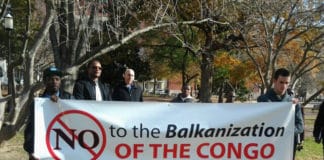
Six million dead since 1996? It’s time to break the silence...
Congolese problems should have Congolese solutions. We ask that the United States of America and the United Kingdom immediately withdraw all forms of financial and military aid to Rwanda that is a state sponsor of terrorism in Africa. We must pledge to ourselves that we will never again betray our people and ourselves by staying quiet and passive.
United States withholds military aid from Rwanda
On Saturday, July 21, 2012, the United States officially announced that it was withholding $200,000 in military aid from the Rwandan government. Although a materially insignificant sum, the symbolism has serious implications for Rwanda’s image and reputation in the global community.
U.S. cuts aid to Rwanda for destabilizing Congo
The State Department announced today that the U.S. “has cut this year’s planned military assistance to Rwanda amid concerns that the government in Kigali is supporting rebel movements in neighboring Congo,” according to the Washington Post. A three-year campaign by advocates for peace in the Congo and an end to the plundering of its mineral riches culminates successfully in today’s announcement. They have been pressing for implementation of the only law sponsored by then Sen. Obama allowing denial of aid to Congo's neighbors that destabilize the Congo.
Sanford Weill and Paul Kagame: Doctors of Humane Letters?
On May 12, Sonoma State University awarded honorary doctorates in humane letters to former Citigroup CEO Sanford Weill and his wife Joan, paid for with a $12 million “donation.” On the same day, William Penn University awarded an honorary doctorate in humane letters to Rwandan President Paul Kagame, despite his army’s atrocities in Rwanda and Congo.
Justice for the Congolese people, an attainable goal in 2012
Congolese people have seen an estimated 6 million of their citizens perish in an unjust war. They have witnessed how the perpetrators of these crimes still roam the streets of their country or are given humanitarian awards and accolades. We hope that all justice seekers around the world will join us in working to deliver justice to the Congolese people.
U.N. on Congo: Dodd-Frank conflict minerals law increases conflict
A U.N. report says that the USA’s conflict minerals legislation, Section 1502 of the Dodd Frank Wall Street Reform and Consumer Protection Act, is increasing rather than decreasing criminality and conflict in the Congo and that Bosco Ntaganda is now in control of minerals smuggling from the Congo into Rwanda.
Congolese will decide the fate of Congo
Knowing of the vast reservoir of strength of the Congolese people, more important than its mineral wealth, one can expect a uniquely Congolese solution to finally securing a government that is accountable to its own citizens. With 70 million people, half under the age of 18 and half women, the future of the Congo is in the hands of the Congolese.
Congo: Elections, democracy and the Diaspora awakening
Congo’s Nov. 28 presidential and legislative elections were fraught with tremendous irregularities and widespread charges of fraud. The opposition categorically rejected the results as fraudulent. Nonetheless, Joseph Kabila was sworn into office on Tuesday, Dec. 20.
Congo: What’s Rwanda got to do with it?
Rwandan political prisoner Victoire Ingabire is spending her second Christmas in Rwanda’s maximum security prison. Her ongoing trial, on charges of terrorism and genocide ideology, has implications not only for Rwanda, but also for the entire Great Lakes Region of Africa – most of all, for the Democratic Republic of Congo.
Kabila, Tshisekedi and Congo
The Democratic Republic of the Congo is in political crisis. The Independent National Electoral Commission announced that incumbent President Joseph Kabila is the winner, with 49 percent of the vote. But his leading challenger, Étienne Tshisekedi, rejected the results and declared that he now considers himself the nation’s president.
Crisis in the Congo: Occupy the phones to the U.S. Senate...
The Senate Foreign Relations Committee meets today on the election crisis in the Democratic Republic of the Congo. If your senator is a member, call him or her to demand that the U.S. government does not recognize the current election results published by the Congolese electoral commission in light of the Carter Center’s report about the irregularities during the electoral process.
Congo in crisis: Election results cannot be reconstructed
The Democratic Republic of the Congo is in political crisis. After an unfair, fraudulent and violent election, the National Electoral Commission, stacked with supporters of incumbent President Joseph Kabila, has announced Kabila is the winner. Leading challenger Étienne Tshisekedi has declared himself the winner.
Resource sovereignty: Congo, Africa and the Global South
Congolese youth are not going to give up. They’re fighting day and night, educating their peers, their communities and mobilizing throughout the country to bring about change, whether it comes today or tomorrow. They’re clear that they have to be organized to protect their interests, and no one, no one, can protect their interests like they can.
Call the doctor: Walmart needs urgent care for a bad case...
Walmart released a video for their back-to-school campaign series titled “Urgent Care” that features three teenage boys trying to identify an unknown skin condition. One boy browses a “Web MD” page on leprosy, asking if the boy with symptoms has “been in the Congo recently.”
Seeing no evil in the Congo
Do you have a smart phone? A laptop? Then you play a role in the violence that occurs in the Democratic Republic of Congo. Cell phones, laptops and other electronics don’t work very well without the mineral, coltan. In the Democratic Republic of Congo, poor farmers are gathered by armed gangs and enslaved to dig coltan out of the ground.
White man’s burden: Affleck and Prendergast in Congress for Congo
On Tuesday the House Foreign Relations Committee held a hearing on the Democratic Republic of Congo, the most lethal conflict in the world since World War II, killing over 6 million. No one from the Congo or anywhere in Africa was called to testify.