


by JR Valrey, The People’s Minister of Information
One of Oakland’s most celebrated and well attended summer festivals is back: Oakland Carnival is on Saturday, June 6, at Mosswood Park.
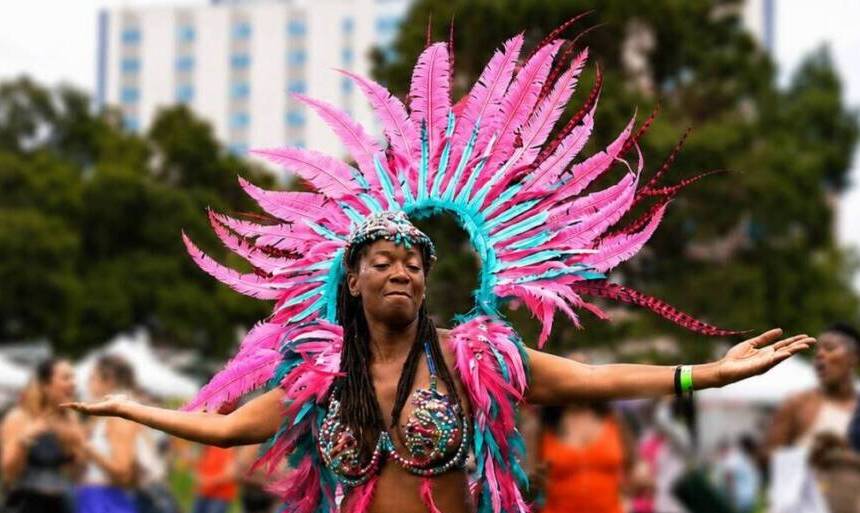
For natives, residents and newcomers, Carnival is a time to celebrate our greater Pan African culture, as well as our individual national identities through elegantly made flamboyant colored costumes, delicious food, thumping bass, with elaborate dances, among many more attractions.
I got a chance to catch up with the legendary King Theo Aytchan Williams, the director of Carnival Operations, to spread the word about the event and also to teach a little bit of history about this unique holiday born in the Americas.
MOI JR Valrey: What is the history behind Carnival? And where and how is it celebrated?
King Theo Aytchan Williams: Carnival is an expression of JOY and Resistance. It is very revolutionary at its core. It’s a misnomer that Carnival started in Europe. Like many traditions – especially those preserved by Black folks – once we dig deeper we can trace the origins back to Africa. In this case, the concept of Carnival originated in Kemet – what the Greeks referred to as Egypt. It started as a harvest festival, which made its way into Europe and began to morph, evolve and take on other meanings, but the celebration withstood all the changes.
Through the Trans Atlanta Slave trade, kidnapped enslaved Africans, under the religious domination of the Catholic church, incorporated disguised African traditions, rituals and gods into Catholic practices. In the Caribbean and South American territories where African people are and the Catholic church was forcefully expanding its control, enslaved Africans were awarded a day away from the toiling labor in the plantation fields.This gave birth to the celebratory religious holiday we call Carnival. With Brazil having the largest population of descendants of Africans outside of the African continent, it makes sense that Brazil also has the largest Carnival in the world.
Salvador Bahia Brazil is the proud home of African Brazilian culture. Here in the States we have Mardi Gras, which also traces its cultural roots to connections with the Catholic Church, Easter, Good Friday. Lent and the celebrations of Fat Tuesday. Today Carnival is loved and celebrated throughout the world including North America, the Caribbean, Central and South America and even in Europe and Asia.
MOI JR Valrey: How long have you been involved with Carnival? How did you become involved?
King Theo Aytchan Williams: I feel like I’ve been connected since birth but my formal involvement started in 1998 when I was first introduced to Carnival by a local Bay Area carnival group Fogo Na Roupa. My spiritual sister Regina Califa Calloway – the sister of Sway Calloway, who is also a big supporter of Carnival, invited me to participate. She was a co-director with the Founder Mestre Carlos Aceituno. Carlos was my teacher and friend. He was super creative and open to new ideas. If it was gonna help Fogo be better, he was down to listen. Two years later, when I relocated back to Oakland from Atlanta, I brought my Clark Atlanta HBCU experiences. Carlow allowed me to incorporate my energy into Fogo’s Carnival experience. I was jumping, hopping and stepping all through San Francisco Carnival. Clark Atlanta’s mascot is a Black Panther and I was the mascot, so entertaining large audiences came easy. The following year, I was encouraged to run for SF Carnival King. The competition was held at the Roccopulco club on Mission Street. That night was super crazy but I won. They crowned me King and I’ve been involved with some aspect of Carnival, whether in the Bay, Atlanta or Brazil, ever since.
MOI JR Valrey: With San Francisco having such a big and legendary Carnival, why does Oakland need its own?
King Theo Aytchan Williams: Interesting question, Oakland has its own voice and its own message. Oakland has a very unique and distinct history, flavor and swag: Swag is a word that was created in Oakland. I like to use the word create because that’s what we do in the Town. We have a way of creating and adding to the civic, social and political climate. We expand the culture. We do this differently. I like to say, why compete when you can create. For Oakland Carnival it represents that creative idea and creates space for Oaklanders to develop healthy Civic pride, especially the youth, plus Oaklad has impacted the Culture in so many ways with hella innovators and influencers in the Arts, music, dance, sports, education, politics and community building. For example, we call Oakland’s Carnival a Wellness Festival. For us, Wellness is a revolutionary act. We are reclaiming public space to advocate for Community Wellness, Wellness for Black People and supportive allies are welcome. We feel that having a good time is definitely necessary and important but our people need more than another party in the park. We have to offer more. So we curate a Carnival experience that builds the history and expands the scope and mission.
MOI JR: What do the elaborate beautiful and colorful costumes that the dancers’ wear mean?
King Theo Aytchan Williams:
Each Carnival band or samba school determines the theme each year. The theme, the music, dance, float design and costumes needed to support the vision of the Artistic Director. There all several types of costumes and multiple Carnival cultures and expressions, but when people usually think of Carnival they think of the elaborate feathered costumes. That’s what catches the eye.Those are traditionally used in the Caribbean, Trinidad & Tobago and Brasil, Rio de Janeiro. However, Carnival is celebrated in so many cities and towns across the Americas and the world. In the countrysides we see fewer elaborate Carnival displays but they are just as fun, and full of energetic passionate participants. I experienced a “wet Carnival” in Panama, where everyone is wet up with giant waterhoses. This didn’t stop the celebration, but it would have destroyed one of those big beautiful feathered costumes.
MOI JR: Has the City of Oakland aka local government been supportive of Carnival in Oakland over the years?
King Theo Aytchan Williams: I have to say yes but not in the way you might think. We don’t receive any major financial support from the City, Mayor’s Office or Cultural Affairs Division. We’re charged for every city resource we use. However the Department of Parks and Recreation city staff has been very cooperative and supportive of Oakland Carnival. Some city staffers remember Carijama and honor that we are working to keep that tradition alive while others have no knowledge of the history but do their best to facilitate our requests for permits and inspection appointments.
Working with the City of Oakland can be tricky, but the PRAC board, Mosswood Park Director Terri Westbrook, Zermain Thomas in Central Reservations and Fred, who manages Mosswood Park softball field, have been helpful over the years also District 3 City Council members have helped by supplying the trash dumpsters. We haven’t received any financial support from the City or Mayor’s Office since Mayor Libby Schaaf; she was a big supporter of Carnival.
MOI JR: How can people sign up to participate? If it’s too late, where would they look next year?
King Theo Aytchan Williams: There’s still time to participate in Carnival. SambaFunk! Is a local cultural arts nonprofit located in the Malonga Casquelourd Center for the Arts in Oakland. We participate in SF and Oakland Carnivals and we are also the presenters of Oakland Carnival. If folks are interested in participating with SambaFunk! our main sections are closed, but we’re still accepting dancers for the Spirit sections and drummers in the bateria. But you have to come to rehearsals on Thursdays and Sunday afternoons. This year our theme is “Artists United – WE ARE ONE – Rise of the Sixth Element. It’s a collaboration with Estrellas do Samba. We will be introducing new music and a dance from Afro-Danca Pentecostal or Danca Afro P.
For Oakland Carnival we need volunteers and sponsors. We have great opportunities on our live stream by Epic Vision. With the federal government’s attack on culture, it caused traditional funders to shift their priorities, which leaves local artists scrambling for new funding sources. Without the support from the San Francisco Foundation, Eastbay Community Foundation, California Arts Council, Rainan Foundation, Akonadi Foundation, we would be stuck. Even with the funding, Oakland Carnival would be impossible without the dedication of the Oakland Planning Committee and community organizers.
MOI JR: When and where is Carnival? How could people get more info to attend Oakland Carnival?
King Theo Aytchan Williams: CarnivalSF happens Memorial Day Weekend with the grand parade on Sunday, May 24, in the SF Mission, over 70 groups. Our group, SambaFunk! is #64 in the parade. Our 2026 theme is Artists United WE ARE ONE Rise of the Sixth Element, and we are collaborating with Estrellas do Samba.
Oakland Carnival is always the first Saturday in June; this year it’s June 6th at Mosswood Park. The park opens at noon with the Youth Zone hosted by Higher Ground. In 2026, we’re featuring all local talent on our Carijama Vibes stage and free dance classes, drum circles and health screenings in the Axe’ Wellness Dance & Drum pavilion. The African Marketplace and Taste of Carnival food vendors are set up next to the basketball courts. The parade starts around 2 p.m. and it’s been growing every year. We want the community to line up on MacArthur and witness the spectacle. For more information you can go to our website OaklandCarnival.net or our Instagram @oaklandcarnival, email us at oaklandcarnival@gmail.com or call us at the SambaFunk! office: 510-451-6100.