


The July 11 Town Hall exposed a pattern community leaders describe as an “economic holocaust of opportunity” in Bayview Hunters Point, Sunnydale and Potrero Hill.
by Kevin B. Williams, Senior Advisor, Bayview Hunters Point Coordinating Council
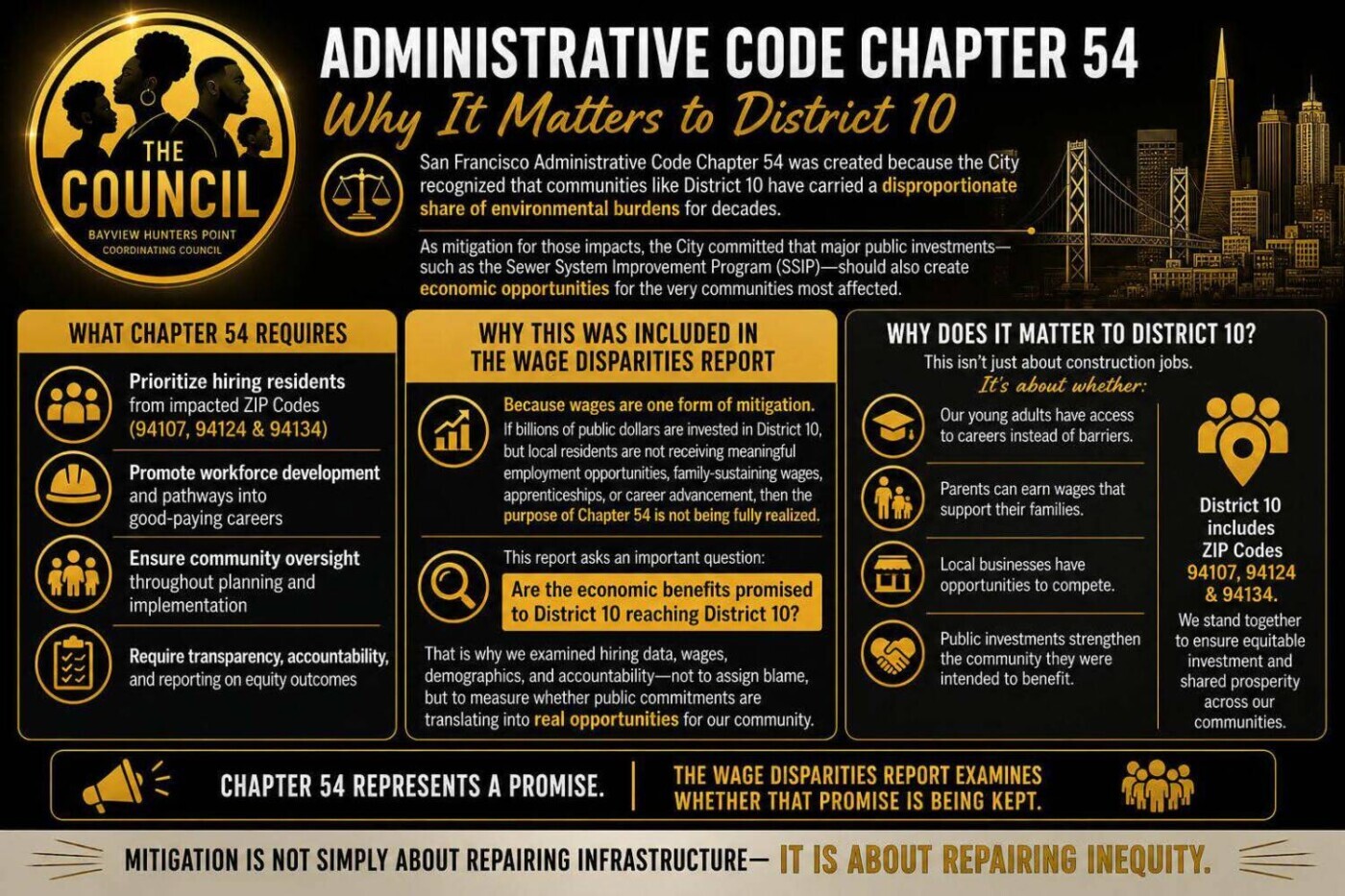
On July 11, 2026, residents, young people, civic leaders and candidates for the District 10 seats on the San Francisco Board of Supervisors gathered in the Alex Pitcher Community Meeting Room at 1550 Evans Ave. A representative of the Mayor’s Office also attended. They came to hear the findings of the Wage and Contract Disparity Report prepared by the newly organized Bayview Hunters Point Coordinating Council — an organization once led by great community icon Mother Shirley Jones.
The meeting took nearly a year to secure.
The community had to pay approximately $500 to use a public room in its own neighborhood to explain how public agencies have allegedly denied that neighborhood a fair share of public wages, contracts and economic opportunity. Yet after the evidence was presented, those holding political authority offered no meaningful public response. According to the Council, no representative of the San Francisco Public Utilities Commission — the agency most directly implicated by the findings — appeared to answer the community’s questions.
That silence spoke loudly.
The numbers testified
The presentation did not rely on rumor, emotion or political slogans. It relied on government wages and contracting data. The report was originally created and presented to the Southeast Community Facilities Commission in September 2025.
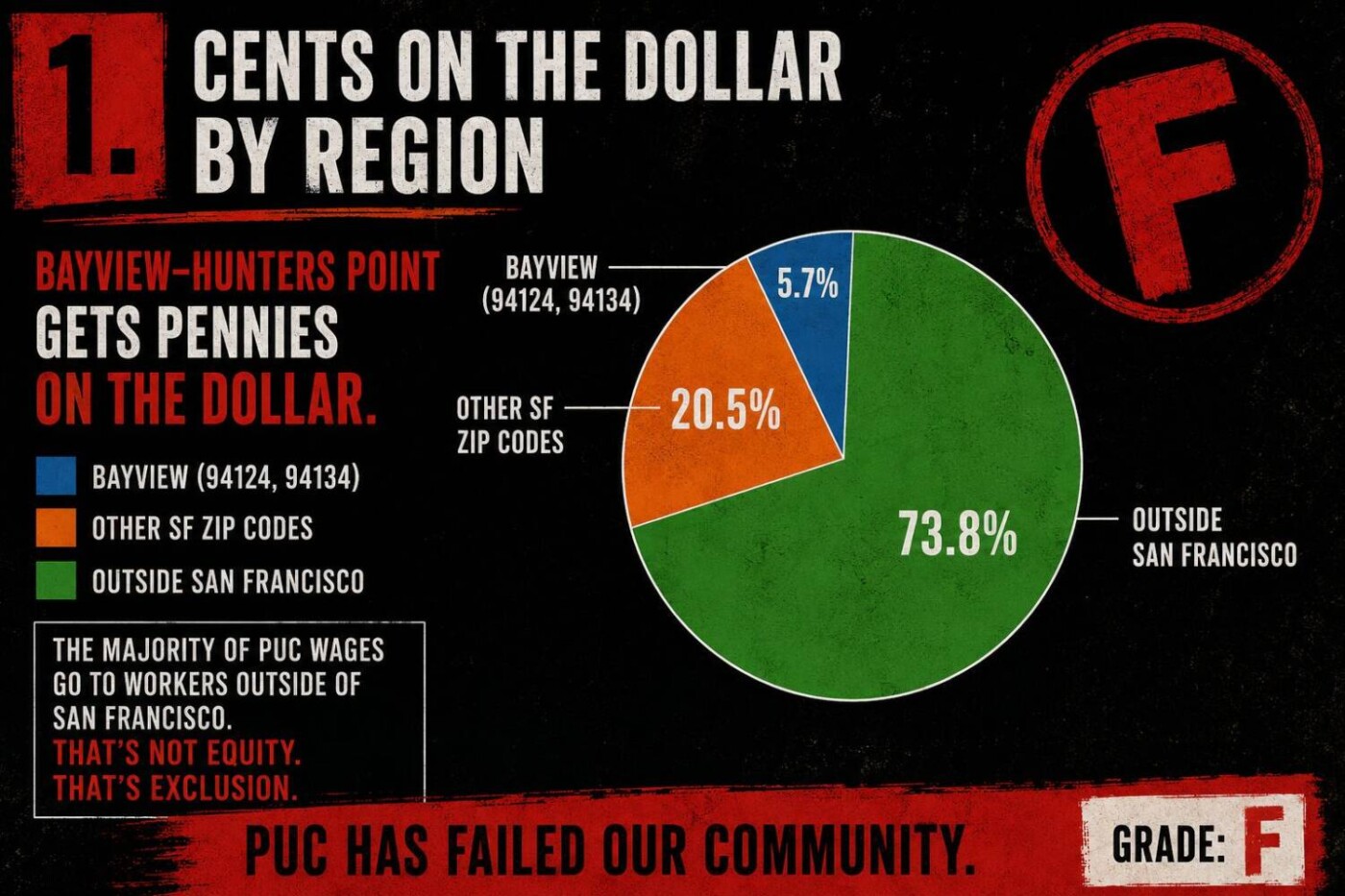
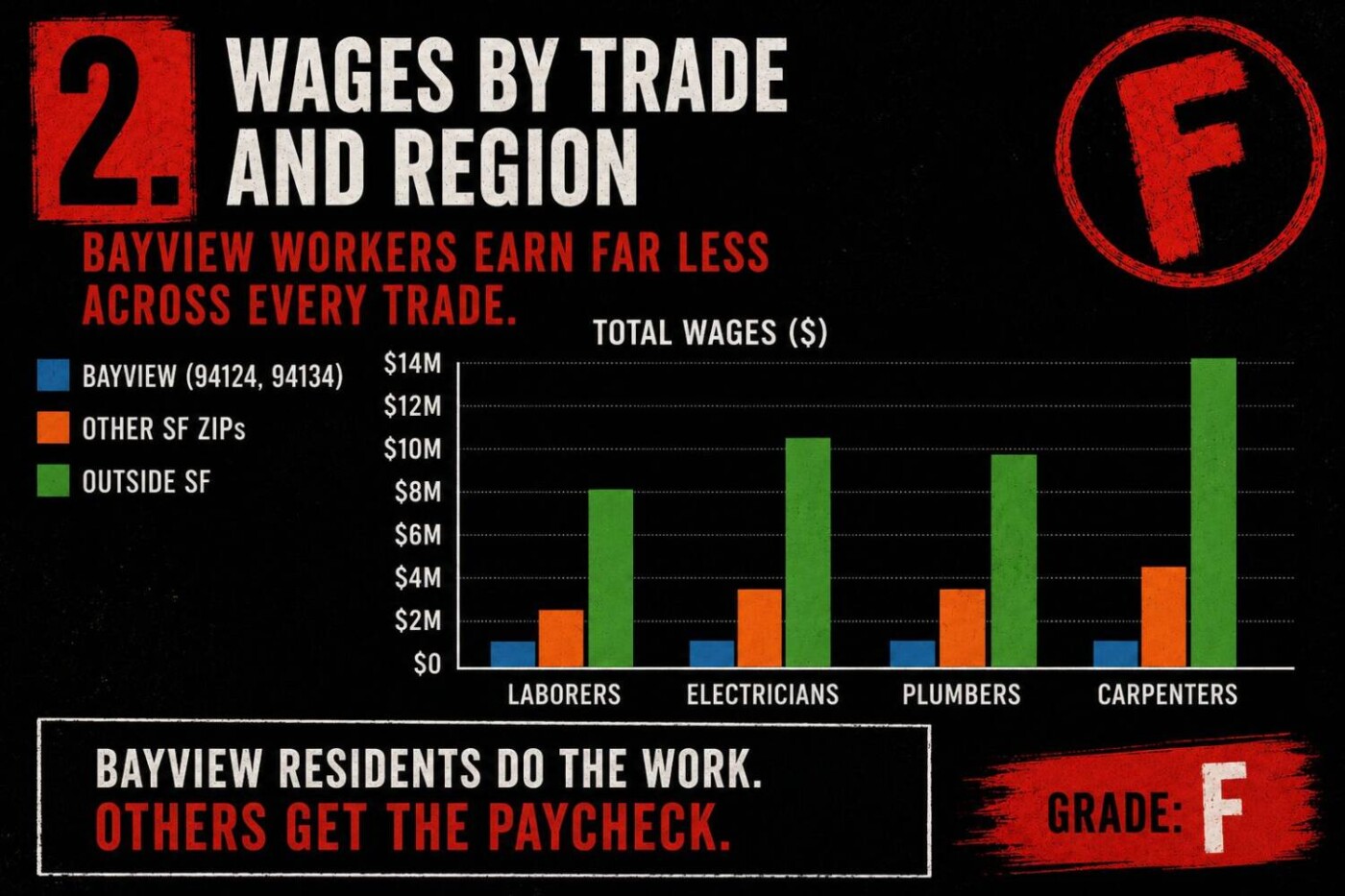
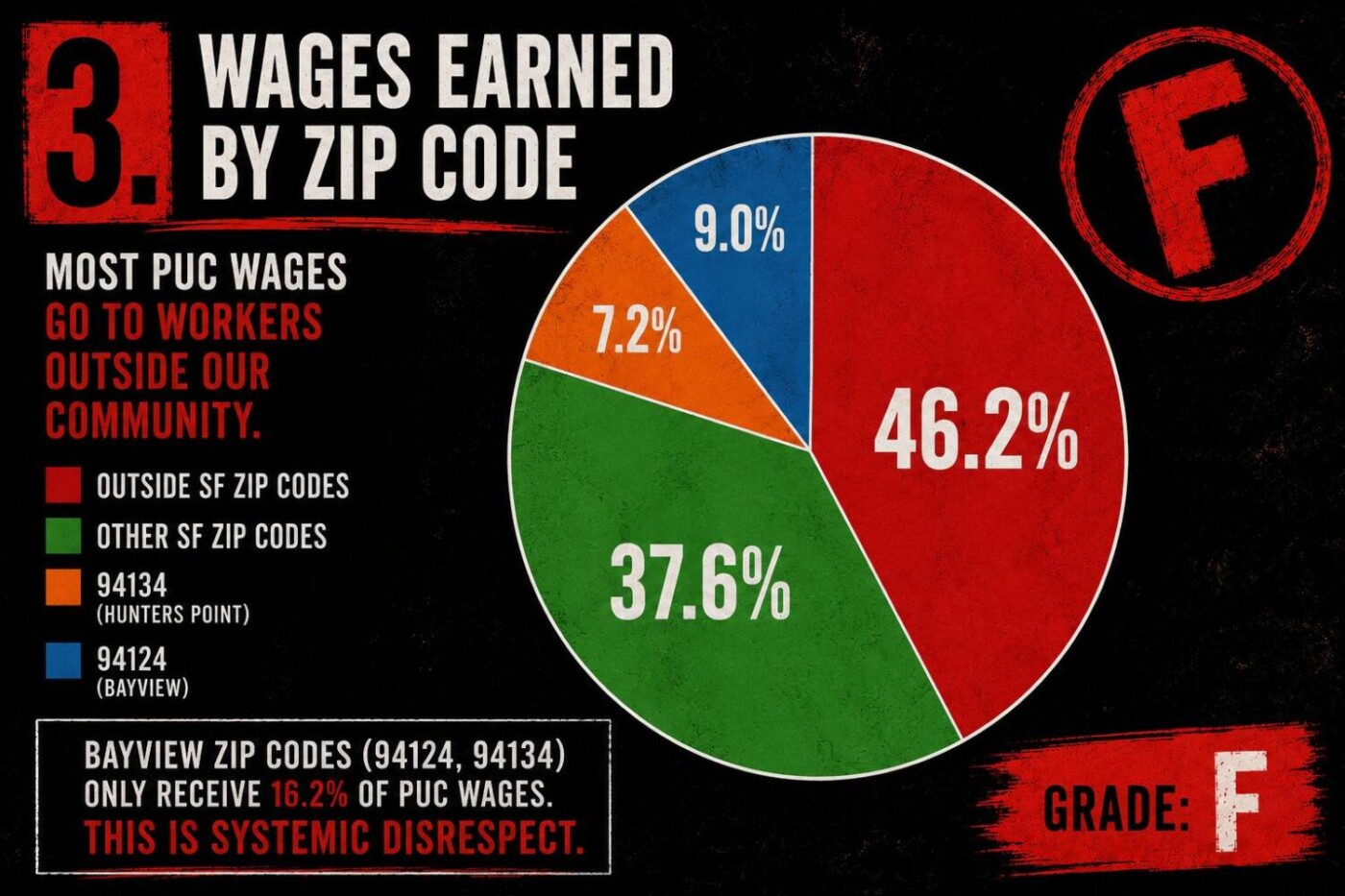
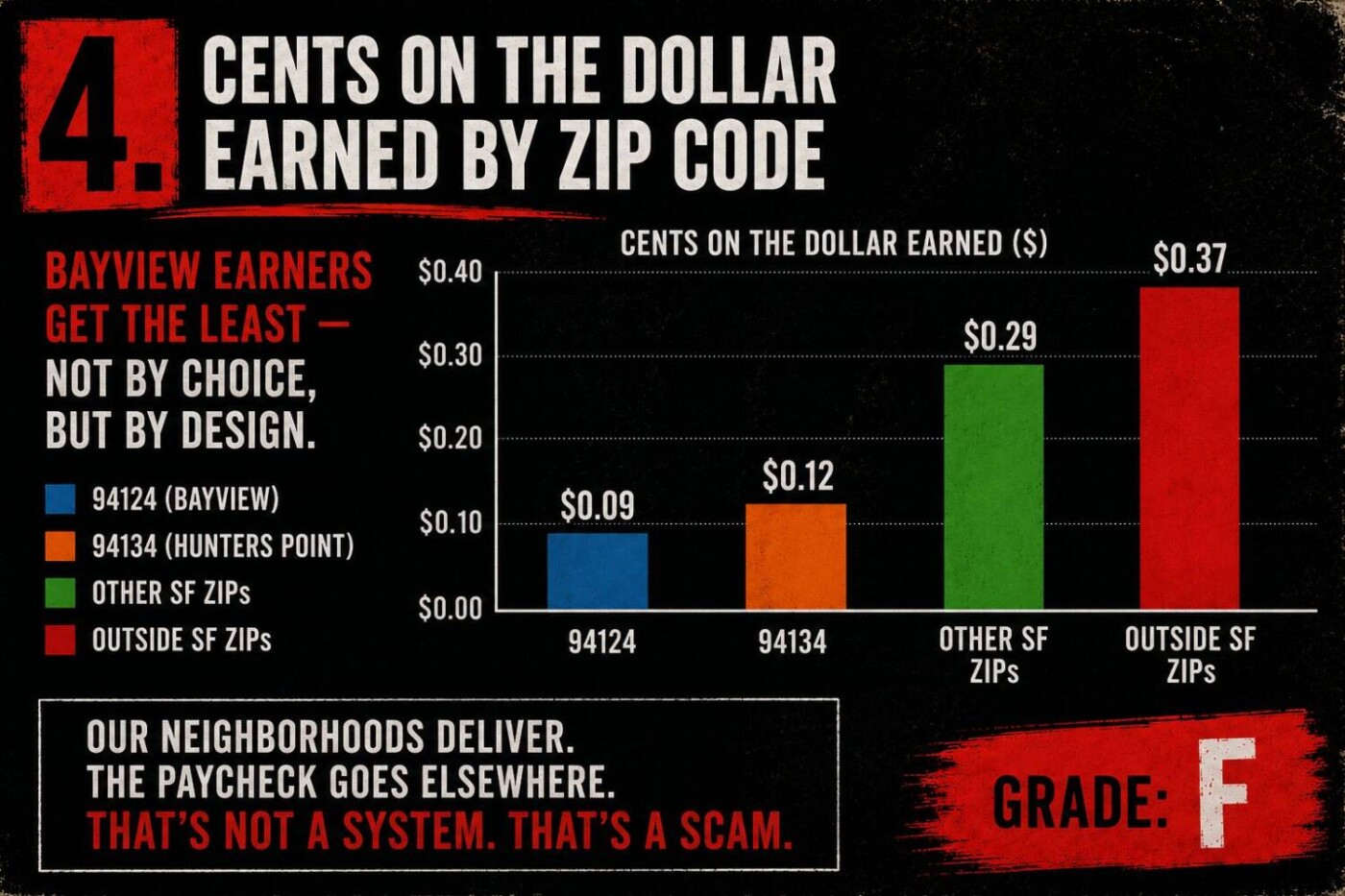
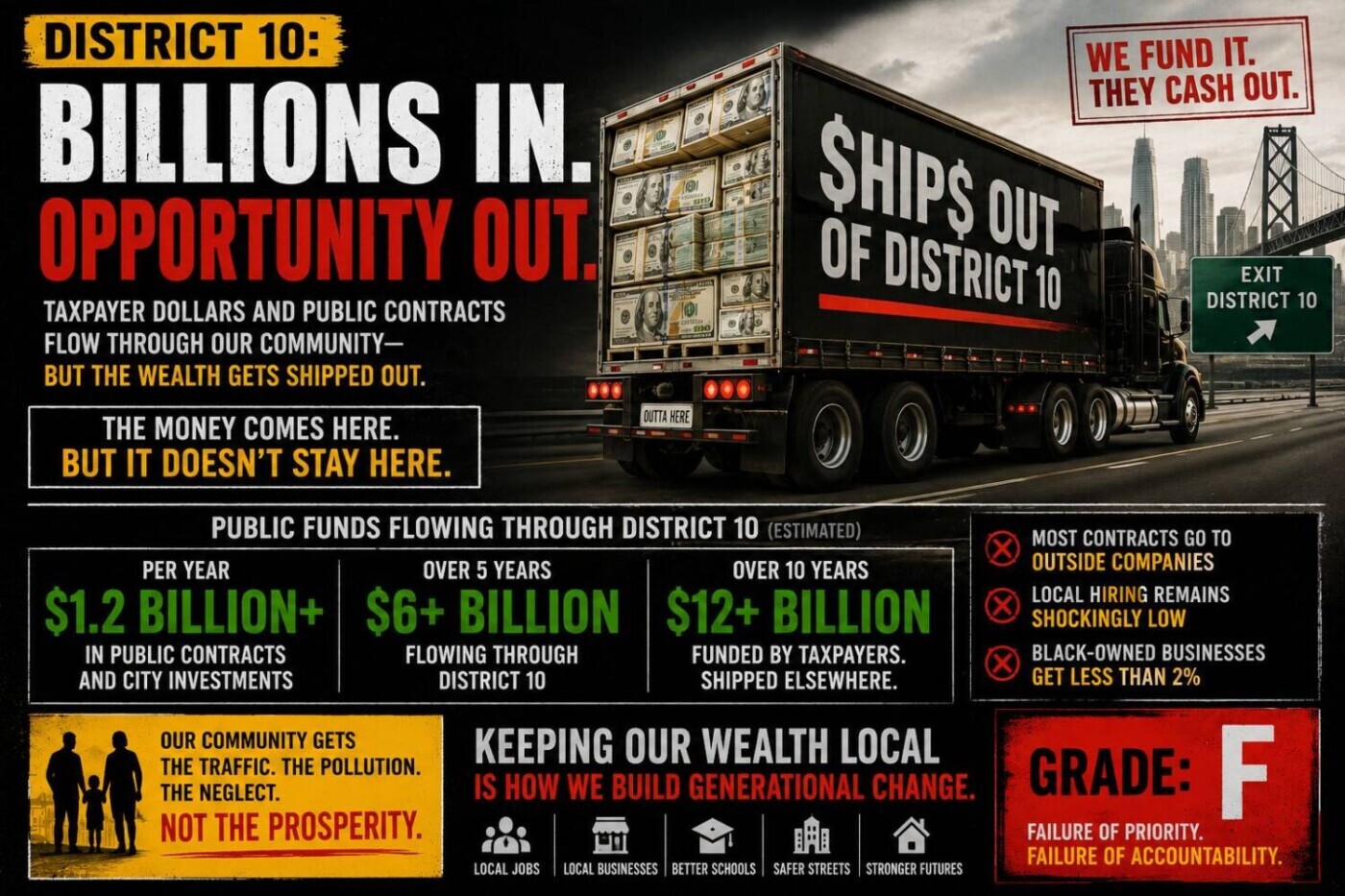
Workers residing in ZIP code 94124 — Bayview Hunters Point — received only 4.5 cents of every project wage dollar. Workers in 94134 — Sunnydale and Visitacion Valley — received only 3.6 cents. Together, the two southeast communities closest to the environmental burden received merely 8.1 cents of every wage dollar.
Workers living outside San Francisco received approximately $30.3 million, representing 23.1 cents of every project wage dollar.
The contract data presents the same pattern. Average reported Local Business Enterprise (LBE) participation in District 10 was approximately $132,000, while reported awards exceeded $25 million in ZIP code 94110, exceeded $40 million in 94111, and totaled more than $200 million for firms located outside San Francisco.
These figures describe more than inequality. They document economic extraction.
The sewage treatment plant is in Bayview.
The burden is in Bayview.
The history of pollution is in Bayview.
But the wages, contracts and wealth leave Bayview.
Community leaders therefore describe what is occurring as an economic holocaust of opportunity: not a comparison to the singular historical horror of genocide, but an urgent description of the sustained destruction of Black economic life through unemployment, displacement, contracting exclusion and the export of public wealth.
A city that protects property but not Black opportunity
San Francisco has demonstrated how quickly it can act when valuable merchandise is stolen from Union Square.
When groups of young people smashed windows and carried expensive goods from downtown stores, the City increased police presence, devoted additional public resources to security and publicly declared that commercial theft threatened San Francisco’s economic vitality.
But when economically dominant prime contractors receive billions of dollars in construction opportunities from projects located in the heart of a historically Black community, where is the comparable emergency response?
Where are the compliance officers who by law should be policing the contracts that go exclusively to white male contractors?
Where are the investigators?
Where are the audits?
Where are the sanctions?
Where are the public hearings?
Where is the outrage?
A broken window in Union Square produces immediate action. Billions of dollars passing through District 10 while Black workers and contractors receive crumbs produces another report.
That contrast reveals whose property City Hall protects — and whose economic future it is prepared to sacrifice.
The long history of government silence
This is not a new problem, and the City cannot credibly claim ignorance. San Francisco’s earlier disparity studies and The Unfinished Agenda documented discrimination against minority- and women-owned businesses decades ago.
The Human Rights Commission grew from civil-rights organizing in San Francisco’s Black community. It once maintained a substantial contract-compliance operation, including field personnel who visited construction sites, examined certified payroll records, investigated false-front contractors and determined whether minority businesses were performing commercially useful functions.
Community leaders now contend that this enforcement system was systematically dismantled.
The Town Hall speech described a former compliance operation with more than 50 officers and related personnel. It contrasted that historic field capacity with a present system that community advocates say has only a handful of civil-rights workers and little meaningful power to investigate, stop payments, impose penalties or sanction discriminatory prime contractors.
Technical assistance is not enforcement.
Mentoring is not monitoring.
A 12-week class is not an investigation.
A newsletter is not a sanction.
Without independent government oversight, a dominant prime contractor may exercise near-total control over a small Black contractor’s schedule, work assignments, payments, change orders and future capacity. Government cannot place a Black business entirely at the economic mercy of a powerful prime contractor and honestly call that equal opportunity.
A personal history of Jim Crow
For me, this struggle is inseparable from my family’s history.
My late father, George Williams (George Court next to Adam Rogers Park in Hunters Point at Ingalls Avenue is named for him) was a highly decorated wartime veteran who served as a technical sergeant, cannon-gun leader and expert marksman. He left Louisiana with his family as part of the great Black migration westward in search of dignity, work and a better life.
He told me that Black soldiers were not permitted to eat in the same military mess facilities as white soldiers, even while German prisoners of war were allowed to do so. After arriving in Vallejo, he lived in the dilapidated, rat-infested Floyd Terrace Navy barracks housing project and obtained work as a laborer. He was later fired after an employer learned that he had been jailed in the military stockade for a uniform violation involving a missing button during wartime!
His experience teaches us that military service, hard work and personal sacrifice have never guaranteed Black Americans equal treatment.
Jim Crow was not confined to Alabama, Mississippi or Louisiana. Its logic migrated right here to San Francisco where Black people were not allowed to sit at a lunch counter at Woolworth’s Department Store. This appears wherever institutions control access to work, housing, capital and dignity according to race.
In modern San Francisco, Jim Crow may not be written above a drinking fountain. It may be hidden inside a procurement system, a bonding requirement, a slow-payment practice, an un-monitored subcontract or an annual report that combines categories until racial exclusion, particularly of Black people, disappears from plain view.
Freedom among ourselves — or systemic freedom?
Only weeks before the Town Hall, San Francisco celebrated Juneteenth.
There was music, food, fellowship and celebration. But while watching those festivities, I was compelled to ask:
Do these wage and contract numbers demonstrate that we are systemically free — or merely free among ourselves?
We may gather and celebrate together, but who owns the companies receiving the public contracts?
Who receives the change orders?
Who owns the equipment?
Who accumulates the bonding history?
Whose children inherit the business?
Freedom without economic opportunity is a celebration without an inheritance.
Freedom without ownership allows Black people to perform the labor while others continue to own the harvest.
The cost of silence
Dr. Martin Luther King Jr. warned that history would remember not only the hostility of those who opposed justice, but the silence of those who knew better and failed to speak.
The political silence at the July 11 Town Hall must therefore concern every San Franciscan.
The Coordinating Council first presented the disparity findings on Sept. 24, 2025. Southeast Community Facilities Commissioners expressed concern and discussed a joint public forum with the Public Utilities Commission. Months passed. Contracts continued. Payrolls continued. The money continued moving. The Council followed up for approximately nine months without interest or a response to its so-called public pronouncement of support and ultimately was forced to pay to hold the meeting itself subject to cancellation of the Town Hall Meeting.
Nearly a year later, a Town Hall after the contracts have been awarded is not accountability.
It represents an economic burning cross of contempt for the entire Black Community. So they seek to hide failure by putting a Black face on it while the evil of segregated servitude lurks within, disclosing nothing more than the illusion of inclusion.
The patience of the Black community, a naturally loving community with a long tradition of racial tolerance and civic participation — has been treated as permission to delay promises of equity repeatedly, without sufficient monitoring, enforcement or measurable results.
I ask, as Dr. King once did: Can a lie last forever?
The wage data is speaking.
The contract data is speaking.
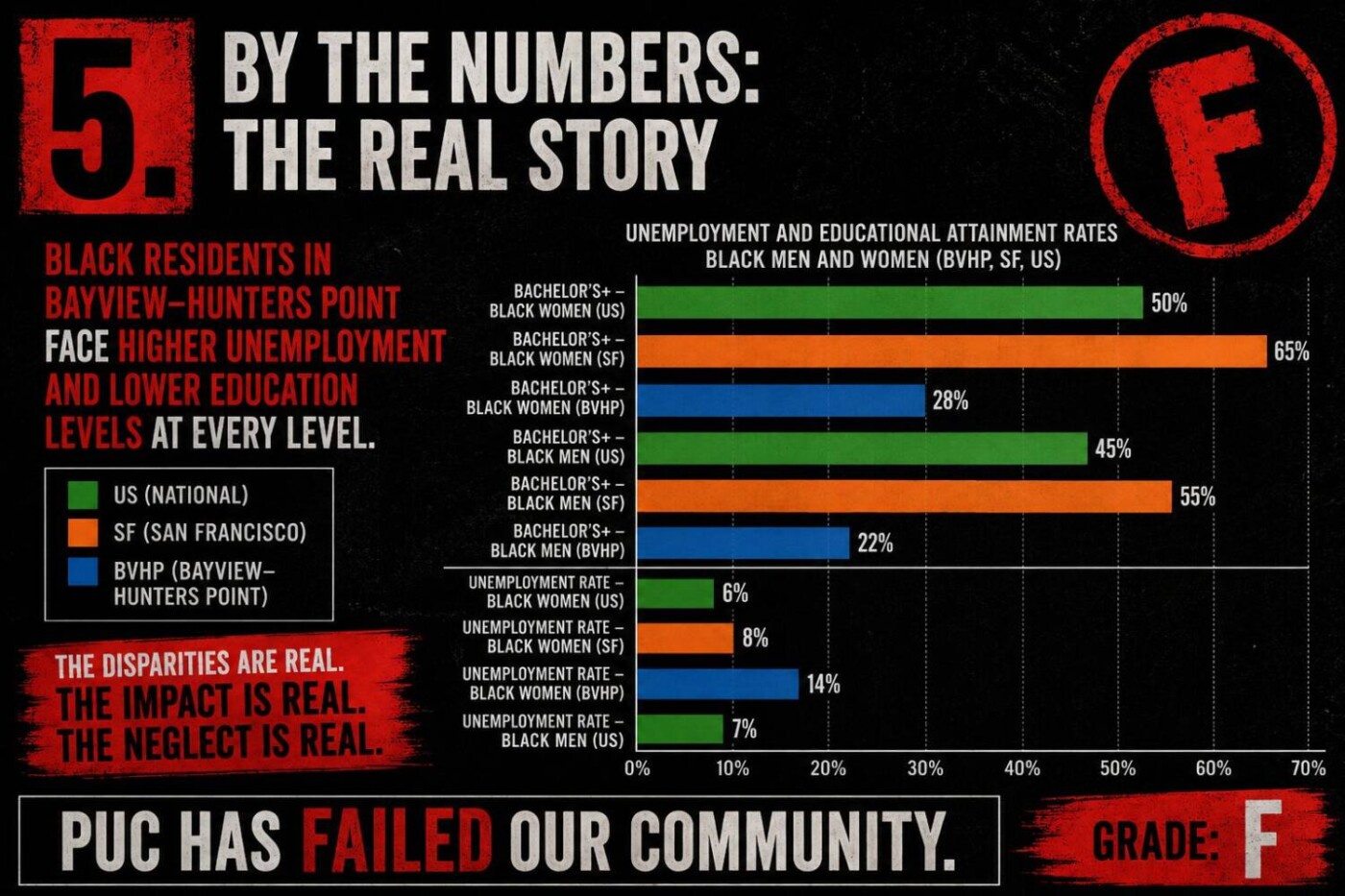
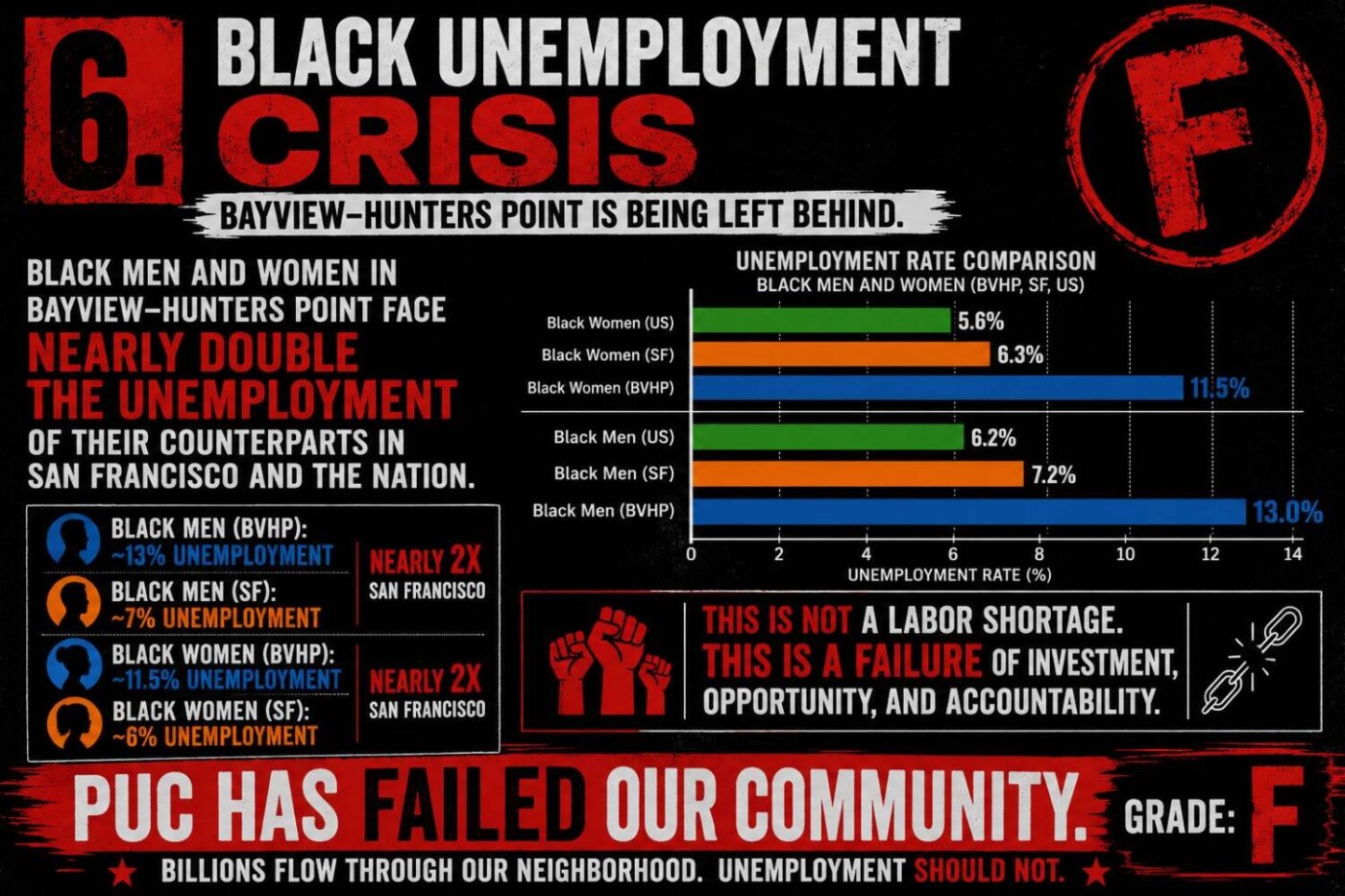
The declining Black population of San Francisco is speaking.
The only remaining question is whether the good people entrusted with public authority and real community advocacy will continue to remain silent.
What San Francisco must answer
District 10 residents deserve public answers to basic questions:
• How many City employees physically inspect construction sites for racial discrimination?
• How many false-front investigations were opened during the last fiscal year?
• How many commercially useful function reviews were conducted?
• How many prime contractors were sanctioned?
• How many payments were withheld?
• How many contractors were suspended or debarred?
• How much money went to Black-owned businesses as prime contractors?
• How much went to Black workers residing in the communities carrying the environmental burden?
If the City is proud of its contracting system, it should publish the racial data.
If the contractors are complying, the City should audit them.
If the law means something, the City should enforce it.
This is not a request for pity. It is a demand for democratic accountability.
The plant is here.
The burden is here.
Our families are here.
Our contractors are here.
The public money belongs to all of us.
And the truth should not require permission.
A localized system of economic apartheid
When I look at these numbers, I am reminded that oppression changes its appearance from one generation to the next.
It no longer needs signs that read “Whites Only.”
It no longer needs separate drinking fountains.
It no longer needs poll taxes or literacy tests.
Modern systems of exclusion often operate through access to capital, access to contracts, access to financing, access to bonding, access to decision-making, and ultimately access to wealth.
Throughout history, colonial powers extracted wealth from nations while leaving the people who lived there with little control over the resources beneath their own feet. Countries across Africa — including Burkina Faso — have experienced long periods in which enormous natural wealth benefited political and economic elites while many local communities remained excluded from proportional participation in the wealth generated from their own land.
President Ibrahim Traoré has repeatedly argued that genuine sovereignty requires economic self-determination and that nations cannot be truly free if others continue to control the benefits of their resources.
The lesson is broader than any one nation.
Wherever wealth is extracted from a community while opportunity bypasses the people living there, the result is economic dependency rather than economic freedom.
That is why the statistics presented to the white power structure of San Francisco concern me so deeply.
Bayview Hunters Point produces no gold mines.
It produces no oil fields.
But it hosts a huge sewage treatment plant, one of the most significant public infrastructure investments in California history.
Billions of public dollars have flowed through this community with billions more to come.
The environmental burden has remained here.
Yet much of the economic benefit has flowed elsewhere.
The community bears the burden.
Others disproportionately receive the benefit.
That is the pattern the numbers compel us to examine.
This is why many residents describe what has occurred as a form of localized economic apartheid — not because San Francisco has replicated apartheid South Africa in every respect, but because a community that bears extraordinary public burdens continues to experience persistent exclusion from the full economic opportunities generated around it.
The Wage and Contract Disparity Report asks us to confront that question directly.
If workers living in the two most impacted southeast neighborhoods together receive only 8.1 cents of every project wage dollar, while workers outside San Francisco receive 23.1 cents, then the question is no longer whether disparities exist.
The question becomes:
Who benefits?
Who decides?
Who accumulates wealth?
And perhaps most importantly—
Who inherits that wealth?
These questions are not about race alone.
They are about power.
They are about whether public investment creates shared prosperity or concentrates opportunity in the hands of those who already possess economic advantage.
History teaches us that systems of exclusion often endure not only because of prejudice, but because they exploit division.
Communities divided against one another are easier to govern than communities united around shared economic interests.
Black against Brown.
Brown against Asian.
Native-born against immigrant.
Resident against resident.
Contractor against contractor.
Neighborhood against neighborhood.
These divisions weaken collective bargaining power and distract from the larger structural question: Who controls the public wealth?
Dr. Martin Luther King Jr. reminded us that “We are caught in an inescapable network of mutuality, tied in a single garment of destiny.”
That principle rejects the politics of division.
Economic justice for Bayview Hunters Point is not only a Black issue.
It is a San Francisco issue.
It is an issue of democracy.
It is an issue of accountability.
It is an issue of whether public money serves the public interest.
Tonight we honor those who came before us not by dividing communities, but by uniting them around a common demand:
Publish the truth.
Monitor the contracts.
Enforce the law.
Protect the public trust.
Because freedom is measured not only by the right to vote or the right to speak.
Freedom is also measured by whether a community has a fair opportunity to build businesses, accumulate wealth, pass opportunity to the next generation, and share proportionately in the prosperity created by the public dollars it helps finance.
Only then can we truly say that the burden — and the opportunity — are shared alikeKevin B. Williams earned his political science degree from San Francisco State University and is best known for his work with the SF Human Rights Commission, where he rose to the position of Acting Executive Director while serving as Chief of Contract Compliance at San Francisco International Airport, managing the largest capital improvement projects in the history of San Francisco. Elder Williams co-founded the Greenlining Institute, was Vice President of the New Bayview Committee and currently serves as Senior Advisor to the Bayview Hunters Point Coordinating Council. He is the eldest son of community matriarch Ruth Williams. He can be reached at williams532001@yahoo.com.