


by Leah Harmony
Derick Davies is showing me his first mural before our formal interview begins.
Commissioned for the entrance of Destiny Arts Center near the Oakland-Emeryville border, the mural grew from a relationship he’s been forming for years now. Davies first worked at a summer camp there. After Destiny’s director saw his art, he designed limited-edition hoodies for the organization. They sold out. The mural came next.
“It’s about capturing destiny, capturing the essence,” he says, and I wonder then if he sees parallels between this casual description and his path forward in art and beyond.
At 19, Davies is already learning that talent alone won’t build an artistic career. He must also grow relationships and be willing to put his art in front of people, using his creativity to figure out unique platforms and mediums.
A West Oakland native and graduate of Oakland School for the Arts, he is now a college sophomore studying art on a full scholarship.
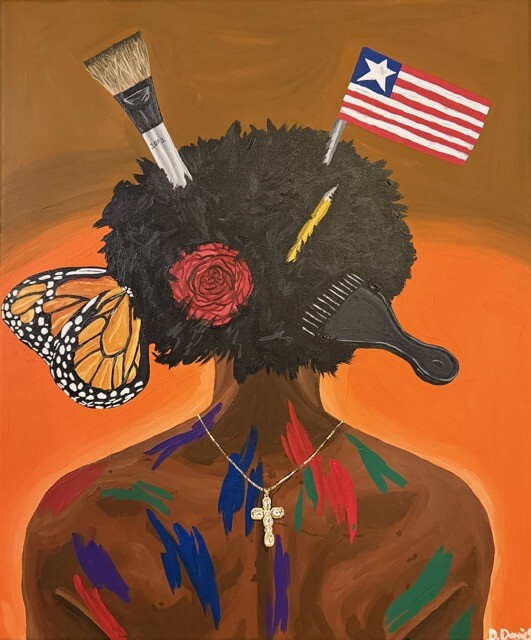
Davies works primarily in acrylic and oil paint, sometimes incorporating fabric, gilded gold and other materials. His paintings draw from comic books, music, Bay Area wall art, social media and scenes witnessed in everyday life. But their strongest material may be his own interior world.
As Oakland marks the 60th anniversary of the Black Panther Party, Davies represents a new generation of Black artists working in the city that raised Emory Douglas, the Party’s legendary Minister of Culture, to international prominence. When asked, Davies had to contemplate whether he’s a revolutionary artist. He is more interested in doing honest work and allowing the people to decide what it becomes. He epitomizes the vibrancy of youth and having all the time and the whole world in front of him.
We discuss it all in our Q & A:
Leah Harmony: When did you realize art could be more than something you enjoyed — that it could become your life?
Derick Davies: I started drawing and making art when I was 4 or 5, so it was always in my life. I went to Oakland School for the Arts from sixth through 12th grade, and going there kept me making art.
But when I really knew I wanted to pursue it was around 2023, when I was 16. I became an upperclassman, and it was like, “OK, I’ve got to lock in.” I slowly started building a business around my art, doing commissions, making business cards and putting myself out there.
I was playing basketball and working jobs, but I knew that after graduation, art was my next step.
Leah: Your paintings involve memory, self-reflection, and personal stories. What are you trying to express through them?
Derick: Stories I feel like I can’t express to people through words or physical actions. I paint feelings, scenes I have seen and things I have been through because I feel like they can reach people on a bigger scale.
One piece, “Reflect,” is about somebody going through hardship. On the outside, the person — which is me — may look OK to the world. But in the mirror, you see the mental reflection of somebody going through a hard time. You may want to cry or scream.
For Black men and Black boys, we’re often told we can’t show that because people will call us weak. That was a heavy emotion, and I thought it would be most powerful expressed through my work.
Music artists sing about their lives through words. I’m singing through my art.
Leah: Do people respond to that emotional openness?
Derick: People tell me the stories feel real and authentic. The emotions are universal. If you put the work out there, the right people — the people who feel it and can relate — will come to you.
The internet has also made some of us less scared to express those emotions. You can reach more people, and people who understand may support you. I feel like I found my way to express myself to the world through art.
Leah: Comic books inspired you when you were younger. Where do they appear in your work now?
Derick: When I was younger, I wanted to be a comic book artist. I’m not specifically pursuing the comic book industry now, but I still read and collect comics.
They come back through my compositions. Some paintings could almost be comic book covers or scenes from comic books. I may also add a phrase or a reference to a character. It’s mixed into my style.
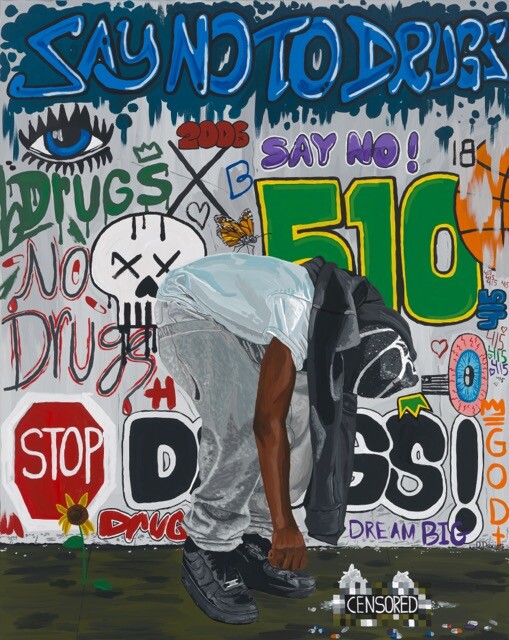
Leah: Tell me about your painting “Say No to Drugs.”
Derick: It was inspired by moving to San Francisco. Growing up, my parents always told me to stay away from drugs. Then I moved here and started seeing people affected by fentanyl — people doing “the fold.” I had never seen that before.
Whenever I see it, my parents’ message comes back to me. In the painting, I use words inspired by graffiti and the wall art I grew up seeing in the Bay and Oakland. You can see the person, but you might not understand what caused their condition. The words in the background give more context and push the message.
I could see that piece enlarged on a wall or put on posters. You don’t see a lot of art like that out here.
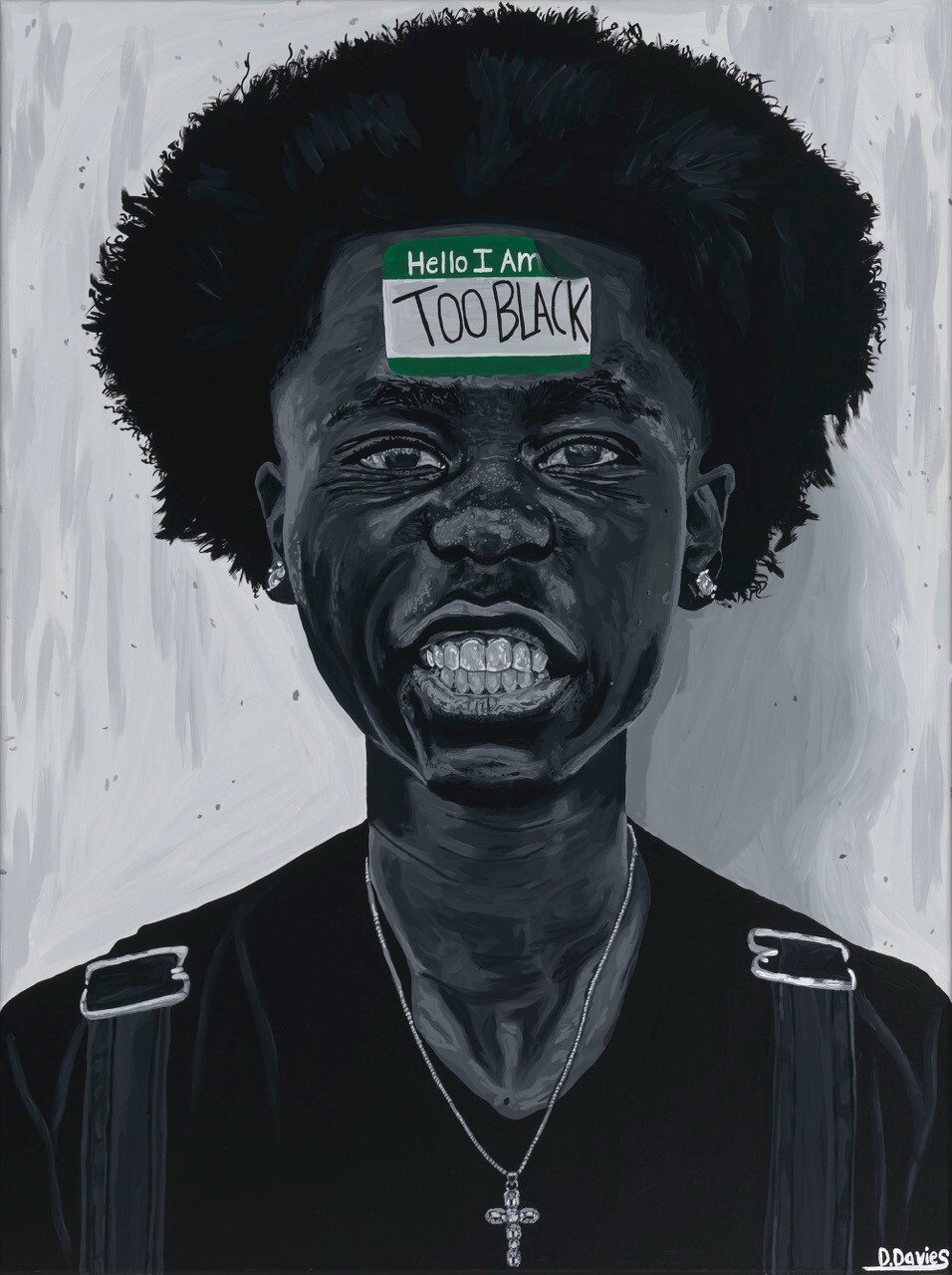
Leah: Another powerful painting contains the words “Hello, I am too Black. Is this light enough for you?” Where did that come from?
Derick: When I was younger, I was always the darkest kid. People made fun of my skin and said, “You’re too Black” or “You hella Black.”
As a kid, I always showed my teeth because they were my lightest feature and a feature I felt confident about. So it becomes: “Hello, I am too Black. Is this light enough for you?”
Now my life has done a 180. People compliment my skin, my teeth and my face. I created that piece as a sign of embracing my skin, my teeth, my face and even the label. I’m proud of it now. I wouldn’t even mind being Blacker.
A lot of dark-skinned kids grow up dealing with this, especially in the social media age. I wanted to put that experience into the world.
Leah: I saw that painting and thought, “This is revolutionary.” What does revolutionary mean to you?
Derick: Something that causes a big change — a chain reaction through time and throughout an environment.
As far as whether my art is revolutionary, I feel like that is for the people to decide. I can create art and have my own views, but once it goes into the world, it can do things I never imagined.
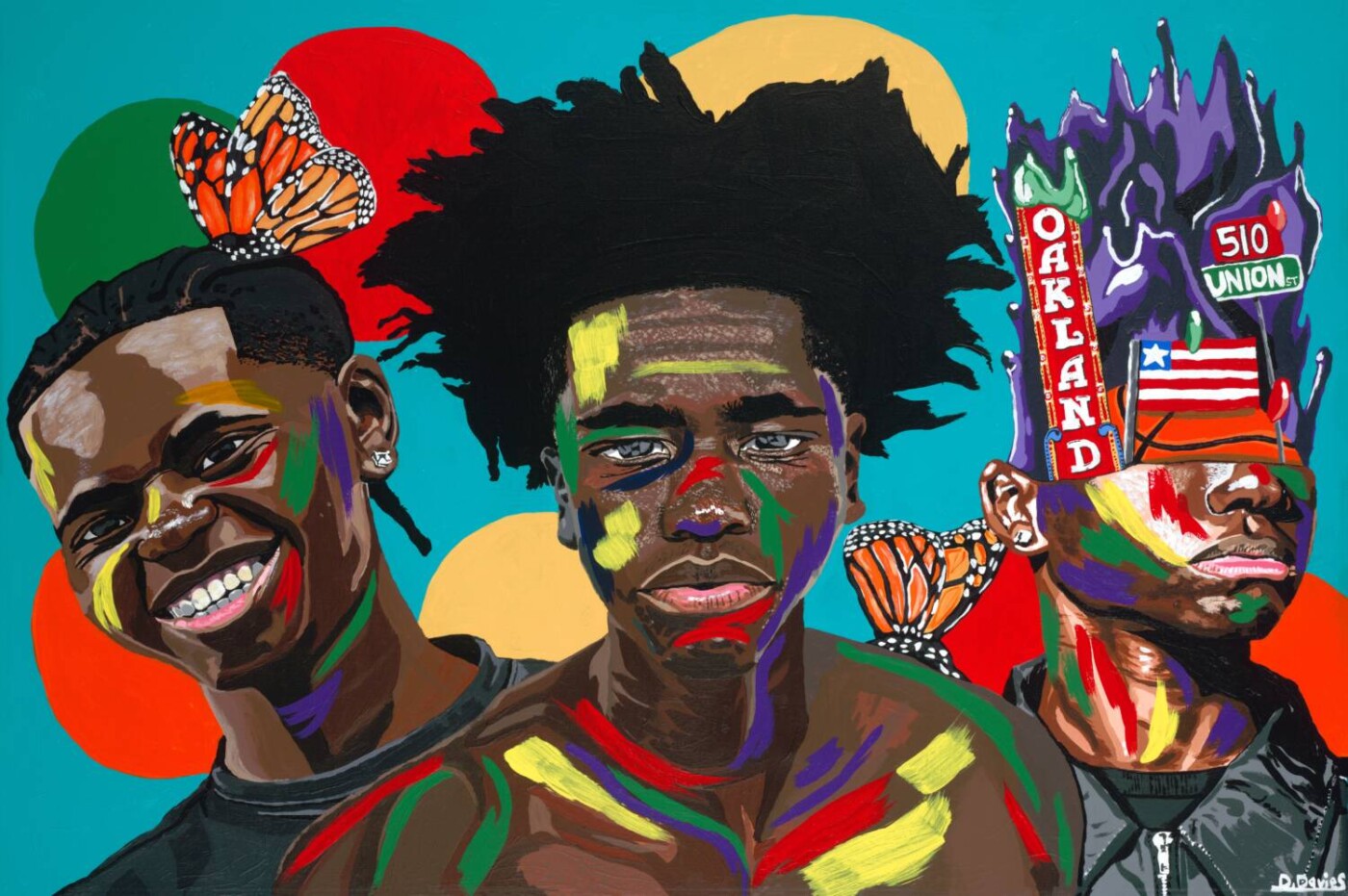
Growing up in West Oakland, the art and history stay with me and enter my work. It may be something natural: showing myself, representing where I’m from and not being afraid to show my work.
Leah: Does an artist have a responsibility to the community?
Derick: I don’t want to put negative things into the world, so I am careful sometimes about what I create. But I think the responsibility is more on me as a person than on the art.
People will always look back at the artist. The responsibility is in how I move through life, how I step up for my younger siblings and how I represent my family. For me, it is more about the artist than the art.
Leah: After looking at Emory Douglas’ images, do you feel that you belong to Oakland’s artistic tradition?
Derick: I feel like anywhere I go, I belong. The people in my community who resonate with my work will always gravitate toward me.
It’s all about finding community.
Leah: What does success look like to you?
Derick: Being able to live 100 percent off my art and give back to my family and community.
I attend school on a full scholarship, so in a way, my art is already supporting me. But after school, I’ll need an apartment and have bills to pay. I want to live comfortably through painting — selling work and being in control of my destiny and my life.
Leah: I think the word your looking for is “free.”
Derrick: Yeah….
Leah: Where do you want your art to take you?
Derick: Looking at the leap I made in the last three years, I want to take it times 100 or times 1,000. I want my work across the country and the world. I want my family in a better position. I want to support them and support my siblings.
I want to be the best artist and the best person I can be. I’m going to keep working and trust the process.
A quote I recently heard says an artist’s duty is to reflect the times they live in. For me, that means reflecting the life of a 19-year-old who grew up in West Oakland in the age of social media, new technology, pop culture and urban life.
I want to make art that reaches young people and older people. Music lives forever. I want my art to affect kids, adults and elders that way too.
Davies may be reluctant to declare his work revolutionary. He paints what he has lived: colorism confronted, emotions released, public suffering witnessed and Blackness embraced. And he paints it in such a way that people have no choice but to be affected.
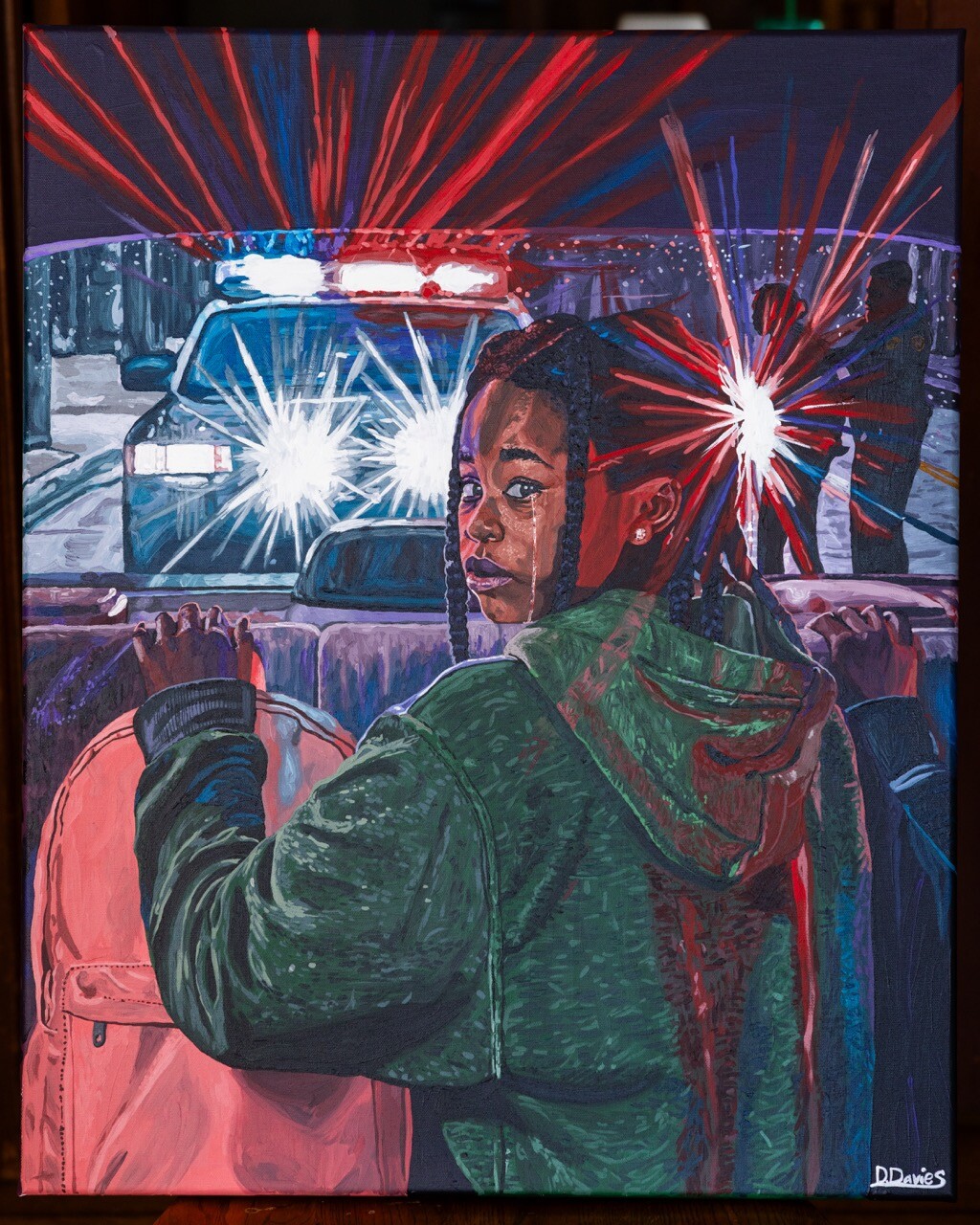
The definition of “revolutionary” has changed over the years, depending on the picture “they” want to paint (pun intended). If we go back to the most basic meaning — causing a sudden, complete change — I think that includes giving struggle, whether it’s drug abuse, police violence or the social media effect, a visual language to invoke change. Davies is finding his own language in paint, murals, video, social media and whatever medium comes next.
The tools evolve. Oakland’s young artists inherit the history, but they are not required to imitate it. Their responsibility — if there is one — is to tell the truth about their own time. Davies does that as naturally as breathing.
You can follow Derick Davies on Instagram: @thederickdavies
Leah Harmony is a journalist and Manager of Production at the San Francisco Bay View. She can be reached at leah@sfbayview.com