


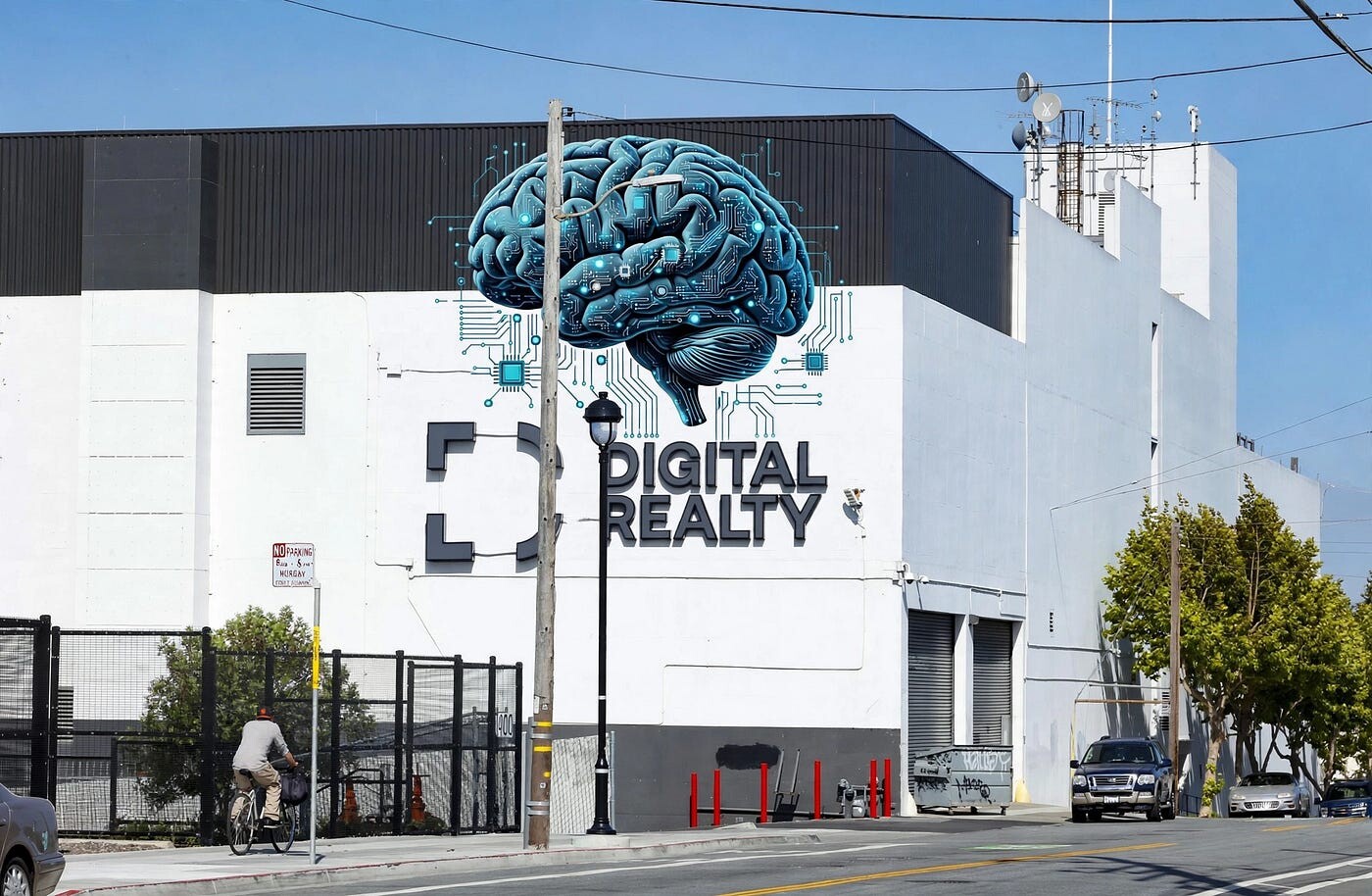
The Hunters Point Community Biomonitoring Program proposes to export it’s award winning community exposure research model to establish the first comprehensive monitoring and surveillance system customized for an AI Data Center Campus. The proposed model incorporates human biomonitoring and geospatial mapping along with environmental monitoring of air, soil, noise, temperature and the built environment.
“HBM is the only way to identify and quantify human exposure and risk, elucidate the mechanism of toxic effects and ultimately decide if measures have to be taken to reduce exposure.” Human Biomonitoring: State of the Art, Jurgen Angerer et al. Int J Hyg Environ Health May 2007
Biomonitoring detects pollution in people! As a method for measuring toxic chemicals in human tissues, HBM is a proven tool for studying harmful environmental chemicals to confirm exposures and validate public health policies. Human biomonitoring detects environmental chemicals and their metabolites in urine, blood, breast milk or hair.
Unlike environmental monitoring to detect chemicals in air, soil, water or buildings, HBM measures chemicals that have entered the human body via inhalation, ingestion, skin absorption and secondary smoke exposure:
Population biomonitoring was first applied to environmental public health in the U.S. Environmental Protection Agency’s reduction of lead in gasoline in 1986. The modern era of HBM began in 1993 when the National Human Exposure Assessment Survey addressed human exposures to multiple chemicals including metals, pesticides and volatile organic compounds using aggregate analysis.
Developing a Conceptual Site Model for an Urban AI Data Center in Southeast San Francisco
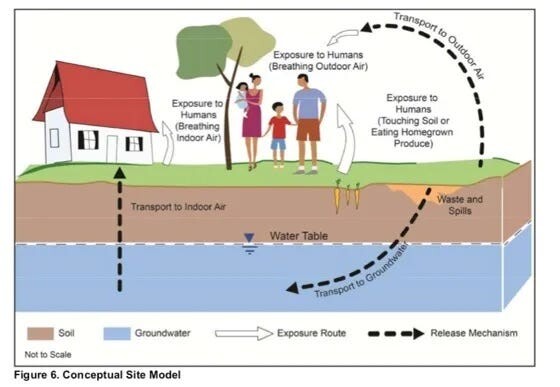
A Conceptual Site Model (CSM) is a written and illustrative summary that explains how contaminants move through a site affecting people and the environment. A CSM acts as a dynamic scientific hypothesis that characterizes wind currents, geology, hydrogeology, the physical plant of the built environment and site history integrated into a comprehensive reference tool.
The National Research Council report Human Exposure Assessment for Airborne Pollutants concludes:
“Monitoring the environment by identifying and measuring concentrations of chemicals in media (e.g. air, water and soil) is not, by itself, an adequate basis for assessing human exposures. HBM offers an improved understanding of potential health risks through the detection of “biomarkers” of exposure that indicate the progressive response to exposures in the human body that lead to disease…before disease occurs.”
When developing a Conceptual Site Model (CSM) for comprehensive monitoring of an AI Data Center Campus situated in a San Francisco neighborhood, the model must characterize the historical legacy of contamination of the site and operational hazards unique to high-density AI infrastructure.
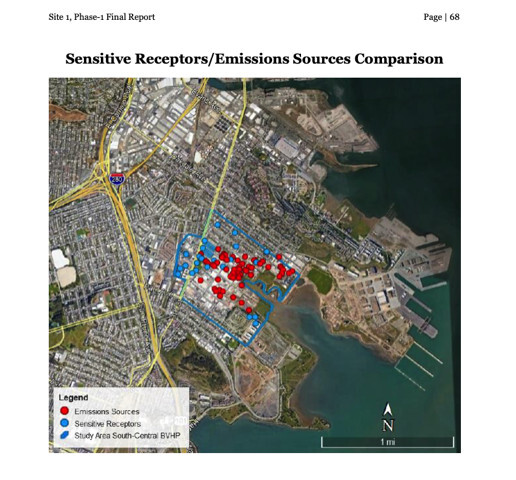
The 200–400 Paul Avenue AI Data Center Campus colocates eight active operating data centers located across the street from homes and a residential cul de sac at the Paul Avenue/Exeter intersection. The three block long, three block wide facility is sited on a street zoned for light industry. The Data Center approved for this location in 2014 as an Internet Electrical Service is an outdated mitigated negative declaration that identified a host of adverse human impacts. [320–400 Paul Avenue Internet Services Exchange Facility — https://ceqanet.lci.ca.gov/2014062031]
Despite being a recognized global leader in AI, San Francisco has no land use designations for data centers or requirements for water, land or electrical grid usage. San Francisco is the site of 15 AI Data Centers requiring that private tech corporations apply for a conditional use permit through the city’s Planning Commission. AI Data Centers are designated heavy industry as a result of serious impacts to air quality, noise pollution and local temperature increases.
The Digital Realty campus is situated one block west from the major neighborhood transit station at Paul Avenue and Third Street. It is boundaried on the east by Caltrain tracks and open windows of senior high rise apartments on Armstrong and Carroll Avenues:
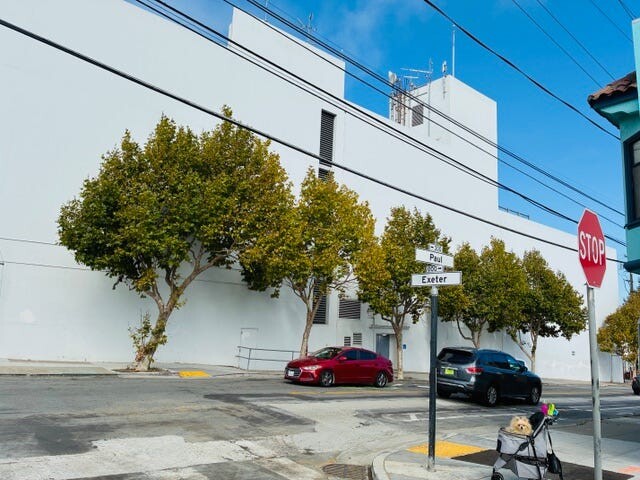
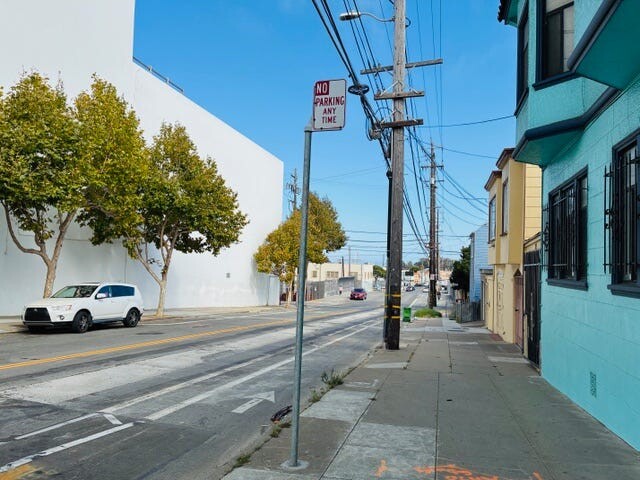
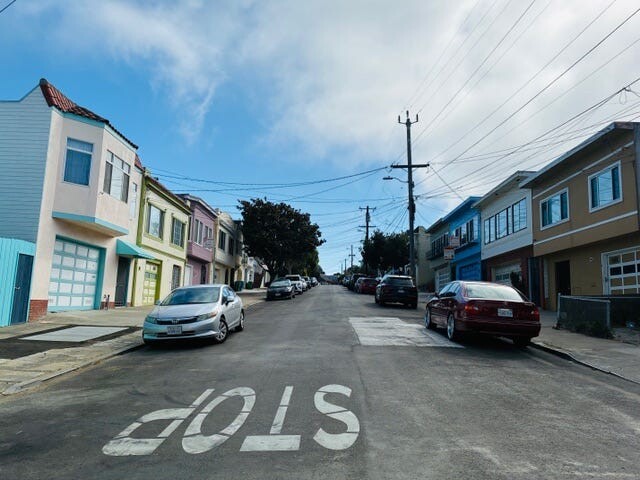
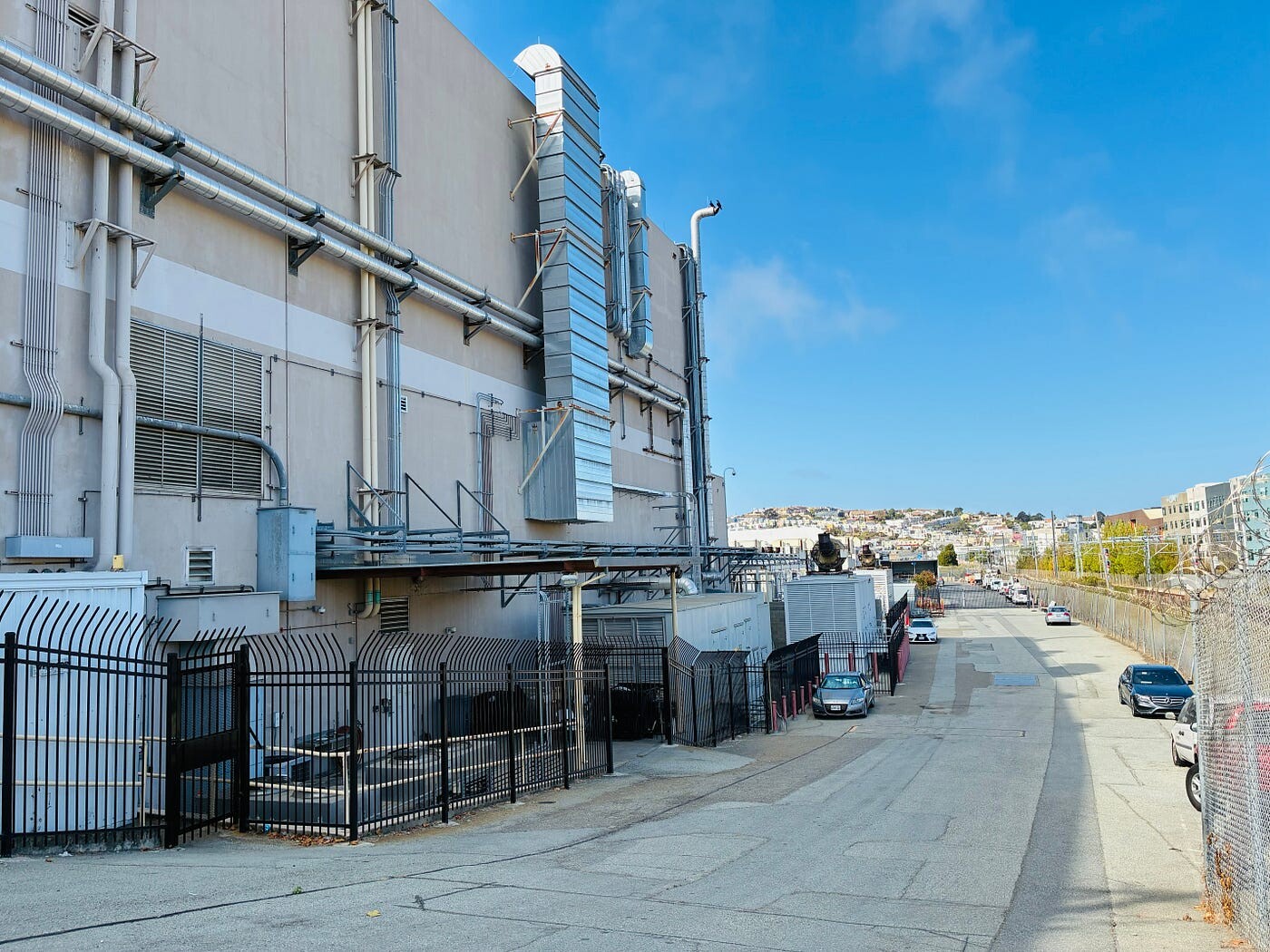
“We are the home of AI, and we should lean into it. We should absolutely make sure guardrails are in place, but I don’t think that’s the job of the Mayor of San Francisco.”

Because AI Data Centers require massive power configurations, specialized cooling, and diesel powered emergency battery grids, a thorough CSM must incorporate site specific impacts including:
Contaminant Sources including historical and legacy sources in the Site Profile. Urban San Francisco industrial zones contain fill material, legacy manufacturing and former maritime uses. Key legacy contaminants include PCBs, heavy metals including lead and arsenic, PAHs and VOCs from manufacturing and auto repair failities.
Operational Sources including Diesel/Methane emergency Backup Generators that rely on massive underground or above ground storage tanks introducing exposure to diesel fuel, benzene, toluene, ethylbenzene and xylene leaks.
Uninterrupted Power Supply Systems include large arrays of lead-acid or lithium-ion batteries and threats of human exposure to sulfuric acid leaks, heavy metals and thermal runaway byproducts.
Industrial Cooling Infrastructure required by extreme heat generated by AI chips. Chemical additives of liquid cooling loops include anti-fouling biocides and corrosion inhibitors used in cooling towers and closed loops.
Migration Pathways for Human and Ecological Exposures including subsurface migration to Bay groundwater exposing San Francisco waterfront neighborhoods with shallow water tables. Spills or legacy plumes migrate horizontally to contaminate aquifers leading to marine ecosystems.
Vapor Intrusion Framework: Volatile contaminants including chlorinated solvents or fuels migrate vertically pward through urban utility corridors, sewer linges and foundation cracks into the indoor air of the data center or neighboring commercial and residential buildings.
Utility Corridors and Express Routes for Liquid or Vapor phase contaminants to migrate offsite.
Air Dispersion Line: Point-source emissions from backup generators release concentrated nitrogen oxides (NOx), fine particulates (PM2.5) and heat.
Human and Ecological Receptors include onsite occupational workers. Data center technicians, facility engineers, and security personnel face chronic cumulative indoor exposure via vapor intrusion or acute direct contact with cooling loops or battery yards.
Offsite Urban Residents in high density industrialized neighborhoods adjacent to data center footprints are the primary sensitive receptors for outdoor air emissions generated by generator testing and localized noise pollution as high as 90 dB.
Construction Workers & Utility Workers performing deep soil excavation, fiber-optic line maintenance or utility repairs directly exposed to contaminated groundwater or soil gas.
Ecological Receptors including marine life and avian populations endangered by storm runoff or ground water discharge of untreated contaminants or cooling water into nearby Bay channels.
Get Ahimsa Porter Sumchai MD – PoliticoMD!’s stories in your inbox
Join Medium for free to get updates from this writer.Subscribe
Remember me for faster sign in
The Conceptual Site Model is completed by tracing the intersection of these impacts in an Exposure Routes Matrix. The major contaminant groups include volatile organic compounds and solvents, heavy metals and PAHs, petroleum hydrocarbons, particulate matter and NOx.
Environmental justice advocates agree diesel generators are expensive, noisy, dangerously polluting and exempt from Clean Air Act regulation during energy “emergencies.” [https://insideclimatenews.org/news/12112025/data-center-diesel-generators-noise-pollution/]

The clear and present danger posed by the siting of AI Data Centers in city residential neighborhoods serves as a clarion call for environmental scientists, environmental justice advocates and experts in the science of human biomonitoring. (HBM)
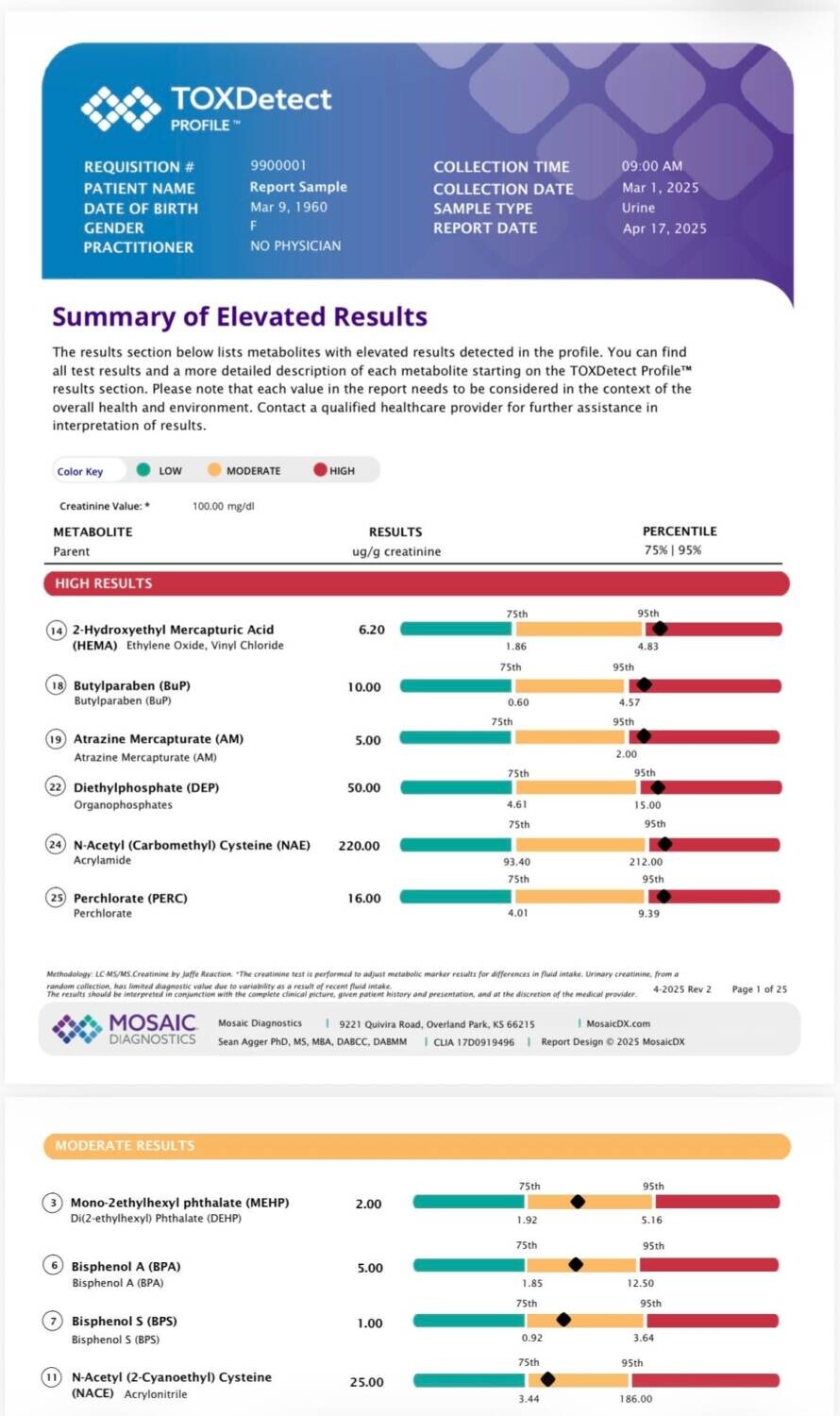
The Hunters Point Community Biomonitoring Program launched in January of 2019 as the nations first independent community HBM program established to offer residents and workers at a Federal Superfund site fast, accurate, low cost access to urinary toxic exposure screenings capable of detecting 35 toxicants documented to contaminate air, soil and the built environment.
Funded by CalEPA EJ grants in 2020 and fiscally sponsored by Greenaction for Environmental Health and Justice, HP Biomonitoring and it’s Principal Investigator — Dr. Ahimsa Porter Sumchai MD — were awarded the KPIX/CBS Jefferson Award in July 2020 and the coveted UCSF Medical Alumna of the Year Award in 2021. [https://www.cbsnews.com/sanfrancisco/news/san-francisco-doctor-researches-impact-of-toxic-dump-on-hunters-point/]

Biomonitoring for detecting toxic chemicals in human tissue was first enacted by the EPA in 1967 when the National Human Monitoring Program established an exposure based assessment to detect pesticides in fatty tissue. HBM was subsequently used to detect and prevent exposures to lead, PCB’s and the pesticide DDT.
Research on Human Exposure to AI Data Centers
“The report calls on EPA to reverse course to…restore and enforce pollution safequards, make sure data centers and their on-site power are properly permitted and monitored, with meaninful public review before major decisions are locked in; and maintain and rebuild the science, monitoring and enforcement capacity need to understand what facilities are emitting and make sure the law is followed.”
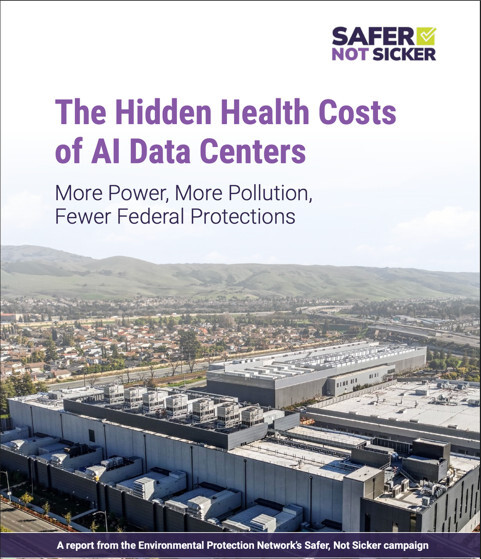
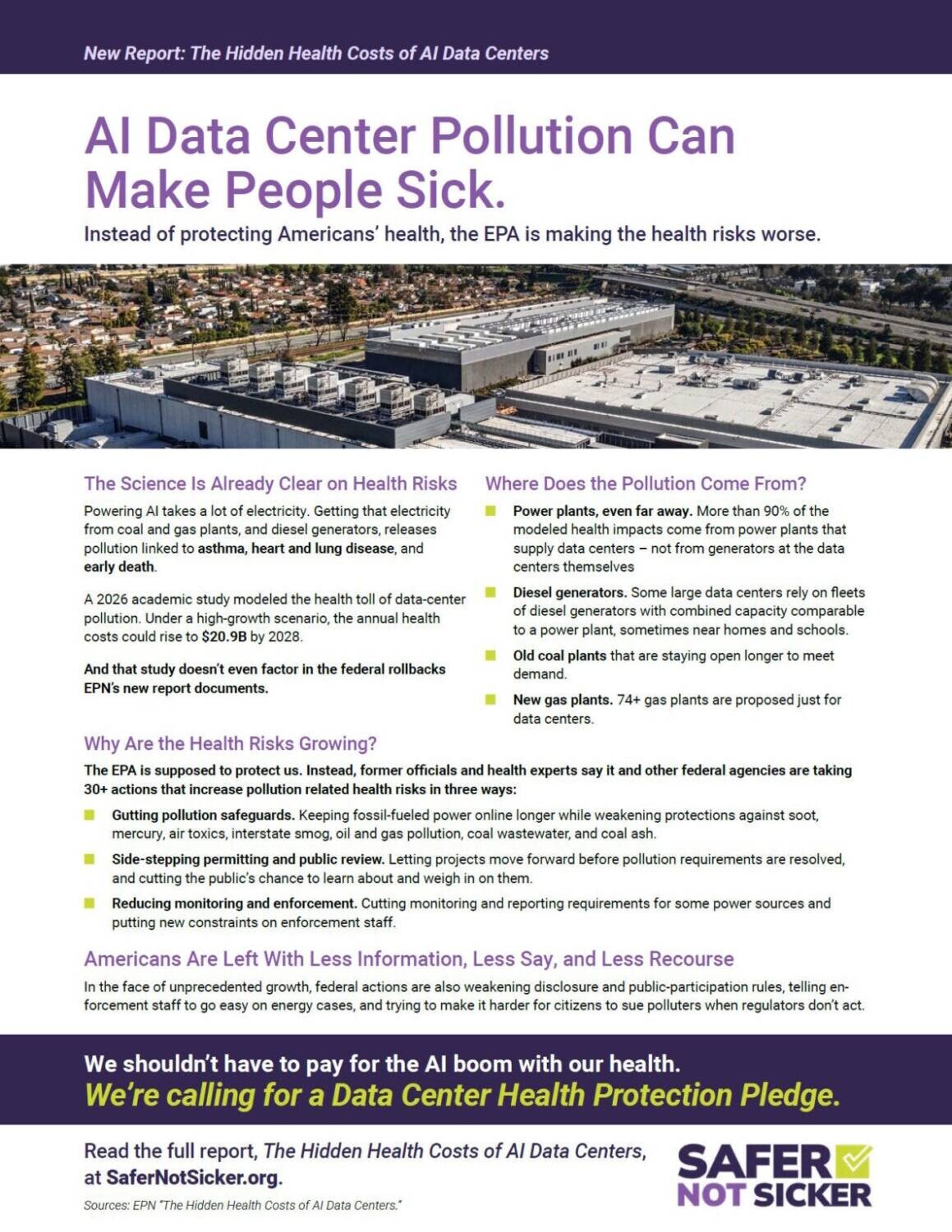
Research on the human health impacts of the rapid expansion of AI Data Centers adjacent to vulnerable neighborhoods and transit hubs is in it’s embryonic stage and includes no independent studies on human and environmental monitoring. The Environmental Protection Network calls for a “Data Center Health Protection Pledge” so Americans don’t pay for the AI boom with their health. The four key findings of the report are summarized as:
- The health toll is substantial but we do not know the full scale.
- Data Centers drive pollution nearby and far from their location.
- At least 30 federal actions weaken the regulatory oversight designed to prevent the rapid expansion and build out of AI Data Centers, how data centers are powered, what pollution safeguards apply and how projects are sited and approved.
- Vulnerable exposed communities are left with less information, less say and less recourse.
“EPA should measure how the buildout is changing pollution, who is being exposed and what that means for health, and make that information public.”
Examples drawn from real life include the raging controversy over Elon’s Musk’s xAI artifical intelligence facility — touted as “the world’s largest supercomputer facility. The Colossus training cluster is located in a predominantly black area of South Memphis Tennessee that struggles with economic hardship and poor health outcomes impacted by industrial pollution from a steel mill, coal fired plant, an oil refinery and an existing natural gas power plant. [Tech, Toxins, and Memphis: Evaluating the Environmental Footprint of the xAI Facility — https://www.tba.org/?pg=Hastings2025AIX]
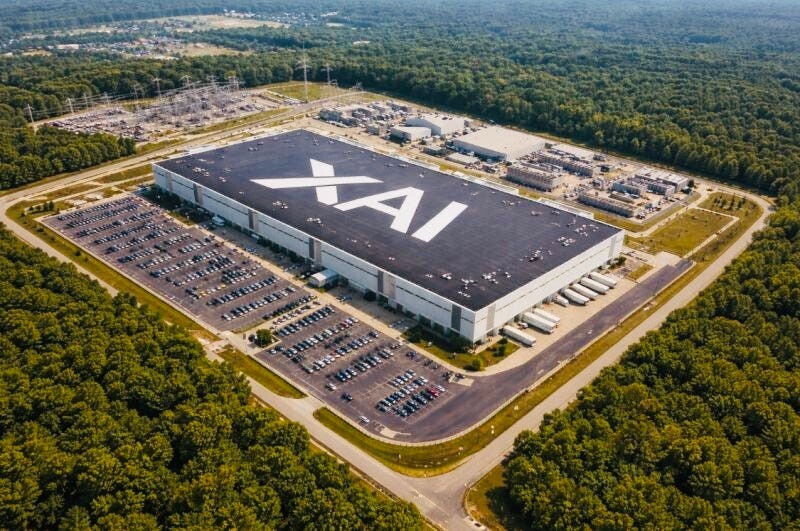
The xAI facility currently deploys 20 gas turbines with a 100 MW combined capacity. Over five years, plans to add 15 more gas turbines are expected to generate an estimated 57.55 tons of hazardous pollutants contributing to extreme levels of ozone, particulates and nitrogen oxides. The facility has not obtained permits from the County Health Department and Elon Musk’s companies have a legacy of accepting fines for environmental law violations to avoid regulation.
The Tennessee Bar Association evaluated the footprint of the xAI Facility and identified three major environmental concerns, (1) Air pollution and permitting failure, (2) Water usage and potential threats to the aquifer and (3) Energy consumption and its impact on the power grid.
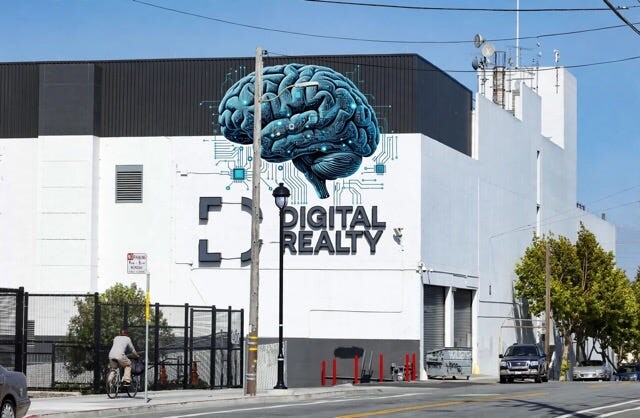
The Paul Avenue AI Data Center Campus underwent EIR Review in 2014. Reviewing agencies included over 20 state agencies including California Air Resources Board. The original review of the 243,000 square foot facility did not include state or local health agencies, despite the fact the Paul Avenue facility lies across the street from homes, a block away from a transit station and less than a quarter of a mile from Bret Harte Elementary School and Two Jacks Sea Food.
The original 2014 CEQA review documents SFMTA T-third light rail and Caltrain railways, “various schools” and San Francisco Bay waterways as project “issues”.
The conditional use permit issuance documents multiple project impacts including air quality, biological resources, hazards and hazardous materials, noise, cumulative effects, public services and land use considerations. [https://ceqanet.lci.ca.gov/2014062031]
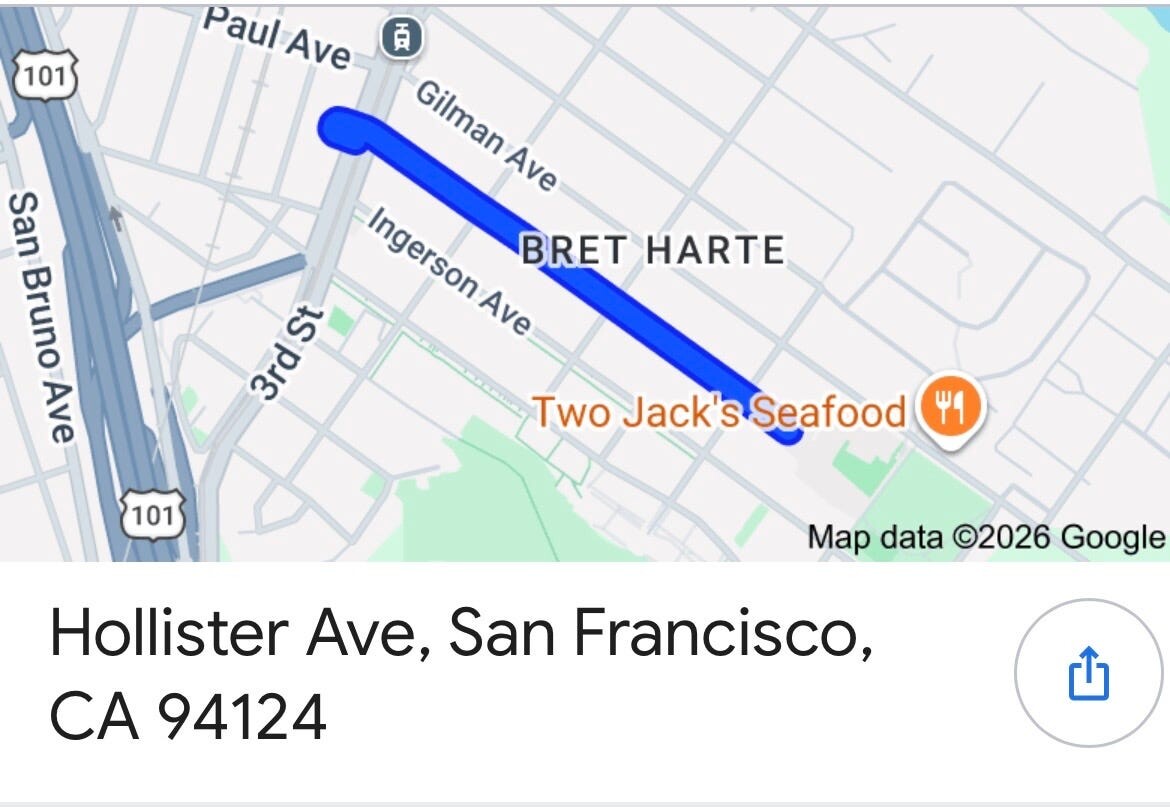
Paul Avenue courses a block from Hollister Avenue — where District 10 Supervisor Shamann Walton claims his residential address. It is inconceivable the Supervisor would endanger himself…and family by siting a complex of AI Data Centers east of his San Francisco address.
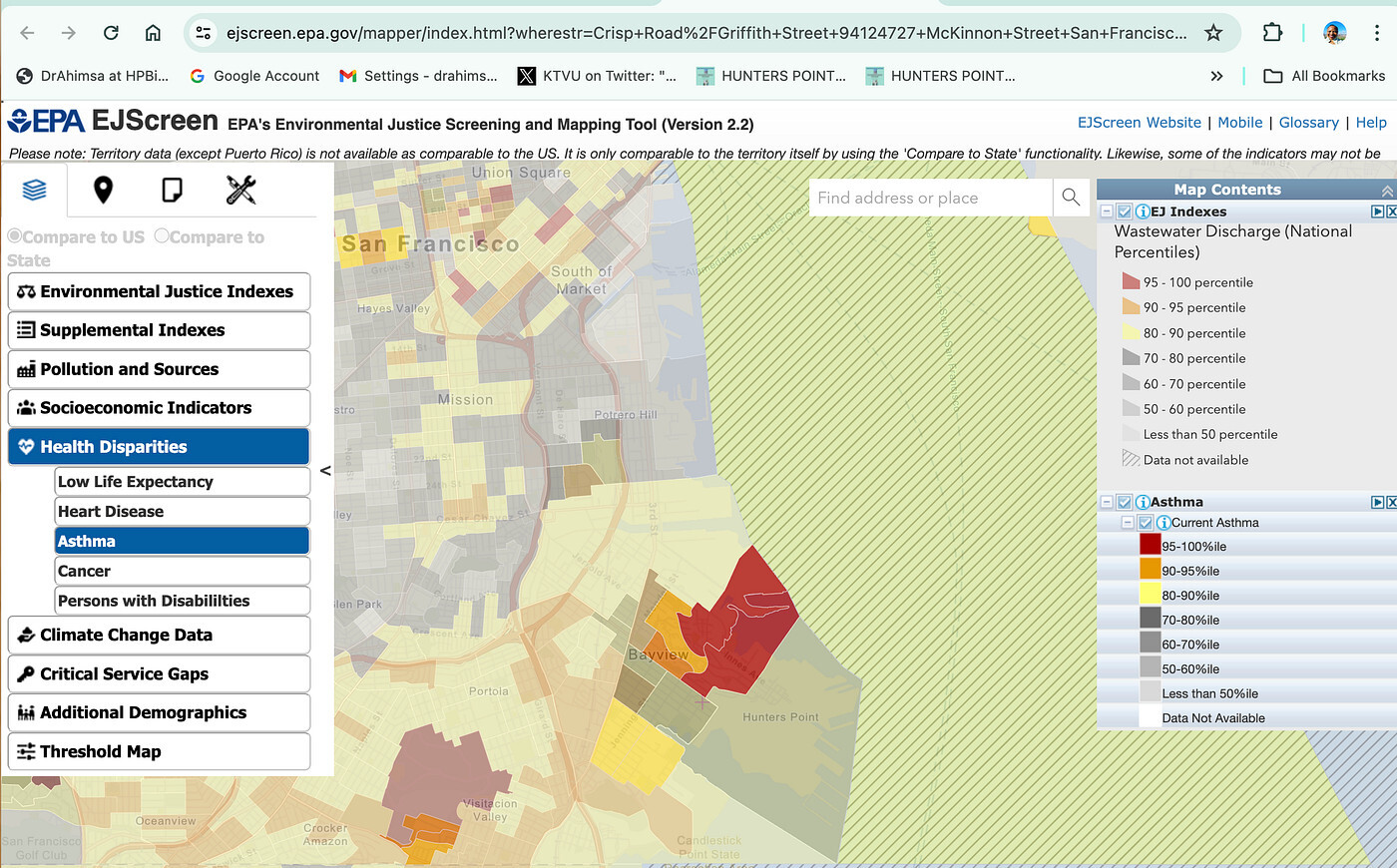

The Hunters Point Biomonitoring Foundation and Toxic Registry proposes the launch and establishment of a pilot program designed to evaluate the feasibility of the HP Biomonitoring AI Data Center Comprehensive Monitoring Program. The goals of the one year pilot program are:
- The creation of a Conceptual Site Model for the 200–400 Paul Avenue AI Data Center Campus.
- The creation of the one mile target zone centered at the intersection of the Paul Avenue/Exeter residential neighborhood and export of the community exposure research model developed for monitoring the Federal Superfund System at Hunters Point, Yosemite Slough and Candlestick Point.
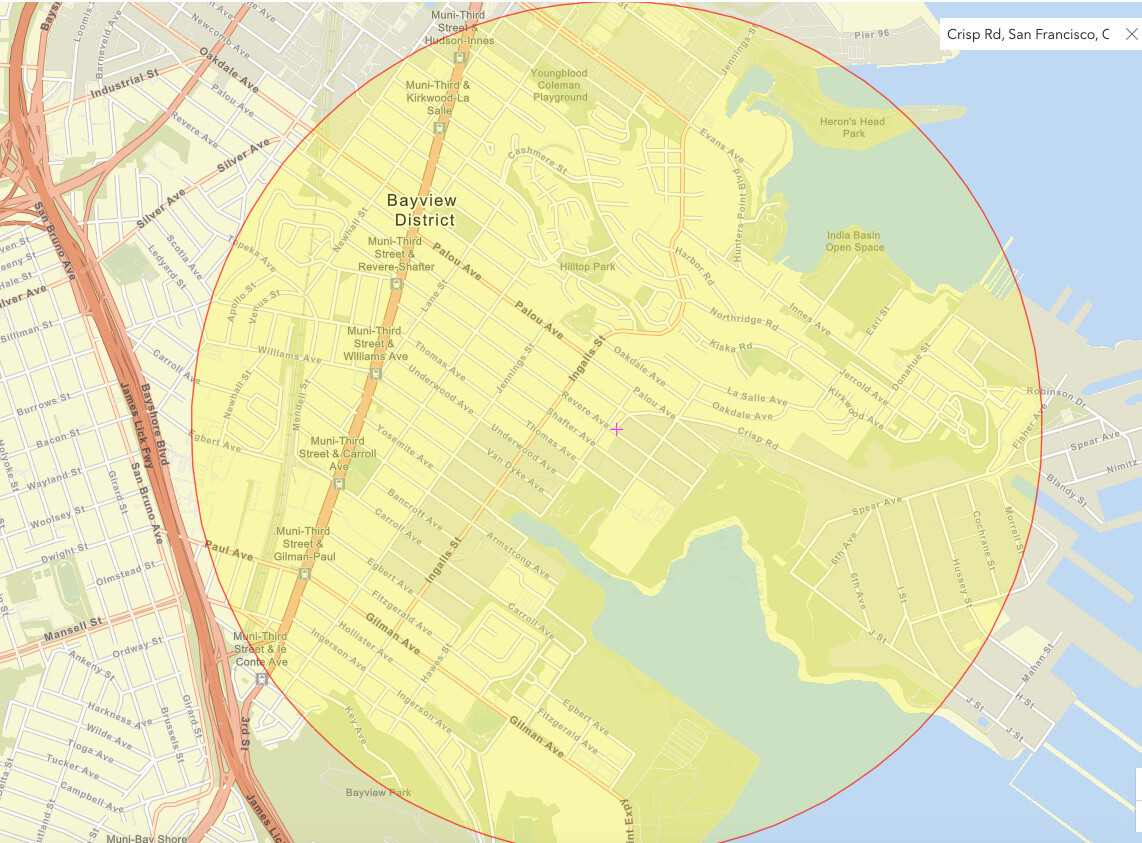
3. Installation of a system of monitors around the three block perimeter of the Paul Avenue campus in keeping with protocols created by Greenaction for Health & Environmental Justice in siting the Marie Harrison Bayview Air Monitoring system.
4. The AI Data Center Comprehensive Monitoring Program must demonstrate the capacity to detect toxic air contaminants, volatile organic compounds and criteria pollutants regulated by the U.S. EPA under the National Ambient Air Quality Standards using scientific criteria to protect public health and the environment. The six criteria pollutants are ground-level ozone, particulate matter, carbon monoxide, nitrogen dioxide, sulfur dioxide and lead. [Criteria Air Pollutants/US EPA — https://www.epa.gov/criteria-air-pollutants]
5. The AI Data Center Comprehensive Monitoring Program must demonstrate the capacity to measure noise pollution in decibels and to distinguish ambient noise levels at a transit station and railroad tracks from noise emanating from the Paul Avenue Campus. Preliminary noise analysis detects baseline noise levels as high as 70 dB at the transit station. The AI Data Center noise surveillance must include late night readings obtained at the perimeter of the facility to exclude traffic and transit noise pollution.
6. The AI Data Center Comprehensive Monitoring Program must demonstrate the capacity to isolate and graphically analyze heat generated by the facility measured in Farenheit.
7. The AI Data Center Comprehensive Monitoring Program must recruit, educate, consent and enroll residents and workers within the one mile target zone of the Paul Avenue facility for urinary biomonitoring using the Mosaic Diagnostic EnviroTOX Complete + Metals Test to detect the combined impact of environmental toxicants, toxic heavy metals and mycotoxins. EnviroTox Complete detects biomarkers highly specific for Data Center biomonitoring including breakdown products of benzene and other volatile organic compounds and organic acids.