


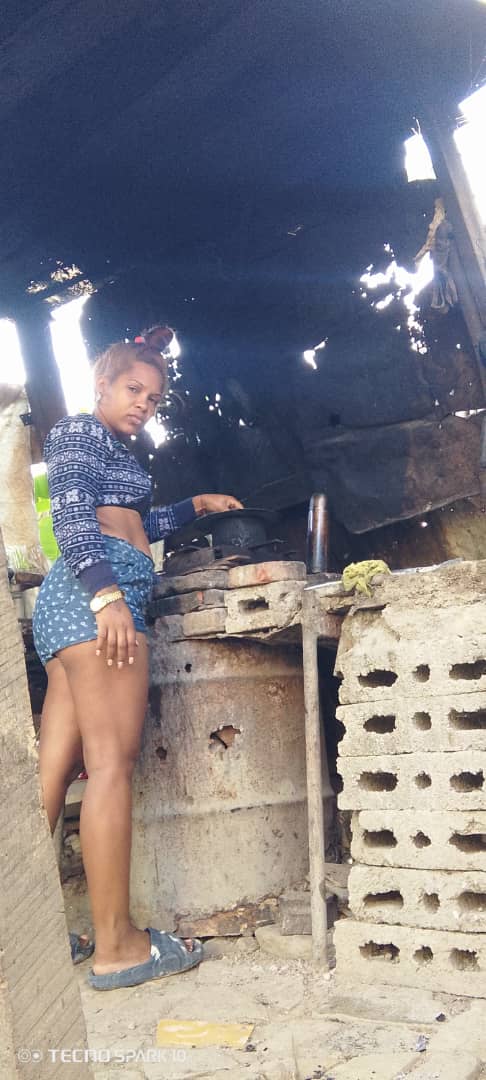
Maria Mirabel cooking
by JR Valrey, The People’s Minister of Information
Four months after Hurricane Melissa set records, wreaking havoc in Caribbean nations Haiti, Jamaica, and Cuba, I want to continue to report on this catastrophe, although it has fallen from the national headlines of mainstream news platforms, because there is still an everyday struggle for the hundreds of thousands or even possibly millions of already impoverished people, many of them Black, who were affected.
I initially interviewed Cuban translator and mother of three Maria Mirabel in October about how her life has been severely affected by the hurricane that destroyed her family’s home, compounded with a US government-sponsored 65-year blockade on Cuba for refusing to follow US dictates, further compounded by the recent US sponsored coup d’état and destabilization of Cuban ally Venezuela. Here is an update on how she has been surviving and the obstacles that her family and the Cuban people are facing.
JR Valrey: How has life changed two months after the hurricane destroyed your home?
Maria Mirabel: I can tell you that it’s been two months since the hurricane, and we still feel like it was yesterday, because the situation with housing, food, electricity and water remain the same or have gotten worse. The protests in many parts of the country haven’t stopped against all these conditions – shouting “freedom and life” – but we continue like this day after day, trying to survive and not knowing what tomorrow will bring. I personally haven’t been able to recover from the damage to my home since the hurricane, no matter how hard I’ve tried, because the government here doesn’t lift a finger to solve anything.
JR Valrey: An estimated 90,000 buildings were affected by the hurricane. How are the cleanup and reconstruction efforts progressing?
Maria Mirabel: It is said that 90,000 buildings were affected by the cyclone! I think many more things happened that the government isn’t talking about or allowing to come to light, limiting internet and electricity access for the inhabitants of our country to keep us quiet. I live in Guantánamo, Cuba. In my province, there are two municipalities called Imías and San Antonio del Sur, and currently, people there are living in shipping containers, which is the only thing the government has provided. Instead of rebuilding their homes or giving them another place to live, they’re forced to live in containers like animals. This is just one part of Guantánamo; what about Santiago and Holguín, where many more homes were destroyed? I’m sure nothing has been resolved there, and nothing will be.
These municipalities, as I was telling you, are very close to the sea, which is always where hurricanes cause the most damage in our province, and if it caused damage in the city, what can I say about what happened there?
The cleaning efforts are already quite advanced; some community brigades are handling the cleaning in the city centers, but in the more remote neighborhoods, the cleaning has been carried out by residents of those communities. There isn’t much dirt visible anymore.
JR Valrey: How has the government-declared epidemic of mosquito-borne diseases in Cuba affected your family and your neighborhood?
Maria Mirabel: Well, my family and I overcame it, and like in almost all the provinces of the country, or we could say throughout the entire country, this epidemiological virus that has been attacking us, called Chikungunya, is present. This virus has caused a great number of deaths among people of all ages, but mostly among children and the elderly, who are always the most vulnerable. This virus is said to be transmitted by mosquitoes, causing severe symptoms such as intense fevers of over 39 degrees Celsius, pain in all the joints, especially in the hands and feet, uncontrollable vomiting, and a complete loss of appetite.
I know this firsthand because I experienced it; it’s a very strong illness, and people feel as if death is chasing them. I personally was in bed for four days without eating anything because I vomited everything I put in my mouth, and the pain was indescribable. I saw the same thing in my children and my mother. My mother still has lingering effects, swelling in her hands and pain in her legs at times; that’s what everyone who has had it complains about. It is said that the after-effects last for 90 days.
JR Valrey: How are these events affecting the schools? Are the children attending classes?
Maria Mirabel: Nowadays, the school has stabilized a bit, but many families still don’t send their children to school every day for the same reason: Many of us are single mothers, and we don’t have enough food to give our children breakfast every day. And if I tell you that the electricity is unreliable, it doesn’t even give us a chance to iron their uniforms, which isn’t the most important factor, but it does have an impact. All mothers, and sometimes even mothers with husbands, don’t have enough money to feed their children because prices are very high and wages are very low. Some of the highest salaries in this country are between $10 and $20, which often isn’t even enough for a package of chicken. And like so many other mothers, when I don’t have food, I don’t send my children to school.
JR Valrey: How long do you think it will take to rebuild your house at this rate?
Maria Mirabel: The rebuilding of the houses, both mine and those of many families whose homes were destroyed by this natural phenomenon in this country where we are living, will take a long time because there is no money, and even less help from the government. The people who receive financial assistance from other countries, from family or friends, are the ones who can move forward, otherwise I don’t think it’s possible, because the little money that comes in is for food.
JR Valrey: Besides money, what supplies are most urgently needed?
Maria Mirabel: In addition to money, which is one of the most essential things because it’s used to buy food, medicine, clothing and shoes — in other words, the economic stability that everyone needs — families also need equipment that generates electricity for lighting and cooking. They also need water purifiers, as the water they receive is very dirty, and poor people cannot afford to buy bottled water at the markets due to the cost.