


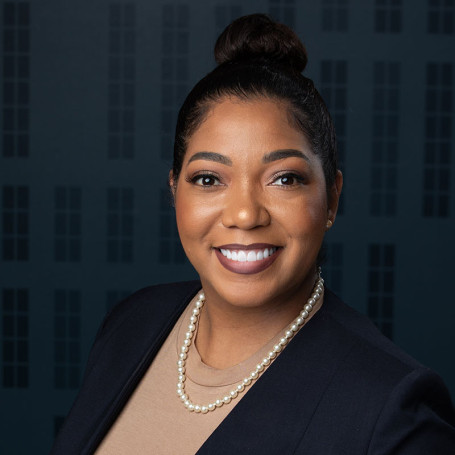
Statement from National Bar Association President Ashley Upkins on the U.S. Supreme Court’s decision in Louisiana V. Callais
The National Bar Association expresses outrage regarding the April 29 United States Supreme Court decision in Louisiana v. Callais, a ruling that significantly narrows protections long relied upon to challenge racial vote dilution under Section 2 of the Voting Rights Act. Read the full Supreme Court opinion here.
For generations, Section 2 has served as one of the nation’s most important legal safeguards against schemes designed to weaken the voting strength of Black communities and other historically marginalized voters. It has been a critical tool in ensuring that representation in our democracy reflects fairness rather than manipulation.
The April 29 ruling raises the bar for proving discrimination, diminishes the weight of historical realities, and makes it more difficult to challenge district maps that dilute minority voting power. In practical terms, this decision threatens to reduce opportunities for Black voters to elect candidates of their choice and further erodes federal protections that have already been weakened over the last decade.
Let me be clear: this moment is bigger than Louisiana. This is a civil rights inflection point.
This decision has implications for communities across the country, particularly in states where demographic growth has outpaced political representation and where district lines have too often been used as barriers instead of bridges.
The National Bar Association was founded in 1925 because Black lawyers were excluded from institutions that claimed to represent justice. This decision reminds us that rights once won are never permanently secured. Every generation must defend democracy anew.
That responsibility now calls on us again.
Our call to action
We urge our members, chapters, affiliates, judges, law students and community partners to mobilize immediately in the following ways:
1. Litigation readiness
Support and engage in strategic litigation efforts to challenge discriminatory practices wherever lawful avenues remain.
2. Legislative advocacy
Push for federal voting rights legislation that restores and strengthens protections gutted by recent court decisions.
3. Voter education and protection
Expand voter education, election protection and turnout efforts in every jurisdiction, especially in underserved communities.
4. Local power building
Remember that prosecutors, judges, school boards, sheriffs, mayors and state legislators shape daily life. Local elections matter deeply.
5. Membership mobilization
Every National Bar Association chapter should convene immediate discussions on the impact of this decision and develop local action plans.
Our commitment
The courts may narrow pathways, but they cannot silence a people determined to be heard. We have faced literacy tests, poll taxes, intimidation, exclusion and obstruction. We have answered every challenge with courage and collective action. We will do so again.
The National Bar Association remains steadfast in its mission to protect civil rights, defend democracy and ensure that equal justice is a lived reality for all. I will see you at the annual convention. Bring your boots, there is much work to be done.
Ashley L. Upkins is the 83rd president of the National Bar Association and the first woman from Tennessee to hold this historic role. Recognized as a powerful voice for justice, equity and leadership, she is an award-winning attorney and advocate who inspires with her vision, faith and commitment to lifting the next generation of change-makers. She can be reached via info@nationalbar.org.