


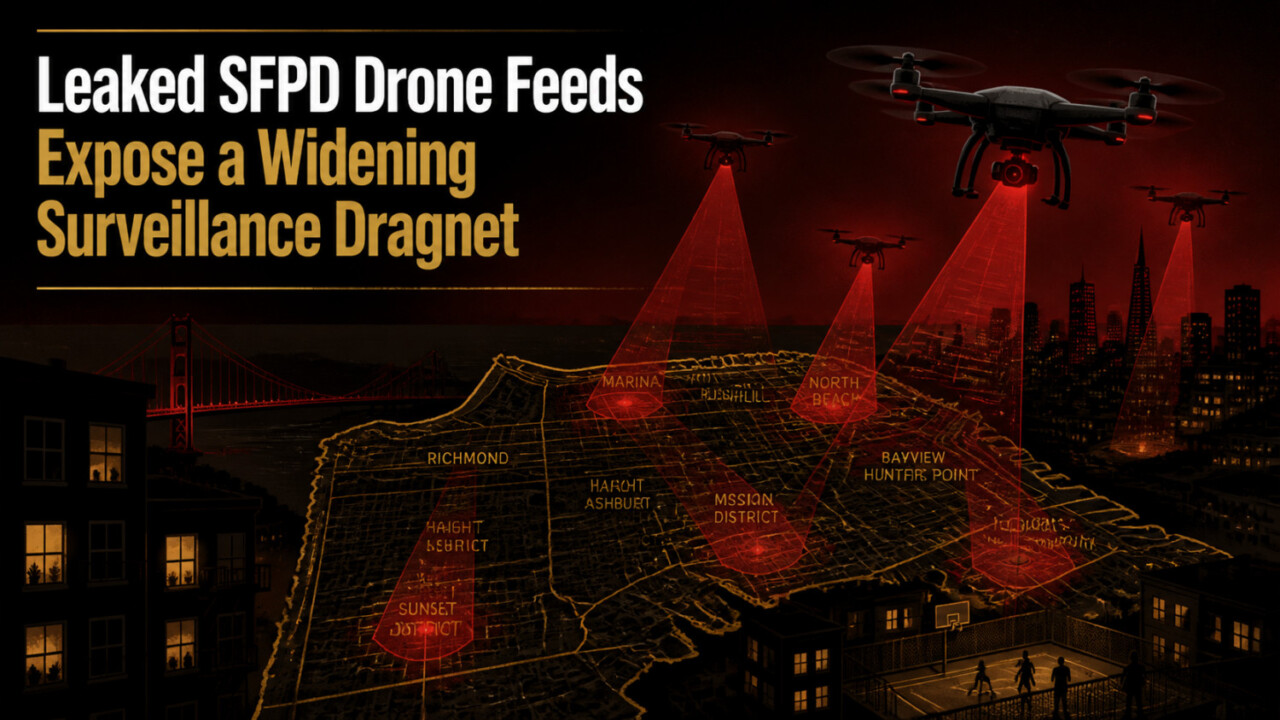
Newly exposed livestreams from San Francisco police drones show how fast the city’s aerial surveillance program has expanded, how easily sensitive footage was left open online, and why residents must stay informed as oversight is more out of sight than these drones are.
by Tabari Morris
Hours of San Francisco Police Department drone footage were exposed on the open internet through an unsecured Skydio sharing link, revealing real-time police operations, thermal video, location data, and identifying information connected to drone operators. The leak gave the public an unplanned look at how SFPD’s drone program is being used across the city, including footage of police detentions, surveillance of people who did not appear to be engaged in criminal activity, and images from inside a residential building. For us in Black, Brown, poor and heavily policed communities, the exposure is not only a cybersecurity failure but a warning about how deeply aerial surveillance has reached into our everyday lives.
According to reporting and the leaked material reviewed so far, security researchers Sam Curry and Maik Robert found that five SFPD drone feeds could be viewed without authentication after a sharing link was apparently created with a one-year expiration period. The archived footage reviewed by WIRED covered roughly 48 hours and included about 20 flights, with color and thermal views that showed police tracking suspects, monitoring streets, and entering at least one apartment building. The coverage also points to scenes in which a drone followed people who later appeared simply to be going to play basketball, raising fresh questions about whether the technology is staying within the limits SFPD publicly claims it follows.
The severity of this breach goes beyond an embarrassing leak. When police surveillance footage can be left accessible online for months, residents are forced to confront two dangers at once: the spread of high-tech monitoring and the failure to secure the data created by that monitoring. The footage reportedly captured hundreds of uninvolved people and vehicles, despite SFPD policy language saying pilots should minimize inadvertent recording of people not connected to an investigation. In a city where surveillance tools have repeatedly been sold as limited and carefully governed, this leak underscores why the public has to stay informed in real time, not after policies have already widened and the technology is normalized.
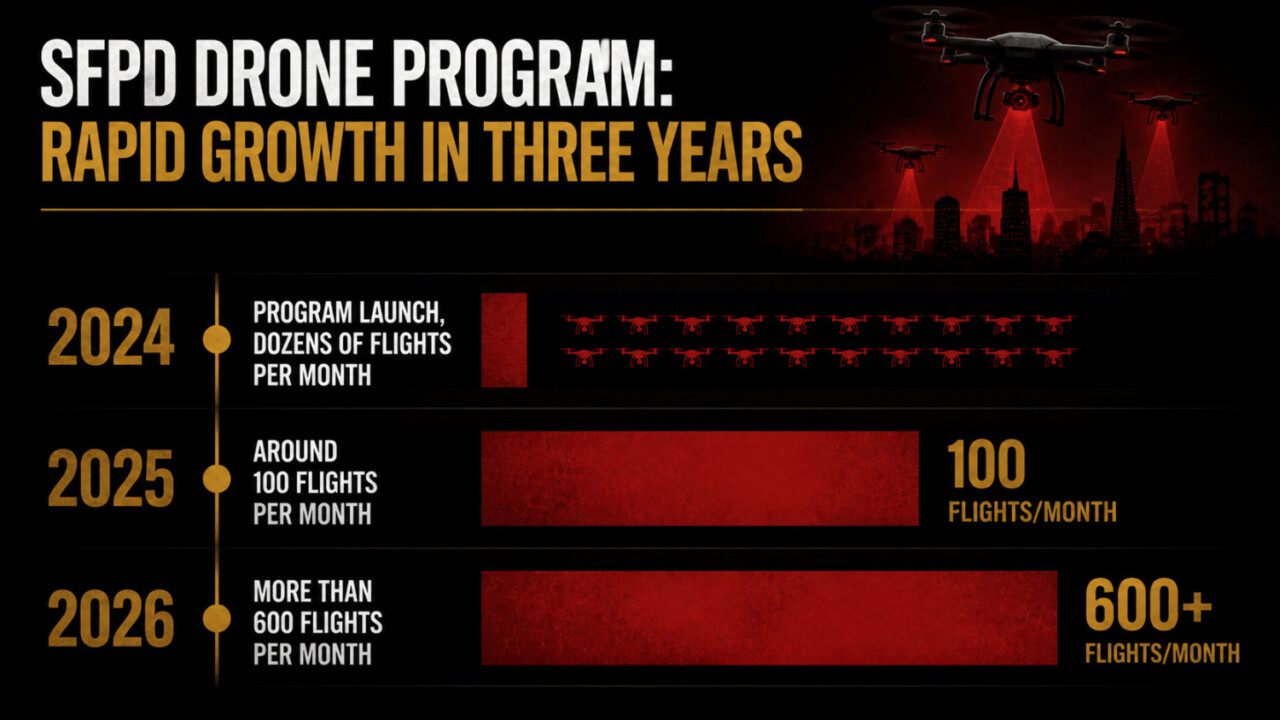
Coverage so far has documented a central contradiction: SFPD says drones are for active criminal investigations, vehicle pursuits and critical incidents, yet the leaked footage shows a broader pattern of routine urban monitoring that many residents would never notice from the ground. The department’s own public materials say the drone program began after Proposition E passed in March 2024, and its flight-log page states that records run from May 16, 2024, to the present month. The attached reporting from our previous coverage also notes that the program grew from dozens of flights a month at launch to more than 600 flights per month in 2026, a scale that helps explain why this is not a narrow technical story but a major public accountability story.
Latest update
As of the latest public reporting, SFPD says it disabled the link after learning of the exposure, has put more restrictive sharing protocols in place, and says it has no information showing anyone other than the researchers accessed the feeds.The department has also said the matter remains under investigation, while continuing to publicly promote the drone program as a tool for criminal investigations and public safety. That means the immediate leak may have been shut down, but the broader questions remain unresolved: Who authorized the exposed link, how long residents were surveilled without meaningful public awareness, and whether current oversight is strong enough to protect civil liberties.
Residents should watch for any Police Commission, Board of Supervisors or departmental response that addresses data security, retention, public notice, audit trails, and the actual limits on drone deployment.They should also watch whether officials treat this as an isolated technical mistake or as evidence that San Francisco’s rapidly expanding surveillance architecture is outpacing public oversight.
In times like these, being informed is not optional; it is one of the few protections our communities still have when the state’s view from above grows wider while accountability on the ground stays absent from the true discussion.
Tabari Morris is Managing Editor at the San Francisco Bayview as well as an investigative journalist. He can be reached at Tabari@sfbayview.com