


Tags Baton Rouge
Tag: Baton Rouge
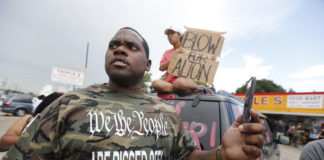
New video shows Alton Sterling wasn’t holding a gun when he...
Alton Sterling, a 37-year-old Black man, was standing in the parking lot selling CDs as he had for years when two white cops arrived on Tuesday night. By Wednesday morning he was dead and protesters were in the city’s streets. Calls erupted from Congress and the NAACP for an independent investigation into the shooting, which the Justice Department announced within hours. District Attorney Hillar C. Moore III said the “officers feel they were completely justified” in the shooting. Alton was the 558th person killed by police in the U.S. this year.

The Ricky Davis affair: A Hurricane Katrina story
It is clear that Ricky Davis never had a chance of receiving fairness in a toxic judicial environment. The Ricky Davis affair is just one of the little known travesties that has arisen as a result of Hurricane Katrina. In Louisiana, a life sentence means you die in prison. Mr. Davis’ act of heroism has turned him into a victim of an arbitrary racially motivated legal lynching. If Black Lives Matter, it’s hard to tell down here in Louisiana.
‘Katrina: After the Flood’
The New York Times sent Gary Rivlin to Baton Rouge and New Orleans, days after the storm, to cover Katrina as an outsider. Rivlin’s instincts had him looking forward “to the mess ahead. Eventually the flood waters would recede. How would New Orleans go about the complicated task of rebuilding?” This carefully researched, beautifully written book describes that process from then until now.

Wanda’s Picks for January 2015
Happy New Year! Happy Birthday to my granddaughter Brianna, niece Wilda and friend Fred T. I am still smiling about America’s new relationship with Cuba and the freed Cuban 5. If you are in New Orleans (NOLA), don’t miss “Prospect 3: Notes for Now,” the biennial there being celebrated throughout the city through Jan. 25.

Amnesty International asks the world to demand justice for Albert Woodfox
Amnesty International has announced that, for the first time, it has put a U.S. prisoner on the list of 10 cases that it will ask people around the world to advocate for in their Write for Rights Global Write-a-thon on International Human Rights Day, Dec. 10. The U.S. prisoner is 68-year-old Albert Woodfox, the final member of the Angola 3 still in solitary confinement in a Louisiana state prison.
A quiet revolution: ‘Not Meant to Live Like This: Weathering the...
One morning after Mass at the Poor Claire Monastery, Maria Victoire, a volunteer with the Fourth World Movement, broached the idea of a collaborative book written by extremely poor New Orleaneans scattered to the winds after Hurricane Katrina. She was asking my opinion as an author about what to do with the 50 or so interviews she had conducted and how to get them published as a book.
Solitary confinement on trial: an interview with law professor Angela A....
On the morning of Tuesday, June 19, the Senate Judiciary Committee’s Subcommittee on the Constitution, Civil Rights and Human Rights is having an important public hearing on “Reassessing Solitary Confinement.” This Senate hearing comes on the heels of widespread prisoner hunger strikes that have made the use of solitary confinement a central issue.
Two years after the BP drilling disaster, Gulf residents fear for...
On April 20, 2010, a reckless attitude towards the safety of the Gulf Coast by BP caused a well to blow out 5,000 feet below the surface of the Gulf of Mexico. “People should be aware that the oil is still there,” says Wilma Subra, a chemist who travels widely across the Gulf. The reality she is seeing on the ground contrasts sharply with the image painted by BP.
Wanda’s Picks for April 2012
The Oakland International Film Festival is Friday-Sunday, April 6-8, at the Oakland Museum of California, 10th and Oak Street, Oakland. Visit http://www.oiff.org/2012schedule.pdf. This year’s headliner is one of the most controversial independent films ever made, “The Spook Who Sat by the Door.” Watch it again here.
Betty McGee: Living for others
Betty McGee, PhD, serves as the Bayview Hunters Point Health and Environmental Resource Center’s (HERC) executive director, working to create a more environmentally just San Francisco.
Dr. King and the 1955-1956 Montgomery bus boycott
Although America’s Declaration of Independence and Constitution are premised on the principles of democracy, the historical treatment of America’s citizens of color is replete with racial dichotomies. Today’s youth need to know that Dr. King was only 25 when he began to fight back with the year-long Montgomery bus boycott.
Cultural extinction
As BP’s deepwater well continues to discharge oil into the Gulf, the economic and public health effects are already being felt across coastal communities. But it’s likely this is only the beginning. From the bayous of southern Louisiana to the city of New Orleans, many fear this disaster represents not only environmental devastation, but also cultural extinction for peoples who have made their lives here for generations.