
 Store
Store


Tags Patrice Lumumba
Tag: Patrice Lumumba
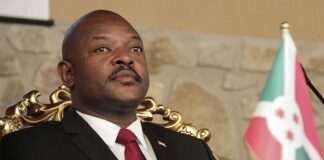
Fare thee well, President Nkurunziza
Burundi happens to be the birthplace of my hero, Prince Louis Rwagasore. Burundians are not drawn to spinning or showcasing their country, so little is known outside of the biases and prejudices of archived material or contemporary writers, largely Anglophones.
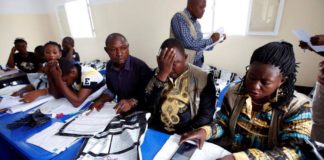
Code talking: UN Security Council on war and peace in DRC
Most UN Security Council (UNSC) meetings are so stuffy that they’re hard to watch without wishing someone would open a window, turn on the ventilator or take the august ambassadors off life support. Norman Finkelstein couldn’t have been more apt than when he called Secretary General Ban Ki-moon a “comatose puppet of the United States.” I went through an entire pot of strong coffee just listening to last week’s three-hour UNSC meeting about the Dec. 30 election in the Democratic Republic of Congo (DRC). The ambassadors spoke in code, without naming key players and perpetrators.
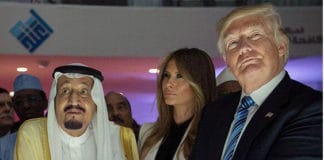
Khashoggi’s murder shows the House of Saud is not only barbaric...
President Donald Trump’s comments regarding the murder of Saudi journalist Jamal Khashoggi aptly reflect the true nature of the power brokers that he represents. Instead of the usual “Empire-speak” statements, hypocritically condemning Khashoggi’s murder, followed by a pep talk on the values of “democracy” and “freedom of speech,” Trump is basically saying, as the leader of one rogue state to another, that was the “worst cover up ever,” boys, and heads should roll.
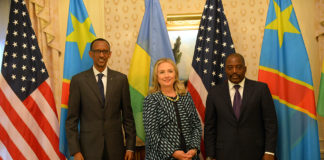
Divide and rule: Balkanizing the Democratic Republic of Congo
Syria has long dominated international headlines while the big powers discuss the possibility of dividing it into smaller, more homogeneous states along ethnic or religious lines. The Democratic Republic of Congo is rarely if ever at the top of the Western headlines, but heads of state and so-called experts have long made similar proposals to carve out new, smaller, more homogeneous nations in Congo’s resource-rich eastern provinces. I spoke with Congolese scholar and activist Boniface Musavuli about the plans.
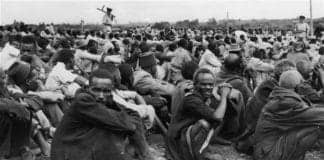
Political crimes of the United Kingdom exposed by Russian diplomat
Excerpts from remarks by Russian Foreign Ministry spokesperson Maria Zakharova delivered April 19, 2018 – And now I am asking everyone to fasten their belts. During a briefing on the OPCW (Organisation for the Prohibition of Chemical Weapons) report held for the international diplomatic community on April 13, UK Ambassador to Russia Laurie Bristow said that “the Russian state has a record in state-sponsored assassinations including in the UK.”
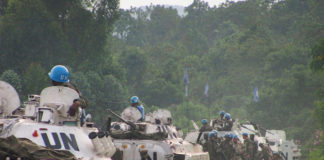
Congo: A neocolonial enterprise managed by the UN Security Council with...
The Democratic Republic of the Congo is the heart of Black Africa. Millions of Congolese have been murdered, massacred, enslaved, robbed of their resources and driven from their homes since the Berlin Conference gave the “Congo Free State” to Belgium’s King Leopold II as his personal property in 1885. I spoke to Jean-Claude Maswana about the latest waves of aggression under current Congolese President Joseph Kabila.

Fifty-five years after Lumumba’s assassination, Congolese see no relief
One of the most devastating U.S. interventions was the overthrow of the democratically elected leader of the Congo, Prime Minister Patrice Emery Lumumba, in 1960. That overthrow has been devastating for the Congolese people, because not only did the U.S. overthrow and assassinate the democratically elected leader, but they also imposed a dictatorship on the Congolese people for over three decades, and it has crushed and destroyed the country and the people.
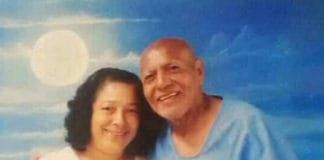
Our hero has not been forgotten
Many times conscious prisoners become lost in their own image and forget the representation of the people as a whole. Our loss came with the death of Hugo Pinell. His introduction is not needed. He helped bring life to a generation that had not – and some still to this day still have not – forgotten the bigger picture. As conscious prisoners and political prisoners behind enemy lines, we as a community cannot forget to reach out to his daughter.

The ENOUGH Project calls for a conflict-free Black Friday
Earlier this week, the ENOUGH Project to, quote, “end genocide and crimes against humanity,” posted an appeal to consumers titled, “What if Black Friday were conflict-free?” ENOUGH is an NGO operating under the umbrella of the Center for American Progress, a neoliberal Washington D.C.-based Democratic Party think tank. They did not include an appeal to the nation’s weapons manufacturers who require minerals on the U.S. Strategic Minerals list.
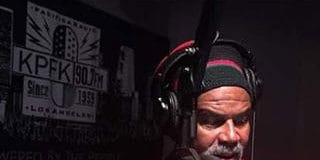
A-APRP comrade speaks on the work of the late Dedon Kamathi
When the African world revolution lost Dedon Kamathi, we lost an organizer’s organizer, a void that will definitely be very hard to fill. I talked to one of Dedon’s close comrades in the All-African People’s Revolutionary Party, Munyiga Lumumba, so that he could give the people who didn’t know Dedon like we did a glimpse into the politics and the spirit that made Dedon Dedon.
The third edition of the ‘Monumental Battle Cry for Cuba and...
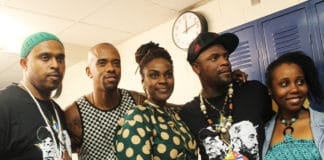
Writer, reporter and Pan Africanist Obi Egbuna, the U.S. correspondent to the Zimbabwean national newspaper The Herald, recently finished, alongside co-executive producer M1 of dead prez, the third volume of the “Battle Cry for Cuba and Zimbabwe” compilation, which is a cultural protest against how the two countries have been unfairly sanctioned by the U.S. government. Check out Obi Egbuna in his own words.
Two years after his murder, his imam recalls the life of...
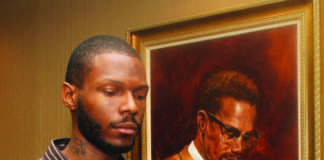
This upcoming week, on May 19, we will celebrate the 90th birthday of the late great El Hajj Malik El Shabazz aka our beloved Malcolm X, all over the world. But what will not be talked about in most of these celebrations, unrightfully so, will be the murder of his grandson, Malcolm Latif Shabazz two years earlier on May 10, 2013. Here is Hashim Aluddeen’s perspective on Young Malcolm, on the second anniversary of his assassination.
‘Friends of Victoire’ launched to free Rwandan political prisoner Victoire Ingabire
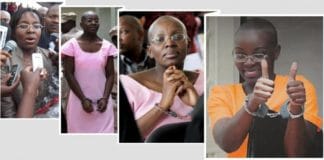
In January 2010, Rwandan opposition leader Victoire Ingabire Umuhoza returned from The Netherlands to Rwanda to attempt to run against sitting President Paul Kagame. She said she knew that she would be either assassinated or imprisoned, and she is now entering the fifth year of a 15-year prison sentence. KPFA’s Ann Garrison spoke to Marie Lyse Numuhoza, the founder of Friends of Victoire, a new organization created to fight for her freedom.
Rwandan prisoner Victoire Ingabire takes case against Rwandan regime to international...
After becoming the leader of the Rwandan Diaspora’s opposition to the authoritarian regime of Rwandan President Paul Kagame, Victoire Ingabire returned to Rwanda to run against him in the 2010 election. She was instead placed under house arrest shortly after her return and is now serving a 15 year sentence. This week the African Court of Human and People’s Rights agreed to hear her case on appeal, in Arusha, Tanzania.
Still no resolution: an interview wit’ Sheikh Hashim Ali Alauddeen, the...
Oct. 8 will mark the 30th birthday of Young Malcolm Shabazz. It’s been over a year since his murder in Mexico City. As time goes by, it becomes clearer and clearer, even to the most skeptical of people, that this was a straight up assassination, like what was done to Malcolm’s grandfather and great grandfather. It is a must that we regularly commemorate the people who mean something to us, especially those who have fought for our human rights.
Why Ferguson is the Congo
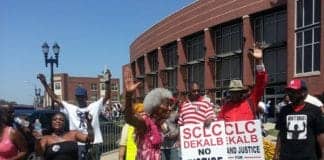
For those who are looking at us, as if we were in a cage like Patrice Lumumba said, there is no difference between a Black African and an African-American. We are the ones making this difference because we think that for the white man there are good Blacks and there are bad Blacks. We don’t look at ourselves through our own eyes but through the eyes of another person who has defined us as not human.
The T-shirt warrior: an interview with Chris Zamani, founder of the...
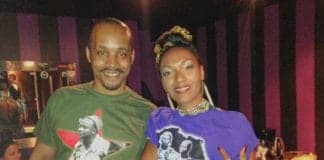
Chris Zamani, founder of the Hapo Zamani Za Kale clothing line, is a t-shirt designer who is on the pioneering front of trying to politicize the consciousness in the Black community through changing the kinds of people and messages on the t-shirts we are wearing. He started a line of t-shirts which immortalizes and commemorates revolutionary heroes and sheroes from the African continent, people like Nkrumah, Lumumba, Machel, Nehanda, Asantewaa, Mugabe and more.

‘Virunga’ documents Congo battle pitting gorillas against greed over ocean of...
The documentary “Virunga” tells the story of the rangers at Virunga National Park in eastern Congo who are battling to keep the last remaining 800 mountain gorillas that live in the park alive – a battle against poachers, the M23 rebel forces and the British corporation Soco, which is trying to convince officials inside the park and in government to allow them to exploit the huge ocean of oil that lies under the park.
Chokwe Lumumba: Dare to struggle, dare to win!
On March 8, hundreds of people, especially from the South and particularly Jackson, Miss., came to mourn and reflect on the life of Mayor Chokwe Lumumba, who died suddenly on Feb. 25 at the age of 66. Starting with a March 5 tribute at the historically Black college, Jackson State University, Mayor Lumumba’s life was memorialized for several days, ending with the masses lining the streets for his burial motorcade. A collection of tributes to the late great mayor of Jackson, Miss.
Cynthia McKinney: The world needs peace – but not a Pax...
Former Georgia Congresswoman Cynthia McKinney, who last week completed a peace mission to Syria along with former U.S. Attorney General Ramsey Clark and others, delivered the following address to the IBON Conference on Democracy, Self-Determination and Liberation of Peoples. The conference was held Sept. 23 at the European Parliament in Brussels, Belgium.