



by Jalil A. Muntaqim
 On Feb. 10, 2011, I arrived at Attica for the third time during my 40 year incarceration. As soon as I entered the reception room, I heard a correctional officer announce to all the other prisoners: “What you heard about Attica is true. We don’t care what you do to each other, but if any of you touch one of us, we will put you in the hospital or worse … Welcome to Attica!” Since being here, I am aware of seven prisoners who suffered a beatdown by guards, and the superintendent here knows what is going on yet fails to curtail the level of violence against prisoners.
In essence, Attica today is pre-Sept. 9-11, 1971, where prisoners are controlled by fear and terror. The only Black captain, apparently sent here for the purpose of overseeing the madness of Attica, is only capable of intervening when on site. As soon as he is gone, the guards return to their racist deadly antics. This is not to blanket all white guards at Attica as racist, but when there is an institutional culture of racism, fear and terror, it is difficult for a humane guard to not jeopardize his own safety; this includes the few Black officers in this prison.
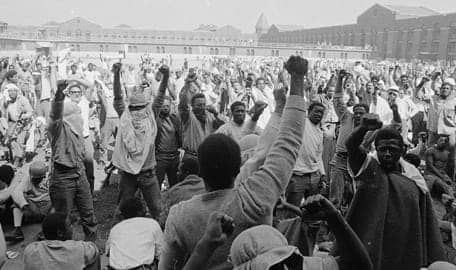
Why? One of the reasons is because these correctional officers, beyond the innate racism, fear another insurrection that will cause “state sanctioned killing,” as when former New York state Gov. Nelson Rockefeller ordered State Troopers and guards to open fire, massacring 41 prisoners and guards. Therefore, fear, terror and brutality are the measure of their false safety and security, none of which is a secret to the authorities in Albany.
In September 1971, there was a vibrant progressive and revolutionary movement in this country. The prison movement reflected the fightback determination of young people believing they could create a better world. On the streets there was a movement, and in prison there was a movement. No such animal exists today, at least nowhere near the level of the late ‘60s and early ‘70s.
Then there were “Free Political Prisoner” campaigns going on – the Free Huey, Free Angela, Free the Panther 21, Free the Soledad Brothers, Free the San Quentin Six campaigns that forged a national consciousness of fightback. No such broad political consciousness or campaign exists today.
 Hence, today’s prisoners reflect the drug and gang culture, much of which includes functional illiterates. Therefore, correctional personnel are not worried about these prisoners fighting back physically or legally. Some of the largest gains of civil rights for prisoners were in the ‘60s and ‘70s, when prisoners filed a multitude of lawsuits and had the assistance of progressive legal organizations. Today, the Supreme Court has severely restricted prisoners’ ability to file lawsuits and win.
The absent dynamic of a vibrant prison movement negatively impacts the capacity of prisoners to fight. Absent both community and legal support, in a confined repressive environment, prisoners can only be expected to survive and try and make it home alive. Attica, Comstock, Clinton and other New York state maximum security prisons suffer the same reality, all of which tells all of us of our collective failure.
It is my sincere hope, on this 40th year commemoration of Attica, that New York City’s activists recognize what for many inside prison seems to be abandonment. That they will decide to recognize the work that needs to be done to help restore the capacity for all of us to fight back for freedom!
Jalil Muntaqim is deeply embedded in the hearts of supporters of the San Francisco 8 for his extraordinary courage and self-sacrifice on behalf of his brothers. We especially should heed his words. Send our brother some love and light: Jalil Muntaqim (Anthony Bottom), 77A-4283, Attica Correctional Facility, 639 Exchange St., Attica NY 14011.