



by Khafre Jay
We don’t win by trusting this system. We win by telling the truth so loudly that it can’t operate in the dark.
That’s what this piece is about. This isn’t abstract for me. Kevin Epps is my friend. I’ve worked alongside him for years, and long before that, I was the kid in the house, jaw dropped, watching “Straight Outta Hunters Point” and realizing you could point a camera at our streets and treat them like history, not pathology.
The trial of filmmaker Kevin Epps isn’t just a legal fight, it’s a test of whether Black San Francisco will let one of our own be isolated, smeared and buried quietly — or whether we’re going to say, out loud, “We see what’s happening, and we’re not letting you do this in silence.”
The only real hope we have is us: our voices, our memory, our refusal to let them turn a Black father and documentarian into a caricature without a fight. This article is one small part of that refusal.
To understand why this matters, you have to know who Kevin is — and how “Straight Outta Hunters Point” turned a boy from the projects into one of the most important documentarians of Black San Francisco.
The filmmaker Hunters Point built
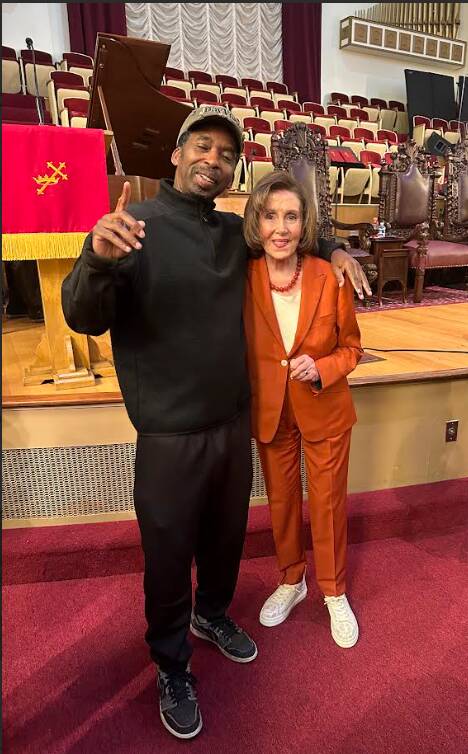
Kevin Epps is not some anonymous name on a docket. He stands in a direct line from James Baldwin’s “Take This Hammer” — that 1963 documentary where Baldwin walked the streets of Hunters Point and said, “This is the San Francisco America pretends does not exist.”
Three decades later, Kevin picked up that same thread from inside the neighborhood itself. Raised in the public housing projects of Hunters Point, the eldest child of a single Black mother, he didn’t come to film school through trust funds and Sundance labs. He took community classes at the old Film Arts Foundation, borrowed a Super 8 camera, and fought his way into directing his first short, “Ghetto Ganks!” — literally learning to shoot and cut with the neighborhood as his classroom.
“Straight Outta Hunters Point” was the turning point. For more than two years, Kevin walked those streets with a camera and let residents tell their own stories — about police, poverty, hustling and hope — in a way that Hollywood “hood classics” never allowed.
When the film premiered at the San Francisco Black Film Festival in the early 2000s and later screened at the Bayview Opera House, it hit like a flare shot into the fog: Here was a social history of Bayview Hunters Point made by someone who actually lived there, not an outsider parachuting in to collect misery.
The film didn’t just move audiences; it forced institutions to pay attention. “Straight Outta Hunters Point” has since been cited in academic work on urban redevelopment, environmental racism and gentrification in southeast San Francisco — alongside policy reports and planning documents — as evidence of what state neglect and corporate land grabs look like on the ground. You know a film has done its job when city planners, developers and scholars are all forced to wrestle with it.
From there, Kevin kept expanding the frame. “Rap Dreams” followed Bay Area rappers grinding for a shot at success, a conscious nod to “Hoop Dreams” and a refusal to let the industry reduce our people to stereotypes rather than whole human beings. “The Black Rock (Black Alcatraz)” turned its lens to the Black experience on Alcatraz and the carceral state. By the time this case came to trial, Kevin wasn’t just “a local filmmaker.” He was already one of the primary visual historians of Black San Francisco — the man who helped make sure Bayview Hunters Point couldn’t simply be erased on paper while it was being erased in real life.
In 2023, he took over as Executive Editor of the San Francisco Bay View National Black Newspaper, one of the last Black-owned newspapers in the Bay Area. He started dragging a 48-year-old liberation paper into the digital age — bringing in young voices, building social media reach, and preserving decades of Black history in print. Under his leadership, the paper began a deliberate push into digital storytelling, bringing younger voices into a publication that had long chronicled police violence, redevelopment battles, and the shrinking Black population of San Francisco.
Just two weeks before his murder trial opened, the Northern California Society of Professional Journalists honored Kevin with their “Silver Heart” award for “bringing fresh energy, multimedia storytelling and digital innovation” to that paper.
Remember that: This state is trying to cage a man it just finished handing a journalism award to. That contradiction is not an accident; it’s a message.
What happened in 2016 — and why the case is only now going to trial
In late October 2016, a confrontation inside a modest Glen Park home ended with one man dead and another in handcuffs.
The dead man, 45-year-old Marcus Polk, was homeless, estranged from his wife and children, and carrying a long record: domestic-violence convictions, a history of drug use, and a sex-offense case that had placed him under supervision. According to public records and news accounts, a clinician had recently warned parole officials that Polk could pose a risk to public safety because of his continuing substance abuse.
The man taken into custody was the man whose home it was, filmmaker Kevin Epps. Epps told authorities that Polk entered the home over his objections, that there were children in the residence, and that he fired in self-defense. California’s “castle doctrine” gives residents broad legal protection when using force — including deadly force — against someone they reasonably perceive as an intruder in their home.
Within days, then–District Attorney George Gascón declined to file charges, citing insufficient evidence and noting that self-defense appeared to be a significant factor. Epps was released. For three years, the case remained in that uneasy limbo familiar to many Black families: no conviction, but no real closure, either.
In 2019, the case abruptly returned. With a new team in the D.A.’s office, prosecutors charged Epps with murder, leaning heavily on a computer-generated “digital animation” prepared by a private firm, 3-D Forensic. The animation purported to reconstruct the shooting and suggested Polk had been shot in the back from a distance. Similar work by the same firm had already drawn scrutiny or been sidelined in other high-profile cases, including the trial over the killing of Chicago teenager Laquan McDonald.
Once the Epps trial finally began this fall — nine years after the shooting — that digital centerpiece began to fray. San Francisco’s chief medical examiner testified in pre-trial hearings that the exact path of the bullet could not be determined with precision, undercutting the scientific foundation of any definitive computer recreation. A crime scene investigator put the likely distance between shooter and victim at just a few feet, which is far more consistent with an up-close struggle than the image of a distant execution.
Other details proved equally unstable. GPS data from Polk’s ankle monitor turned out to be only roughly accurate within a wide radius. A maintenance worker first described Polk as “calm” that day. Still, earlier records showed he had told police Polk threatened him — severe enough that the worker felt compelled to file a report that could have jeopardized the family’s housing. Witnesses for the prosecution contradicted one another on whether Polk posed a threat and how volatile his visits had been.
What remains, after nearly a decade, is a case built on conflicting narratives, contested forensics and a timeline stretched so far that its revival inevitably raises questions beyond the narrow facts: not only about what happened in that house, but about why this case was resurrected at all — and why now.
Self-defense for White America, prison for Black defendants
The Epps case is unfolding against a backdrop of national research that paints a stark picture of who gets to claim self-defense in America — and who does not.
Analyses of “stand your ground” and related self-defense laws by the Urban Institute and others have found that when a white shooter kills a Black victim, those killings are far more likely to be ruled justified than when the races are reversed. One widely cited study of FBI homicide data concluded that white-on-Black shootings were roughly 10 times more likely to be deemed justified than cases involving Black shooters and white victims, even after accounting for other factors.
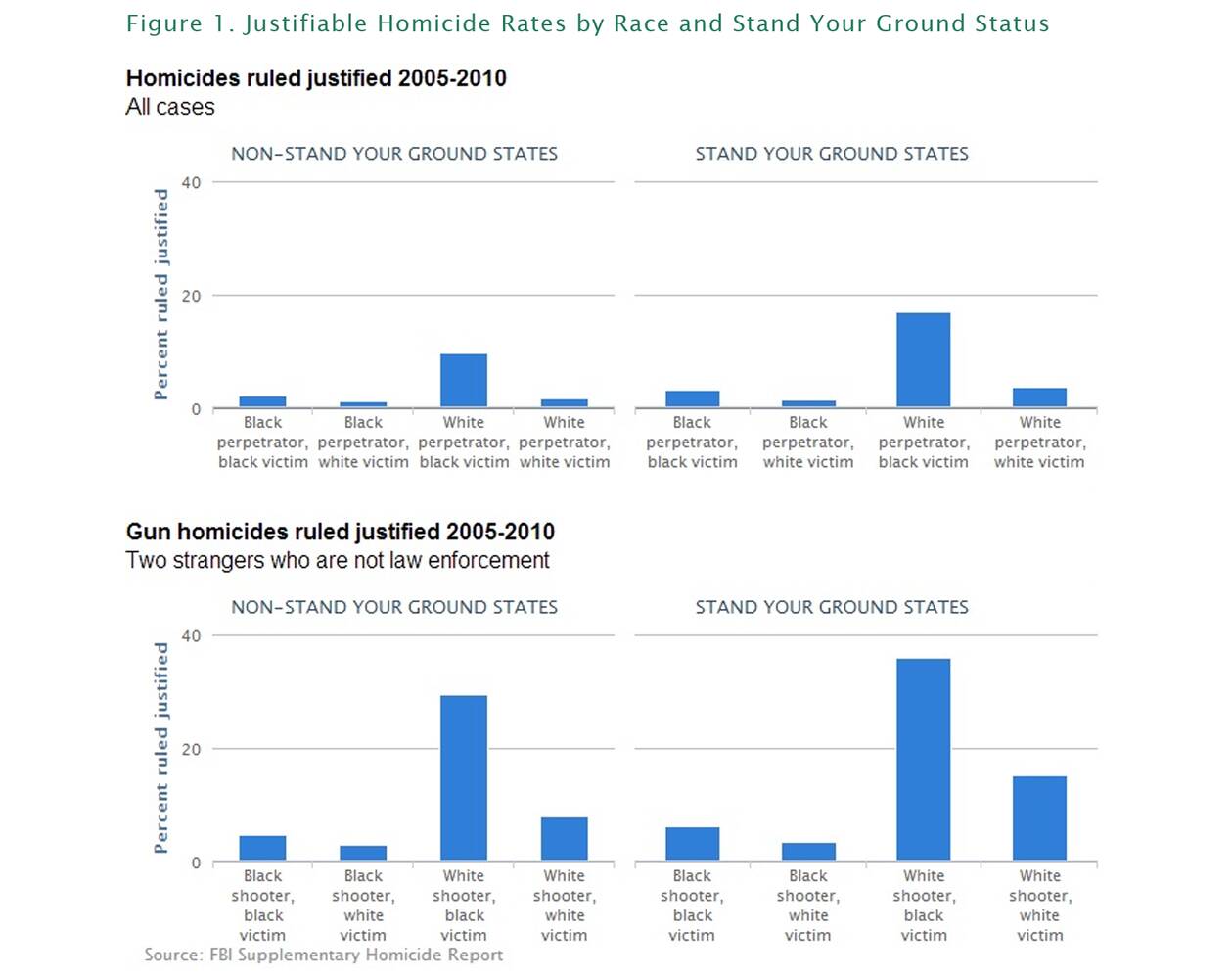
The statutes vary by state, but the pattern is grimly consistent: The benefit of the doubt travels with whiteness. The law may describe “castle doctrine” and “reasonable fear,” but in practice, Black fear is treated as suspicion and Black survival as an offense against the social order.
Viewed in that light, the outlines of the Epps prosecution take on a familiar shape.
- A Black father and filmmaker says he fired in defense, in his own home, with children present, against a man whose record and recent behavior had raised red flags even among clinicians and parole officials. A district attorney’s office that once declined to file charges later returns with a cinematic reconstruction that its own expert testimony struggles to support. A case that might once have been quietly closed as a difficult self-defense shooting is now pushed toward a full trial, with a Black defendant at its center and a city watching.
If Epps were a white tech executive in a more affluent ZIP code, would this nine-year legal odyssey look the same? There is no way to know with certainty. But decades of data on how self-defense is granted or denied suggest that the question is not just rhetorical — it is structural.
A district attorney’s office under its own scrutiny
The decision to revive the Epps case did not emerge from a vacuum. It comes from an office already under sustained scrutiny for its own conduct and priorities.
San Francisco District Attorney Brooke Jenkins rose to power after campaigning for the 2022 recall of her predecessor, progressive prosecutor Chesa Boudin. Since taking office, she has styled herself as a corrective — a “tough on crime” prosecutor who would restore order to a city she and her allies described as too lenient.
Her tenure, however, has drawn a different set of concerns. This spring, the State Bar of California quietly placed Jenkins into a diversion program to resolve ethics complaints, including allegations that she mishandled confidential criminal-record information during the recall campaign and misrepresented her role to the public. The program, which allows some attorneys to undergo remedial training without a formal finding of misconduct, is typically reserved for lower-level violations.
Separate reporting by local outlets has documented repeated clashes between Jenkins’ office and the public defender over late delivery of evidence in criminal cases — delays that judges have said risk violating defendants’ due process rights. And a retired judge filed (and is appealing) a State Bar complaint accusing Jenkins of fostering hostility toward the judiciary with inflammatory public remarks about local judges, underscoring a widening rift between the D.A.’s office and the bench.
The Epps prosecution sits inside this landscape. As American Community Media has reported, the same office that recommissioned a controversial digital animation in his case also moved quickly to drop charges against a San Francisco police officer who shot and killed an unarmed Black man, calling those earlier charges “politically motivated.” For many Black residents, the contrast is hard to ignore: leniency for law enforcement, maximal pressure for a Black civilian defendant.
None of this proves that the Epps case is animated by personal animus or political calculation. But it does mean the prosecution is unfolding under a cloud of broader questions: about prosecutorial discretion, about transparency, and about a system that has historically been far more forgiving of state violence than of Black self-defense.
What this trial is really about
On paper, the State of California is trying one man for one killing that took place on one afternoon in 2016. In reality, the trial of Kevin Epps reaches much further — back into the history of Bayview Hunters Point and outward into the broader question of whose lives the law is built to protect.
Epps came of age in a San Francisco that was still nearly 13 percent Black, when the Fillmore was called the Harlem of the West and Bayview Hunters Point, the Western Addition and Visitacion Valley were dense with Black families, churches, clubs and small businesses — not just “dangerous neighborhoods,” but living economies of music, labor and mutual aid.
Over the next few decades, the city he knew was systematically remade by design rather than fate. Redevelopment cleared Black blocks, but it was the policing strategy that finished the job. City Hall embraced a hard-edged, LA-style model of “crime control” that treated Black neighborhoods as potential war zones. When SFPD’s own scandals boiled over, the answer was not to ask Black communities how we wanted to be kept safe — it was to import Los Angeles command culture.
In 2009, San Francisco brought in George Gascón, a 30-year LAPD veteran and former assistant chief, to run SFPD and then promoted him to district attorney, cementing an LA-bred suppression mindset at the top of both the police department and the prosecutor’s office. Saturation patrols, gang units, “hot spot” crackdowns, and three-strikes prosecutions turned Bayview Hunters Point, the Fillmore, the Western Addition, and similar corridors into a domestic police state — an endless conveyor belt from traffic stop to arraignment to prison.
That is what helped kill San Francisco’s Black population: not mysterious demographic drift, but a decision to govern our neighborhoods through surveillance, cages and displacement, then blame our disappearance on “the market.”
Kevin Epps is now the next Black Man seated at the white man’s defense table: not an anonymous name in a case caption, but one of the primary documentarians of Black San Francisco. For his supporters, the symbolism is unavoidable. A neighborhood that has been poisoned, over-policed and priced out of its own homes is watching one of its best-known historians try to persuade a jury that his fear, in his own house, was legitimate. This is bullshit.
The legal questions for the jury are narrow: Was the shooting “legally justified”? Did the state meet its burden of proof? But outside the courtroom, the case has become a proxy for a larger set of questions:
- Who is allowed to be afraid and survive? Whose fear is treated as reasonable — and whose is criminalized? And in a city where Black residents now make up only a small fraction of the population, whose stories are allowed to end in freedom rather than prison?
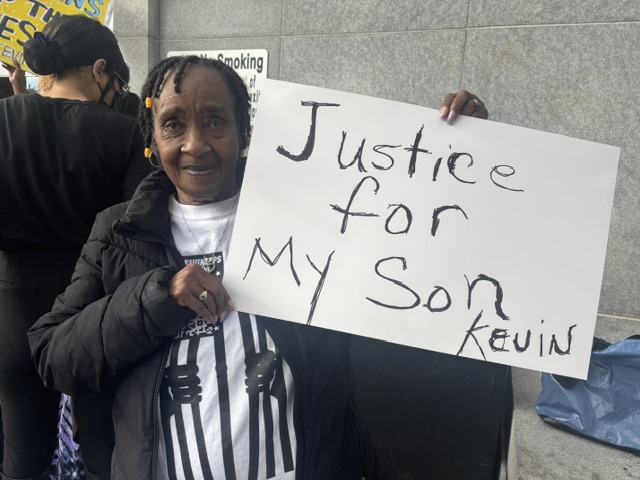
What we owe Kevin — and ourselves
At this stage, the question isn’t whether we “care” about Kevin Epps. It’s whether we are willing to turn that concern into something the system can actually feel.
The state has money, staff, experts and time. Kevin has a shrinking circle of days before a verdict and whatever community steps up around him. If we leave him to fight this alone, the outcome will not be mysterious — that’s how these cases are designed.
So this last part is not about analysis. It’s about logistics: what it looks like, concretely, to stand between a Black man and a machine that is trying to grind him down.
First, help Kevin fight the case in real time. Trials take a huge toll; they are meant to grind people down until they accept whatever the state offers. Kevin needs money to stay afloat. He is not currently receiving a salary because the Bay View newspaper is struggling to keep the lights on and can’t pay its miniscule staff. If you can give, give. If you can’t give much, give a little and share it widely. His official support fund is here: Donate to free Kevin Epps.
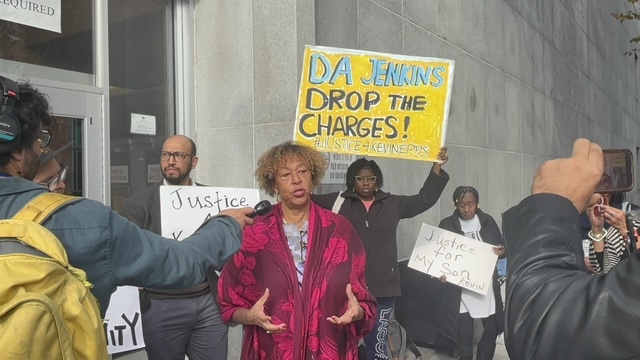
Second, amplify the demand that this prosecution end. There is a live petition calling on District Attorney Brooke Jenkins to drop the charges — not as a favor, but as a recognition that this case is soaked in racialized double standards and shaky evidence. Add your name, then send it to five people who don’t know Kevin but understand what happens when Black self-defense is criminalized.
Third, refuse to let this story be buried. Talk about this case in your group chats, union meetings, faith communities, organizing spaces and, yes, on every social platform you use. Share articles from Black outlets, such as the San Francisco Bay View. Push past the lazy headline version — “local filmmaker on trial” — and make sure people understand the actual stakes: self-defense, racial disparity, imported LA policing culture, and a D.A.’s office already under its own ethics cloud.
Fourth, if you’re in the Bay Area, show up. Pack the courtroom when you can. Stand with the family and community when they call rallies or press conferences. Judges and prosecutors notice who fills the gallery; so do reporters. A visible community presence says, “This man is not disposable, and neither are we.”
Fifth, strengthen the institution Kevin was fighting to save. If Kevin is one of the primary documentarians of Black San Francisco on film, the San Francisco Bay View National Black Newspaper is the paper archive of that same struggle. It’s the outlet that has covered police terror, redevelopment, prison abolition and Bayview Hunters Point long after mainstream media got bored and moved on. If you want to honor Kevin’s work, help keep his newsroom alive:
- Read and share the Bay View’s coverage at sfbayview.com. Subscribe, advertise if you can, and donate to keep Black editors, writers and photographers paid. When you talk about this case, link people back to the Bay View — the house Kevin was literally trying to hold up, even while the state was trying to pull him down.
None of this guarantees a happy ending. White supremacy has never promised us that. What it does guarantee is that when history looks back at this moment, it will not be able to say we shrugged and moved on. So pick one thing from this list — donating, signing, sharing, showing up or supporting the Bay View — and do it today. Then pick another.
Khafre Jay’s life work integrates Hip Hop Culture into business, education, and public health strategy, and he needs your help saving Black people. Movements don’t survive on applause; they survive on support. Please consider contributing if you believe in supporting Black labor and want to see his work thrive: Support free Reproductive Justice events for pregnant women in Bayview Hunters Point, the Bay Area’s only weekly Hip Hop Event in Berkeley, which is soon to expand to San Francisco, and Khafre’s Grassroots Job Program throughout the Bay Area. Your financial contribution, no matter how small, makes a massive impact on our community. Every dollar makes a difference in keeping this culture unapologetically alive. Become a monthly supporter here: https://www.hiphopforthefuture.org/donate.