



Tags Kagame regime
Tag: Kagame regime
Trigger-happy Rwandan police mow down prisoners
FDU-Inkingi, the United Democratic Forces of Rwanda, a coalition of groups opposed to the current Kagame regime, condemns the murder of five prisoners in Huye Prison in the night of Jan. 23, 2019, allegedly for their attempt to escape. It calls on the government to end this barbarism that has become common in detention at police stations and government prisons.
Rwanda: Kibeho Massacre of Hutu covered up to protect ‘genocide against...
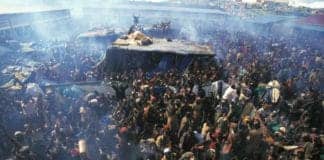
Twenty-two years ago, on April 22, 1995, Rwandan President Paul Kagame’s Rwandan Patriotic Army massacred between 4,000 and 8,000 Hutu men, women and children at the Kibeho Camp for internal refugees in southern Rwanda. I spoke to Rene Mugenzi, a Rwandan refugee, British citizen and human rights activist, who continues to seek acknowledgment and indictment for the crimes against humanity and, arguably, genocide committed at Kibeho in 1995.

Six years since Ingabire arrest, 20 since DRC invasion
Oct. 14 marked the sixth anniversary of Rwandan political prisoner Victoire Ingabire’s arrest, and Oct. 24 will mark the 20th anniversary of Rwanda and Uganda’s invasion and occupation of the Democratic Republic of the Congo. KPFA’s Ann Garrison filed this report on these intertwined anniversaries.

Ban Ki-moon: What about the people of the Congo?
Late last week, the Security Council approved the creation of what it called its first-ever “offensive” combat force, with a mandate to carry out targeted operations to “neutralize and disarm” the notorious March 23 or M23 militia, as well as other Congolese rebels and foreign armed groups in the eastern Democratic Republic of Congo. Until now, U.N. peacekeeping forces’ only explicit mandate has been the protection of civilians.
Withhold U.S. aid to speed end of atrocities in Congo
Over the last 16 years, more than 6 million lives have been lost in Congo – and the major perpetrators of those atrocities have been U.S. allies Rwanda and Uganda. The majority of victims have been children under the age of 5. Subsequent U.S. administrations have provided aid to the Rwandan and Ugandan regimes. The U.S. remains one of the top two donors of aid to Rwanda today.
Victoire Ingabire’s family faces her prison sentence in Rwanda
Earlier this week, a court in Kigali, Rwanda found Rwandan opposition leader Victoire Ingabire guilty of treason and denying the 1994 genocide against the Tutsis. KPFA’s Ann Garrison spoke to Ingabire’s daughter, Raissa Ujeneza. Ujeneza is a student of international and European law in the Netherlands.
Congo: What’s Rwanda got to do with it?
Rwandan political prisoner Victoire Ingabire is spending her second Christmas in Rwanda’s maximum security prison. Her ongoing trial, on charges of terrorism and genocide ideology, has implications not only for Rwanda, but also for the entire Great Lakes Region of Africa – most of all, for the Democratic Republic of Congo.
Conflict minerals: A cover for U.S. allies and Western mining interests?
As global awareness grows around the Congo and the silence is finally being broken on the current and historic exploitation of Black people in the heart of Africa, a myriad of Western based “prescriptions” are being proffered. Most of these prescriptions are devoid of social, political, economic and historical context and are marked by remarkable omissions. The conflict mineral approach or efforts emanating from the United States and Europe are no exception to this symptomatic approach which serves more to perpetuate the root causes of Congo’s challenges than to resolve them.