


Tags Doctors Without Borders
Tag: Doctors Without Borders

Poverty skolaz take Doctors Without Borders tour, ‘become’ displaced persons from...
The rubber sides of the boat were like arms – thick, round, hard. “These are the boats refugees have to travel in. Men sit on the side, the women, children and elders in the middle, sometimes getting splashed and sick with the leaking gasoline from the engine because they are covering miles of ocean to go from one country to another.” The tour guide from Médecins Sans Frontières, known in English as Doctors Without Borders, was narrating the “Forced From Home” traveling exhibit of removal, imperialist wars and NGO and government abuse of indigenous bodies across the Global South.
Wanda’s Picks for November 2017
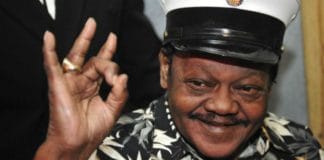
We pour libations for Fats Domino, New Orleans musical legend, who died Oct. 24. He was 89. The Architect of Rock n’ Roll was the child of Haitian Kreyòl plantation workers and the grandson of an enslaved African. And we also pour libations for Dennis Banks, co-founder of the American Indian Movement (AIM), who made his transition Oct. 30. He was 80. Congratulations to Drs. Vera and Wade Nobles on their 50th wedding anniversary this month.
Mumia’s fight for medical treatment
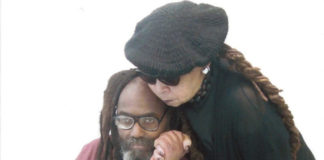
Protest Big Pharma’s price gouging that threatens Hep-C patients, including Mumia, on Monday, Jan. 11, 12 noon, at the JP Morgan Healthcare Conference for Big Pharma executives and investors at Westin St. Francis Hotel, 335 Powell St., Union Square, in San Francisco. Gilead Sciences sells the curative Harvoni pill in Egypt for 10 cents each, and Gilead does not lose money at this price. In the U.S., Gilead is price-gouging at about 10,000 times the cost of production!

The Blue Angels air show: San Francisco’s choice
Few aside from the USA’s military industrial giants have made more money on the Iraq War than California’s U.S. Sen. Dianne Feinstein and her husband, Richard Blum. The Blue Angels first came to San Francisco in 1981, when Feinstein was mayor. Will the MSF hospital bombing in Kunduz, Afghanistan, put a damper on San Francisco’s annual celebration of war and militarism? The Blue Angels are San Francisco’s choice. The Pentagon does not force them on San Francisco or any other city.

Physician Janette Sherman on US gun mania
On Oct. 3, U.S. forces shot up the hospital in Kunduz, Afghanistan, run by Doctors Without Borders, killing 12 staff and seven patients. This news upset me greatly. U.S. military personnel can remotely direct drones to kill whatever target they want to hit thousands of miles away. Americans have developed an amazing killing ability. This last week, 26-year-old Chris Harper-Mercer killed nine people and wounded nine at Umpqua Community College in Oregon.
Rwanda: Kagame’s spy chief Karake arrested in UK
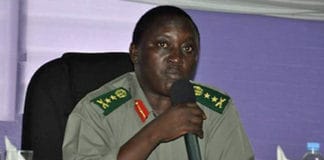
Rwandan intelligence chief Emmanuel Karenzi Karake was arrested last Saturday in London on a European arrest warrant. The warrant was based on a Spanish court’s 2008 indictment of Karake and 39 other top Rwandan officials for genocide – that is, the massacre of Rwandan Hutu civilians and refugees in Rwanda and the Democratic Republic of the Congo. KPFA’s Ann Garrison has the story.
United States Ebola death raises questions about quality of care
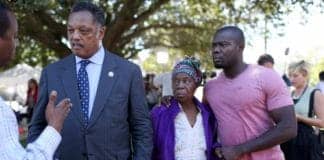
There was a sense of shock and disbelief when news was released about the death of Thomas Eric Duncan on Oct. 8 at the Texas Health Presbyterian Hospital in Dallas. The Liberian-born 42-year-old was the first reported case of the Ebola Virus Disease (EVD) which emerged in the U.S. and resulted in death. Reports during the week of Oct. 6 mentioned that Duncan’s medical condition was worsening and that he was “fighting for his life.”
IRS attacks Cuba-supporting IFCO for fiscally sponsoring Viva Palestina
In addition to condemning IFCO for its support of Viva Palestina, the IRS has also attacked our years of solidarity work with Cuba. In both instances our legal advisor eloquently described work we have historically done to advance the struggles of oppressed people for justice and self-determination. The projects we support and operate have faithfully furthered our mission and our organization’s tax-exempt purpose, as it was originally described.
Congo Genocide: Will Obama’s America collaborate or refuse?
Cholera has broken out in the internally displaced persons camps growing again in eastern Congo, as Congolese people flee the war which, with backing from the Kagame regime in Kigali, Rwanda, resumed in April. The cholera outbreak has sparked fears of an epidemic. Now drenching rain is adding to the refugees’ misery. U.S. Special Forces are in the region, but not to hunt for Joseph Kony. It’s a military operation to secure oil and other African resources and limit Chinese access.
West funds full blown genocide in Ethiopia
For the past four years all aid agencies, including the Red Cross, Doctors Without Borders and U.N. relief agencies, have been blocked by the Ethiopian military from feeding starving people in Ogadenia. There are millions of starving people, maybe as many as 6 million, though no one can say for sure because no one is allowed into the region.
Western funded genocide: Ethiopia and the Ogaden
Ethiopian troops are in the oil rich, contested Sudanese Abyei region in accordance with a new U.N. Security Council resolution invoking sovereign nations’ “responsibility to protect” vulnerable populations from genocide and mass atrocities if their own governments aren’t protecting them. But what about Ethiopia’s own genocide in the Ogaden Basin that the West is funding?
WikiLeaks: Haiti’s elite tried to turn the police into a private...
Leading members of Haiti’s bourgeoisie tried to turn the Haitian police force into their own private army, according to a secret U.S. Embassy cable provided to Haïti Liberté by the media organization WikiLeaks.
Cholera cases emerge in Haiti’s capital
Cholera, a "disease of poverty" caused by lack of access to clean water, has spread to Haiti's capital city of Port au Prince. At a small, desolate camp of ripped tents nearby, a gleaming water tank is propped up on bricks. But it’s empty.
Haiti: Upscale school tries to expel 11,000 families camping on its...
For decades, the Saint Louis de Gonzague school has groomed some of Haiti’s most elite political players. Francois Duvalier, the iron-fisted dictator who ruled Haiti for 14 years, sent his son to the school. Now its grounds are home to nearly 11,000 Haitian families, driven out of destroyed neighborhoods in central Port au Prince.
Wanda’s Picks for April
Set on the banks of the Mississippi during the Civil War, "…and Jesus Moonwalks the Mississippi" is a poetic journey of forgiveness and redemption inspired by the myth of Demeter and Persephone. This thought-provoking play combines traditional storytelling, gospel music and a wicked sense of humor to create a rich, imaginative world that allows trees to preach, rivers to waltz and Jesus to moonwalk. The run has been extended through April 25.
Haiti’s earthquake victims in peril
In the weeks since the devastating earthquake in Haiti, familiar patterns of interference and neglect by the major powers that dominate the country are firmly entrenched. Notwithstanding heroic efforts of ordinary Haitian people, Haitian government officials and agencies and many international organizations, a grave health risk hovers over the people and the direction of Haiti’s reconstruction remains entirely undetermined.
Haiti: ‘Disaster capitalism on steroids’
“Two months after the devastating earthquake, the situation in Haiti is downright criminal,” says Robert Roth. According to the spokesperson for the activist network Haiti Action Committee, major Western players such as the U.S. are more interested in defending their own geopolitical interests in Haiti than truly helping the hard hit Caribbean country.
Venezuela steps up aid effort to Haiti, questions U.S. military deployment
Venezuela was the first country to send aid after the disaster struck on Jan. 12, with an advance team of doctors, search and rescue experts as well as food, water, medical supplies and rescue equipment arriving in Port-au-Prince on the morning of Jan. 13. The Venezuelan government is doing everything in its power to provide as much help as possible while at the same time respecting the independence and sovereignty of Haiti.
Haiti: NGOs and relief groups call for immediate and widespread distribution...
Dr. Evan Lyon of Partners in Health stated, “There’s also no violence. There is no insecurity.” He said the security concerns are being overstated due to “misinformation and rumors … and racism.” In a week since the earthquake, the U.S. had airlifted only 70,000 bottles of water for 3 million people in need.
Congo Week: an interview wit’ Kambale Musavuli, spokesman for Friends of...
Coltan is a mineral necessary for making electronic things work – like cellphones, ipods, PS3s and laptops. Over 6 million Congolese have been murdered to assure that the corporations and governments involved have a corner on the market for the minerals that the Congo produces. This is "Break the Silence" Congo Week. Check out the events and get involved!