
 Store
Store


Tags Great Lakes region of Africa
Tag: Great Lakes region of Africa
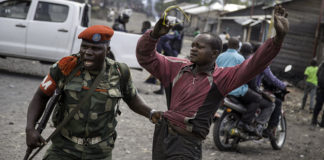
Congolese youth look to chart a new path in the heart...
The path forward for many Congolese youth is clear. They want to be free from tyranny more than the Kabila regime wants to repress them and deprive them of their God-given life pursuits. In the Congo, the youth are prepared for a sustained civil disobedience undertaking to cripple and ultimately remove an oppressive system that not only kills them but also squelches their aspirations and hopes for a dignified life.
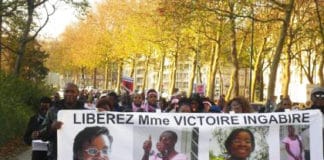
Rwandan Belgians protest inhumane incarceration of Victoire Ingabire
Earlier this week, supporters of iconic Rwandan political prisoner Victoire Ingabire, including her daughter and new granddaughter, gathered to protest her inhumane prison conditions. Members of her party in Kigali report that prison authorities have painted her only cell window black, taken away her books and put her in harsher isolation than before. Prison authorities are denying her legal right to meet with the Rwandan lawyer who’s representing her in her appeal to the African Court of Human and People’s Rights.
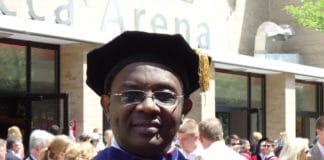
The voice of reason regarding Burundi
Dr. Charles Kambanda’s essay, which was first posted to the Facebook forum Friends of Reason brought reason to the discussion of presidential term limits in Burundi, which had been overwhelmed by propaganda and fearmongering about the renewal of ethnic violence between Hutus and Tutsis in the tiny East African nation. KPFA’s Ann Garrison, who studies and participates in the Friends of Reason Facebook forum, spoke to Dr. Kambanda.
Increasing instability and political repression in African Great Lakes Region
Instability and political repression are increasing in the Great Lakes Region of Africa, as the presidents of Burundi, the Democratic Republic of the Congo, and Rwanda seek to remain in power beyond constitutional term limits. Rwandan and Ugandan troops crossed into the Democratic Republic of the Congo this week, sparking fears of another catastrophic regional war. Burundi is another pressure point further destabilizing the region.
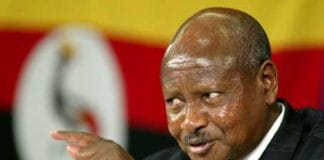
Uganda’s Museveni to seek re-election in his 30th year in office
Three presidents in the Great Lakes Region of Africa, Burundi’s Nkurunziza, DR Congo’s Kabila and Rwanda’s Kagame, are all doing their best to stay in office beyond constitutional term limits. Ugandan President Yoweri Museveni, however, doesn’t have to overcome term limits because Uganda’s Parliament abolished them in 2005. He has already announced that he will run again in 2016, his 30th year in office.
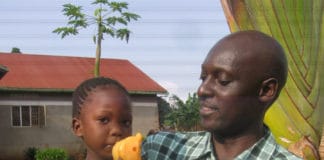
A Ugandan doctor describes the real ‘Ebola Hot Zone’
In a recently published open letter to 60 Minutes, the CBS TV news magazine, former New York Times Africa correspondent Howard French expressed concern about the program’s “frequent and recurring misrepresentation of the African continent.” Dr. Edmund Lubega says, “As Africans, it would be good if we could organize ourselves and try to find means by which we can share and broadcast our stories in our own way, in our own words.”

A call for truth and justice in the African Great Lakes...
On Oct. 1, 2014, BBC2 broadcast a documentary, “Rwanda’s Untold Story,” on the tragedies which have devastated the Great Lakes Region of Africa since 1990. The signatories of this appeal wish to congratulate and express their support to the BBC journalists and management who have significantly contributed to establishing the previously ignored historical truth.
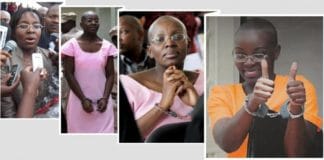
‘Friends of Victoire’ launched to free Rwandan political prisoner Victoire Ingabire
In January 2010, Rwandan opposition leader Victoire Ingabire Umuhoza returned from The Netherlands to Rwanda to attempt to run against sitting President Paul Kagame. She said she knew that she would be either assassinated or imprisoned, and she is now entering the fifth year of a 15-year prison sentence. KPFA’s Ann Garrison spoke to Marie Lyse Numuhoza, the founder of Friends of Victoire, a new organization created to fight for her freedom.
Rwandan prisoner Victoire Ingabire takes case against Rwandan regime to international...
After becoming the leader of the Rwandan Diaspora’s opposition to the authoritarian regime of Rwandan President Paul Kagame, Victoire Ingabire returned to Rwanda to run against him in the 2010 election. She was instead placed under house arrest shortly after her return and is now serving a 15 year sentence. This week the African Court of Human and People’s Rights agreed to hear her case on appeal, in Arusha, Tanzania.
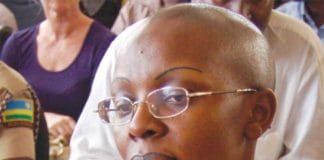
Rwanda attacks political prisoner Victoire Ingabire’s family (with French translation)
Victoire Ingabire has become an icon of peace and democracy in the war ravaged Great Lakes Region of Africa. She returned to Rwanda in 2010, announcing her intention to run against sitting Rwandan President Paul Kagame, who responded by imprisoning her instead. Opponents in Rwanda are neutralized, and they try to do that with people abroad too. This is what is happening now with Victoire Ingabire’s husband Lin Muyizere.
Rwanda 2014: 24 years after the Ugandan invasion
Twenty-four years after the Ugandan invasion of Rwanda in October 1990, both the history of the four-year war that followed and realities of life on the ground in Rwanda today are fiercely disputed. Claude Gatebuke survived the violence and founded the African Great Lakes Action Network (AGLAN) to promote truth and reconciliation in Rwanda and the rest of the Great Lakes Region of Africa.
Democratic Republic of Congo: A prescription for lasting peace and stability
The 17-year quest for peace in the Democratic Republic of Congo has taken a significant step in the right direction; however, many concerns remain. Last week the Congolese military routed the Rwanda- and Uganda-backed M23 and declared an end to its reign of terror against the Congolese people.
US takes one more step toward isolating Rwandan warlord Paul Kagame
On Oct. 3, 2013, the U.S. State Department announced sanctions against Rwanda because of its support of the M23 militia that uses child soldiers in the eastern Democratic Republic of Congo. Rwandan President Paul Kagame has used child soldiers known as Kadogo ever since he invaded Rwanda from Uganda with his refugee Rwandan Patriotic Army in 1990, beginning what came to be known as the Rwandan Civil War.
In Tanzania, did Obama call out ‘Congo’s neighbors’ strongly enough to...
In Tanzania, President Obama said, “The countries surrounding the Congo, they’ve got to make a commitment to stop funding armed groups that are encroaching on the territorial integrity and sovereignty of Congo.” As the U.S. calls on its allies to cease funding armed groups in the Congo, the U.S. should cease funding of Rwanda and Uganda.
Ban Ki-moon: What about the people of the Congo?
Late last week, the Security Council approved the creation of what it called its first-ever “offensive” combat force, with a mandate to carry out targeted operations to “neutralize and disarm” the notorious March 23 or M23 militia, as well as other Congolese rebels and foreign armed groups in the eastern Democratic Republic of Congo. Until now, U.N. peacekeeping forces’ only explicit mandate has been the protection of civilians.
Women of the Congo decry U.S. neocolonialism
This letter, signed by Diaspora Congolese women in the U.S., U.K., Belgium, France and South Africa, was delivered to Ambassador Carson on March 20. We are writing to you with regard to the current U.S. policy position on “Lasting Solution to Instability” in the Democratic Republic of the Congo (DRC), which you presented on Feb. 11, 2013, at the Brookings Institution in Washington, D.C.
Obama administration official provides insights on U.S. Congo policy
On Monday, Feb. 11, outgoing Assistant Secretary of State for African Affairs Johnnie Carson presented an outline of the Obama administration’s policy position on the situation in the Democratic Republic of the Congo. The purpose of Ambassador Carson’s presentation was twofold: discussing why efforts should be redoubled to bring stability to the Congo and laying out a framework for “moving forward.”
Sanford Weill and Paul Kagame: Doctors of Humane Letters?
On May 12, Sonoma State University awarded honorary doctorates in humane letters to former Citigroup CEO Sanford Weill and his wife Joan, paid for with a $12 million “donation.” On the same day, William Penn University awarded an honorary doctorate in humane letters to Rwandan President Paul Kagame, despite his army’s atrocities in Rwanda and Congo.
Congo: What’s Rwanda got to do with it?
Rwandan political prisoner Victoire Ingabire is spending her second Christmas in Rwanda’s maximum security prison. Her ongoing trial, on charges of terrorism and genocide ideology, has implications not only for Rwanda, but also for the entire Great Lakes Region of Africa – most of all, for the Democratic Republic of Congo.
Rwanda: Victoire Ingabire’s daughter calls for world pressure on Kagame
Victoire Ingabire left Rwanda almost two years ago in January 2010 to return to her native Rwanda in hopes of challenging Rwandan President Paul Kagame in the country’s 2010 presidential election. Her party was not allowed to register, she was not allowed to run, and she has spent the last year not as the president of Rwanda, but as a prisoner in Kigali’s 1930 maximum security prison.