


Tags Alfred Sandoval
Tag: Alfred Sandoval

Agreement to End Hostilities
The Agreement to End Hostilities, envisioned and written by the Best of the Best, is perhaps the most powerful document to be created in the past 50 years, a testament to the power of unity, and today a Blueprint for the possibilities for humanity globally.

Liberate the Caged Voices: Where’s the humanity?
“Where is the humanity in that?” asks Nube Brown who pulls the lens in tight on the inhumane policies of the Prison Industrial Slave Complex perpetrated on all human beings suffering prison atrocities of torture, dehumanization, exploitation, extraction, starvation, death by health neglect and physical abuse, while making billions off the backs of those they hold captive.

Who really is the ‘Worst of the Worst’?
Alfred Sandoval digs deeper into the label “Worst of the Worst.” Sandoval deftly explores how this label is applied as an apparatus sustaining fear of each other, us (out here) and them (in there), thereby deflecting attention away from those who aggravate and sustain oppression.

Liberate our elders! California Prison Focus demands Gov. Newsom protect peacemakers...
Support demands by CPF and the Prisoner Human Rights Movement that Gov. Newsom release all state prisoners who are medically fragile or over 60, starting with the authors of the Agreement to End Hostilities and followed by the remaining members of the Ashker Class Action Settlement.

Prisoner Human Rights Movement Blue Print
CDCr has systemic and dysfunctional problems that run rampant statewide within California’s prisons for both women and men which demand this California government to take immediate action and institute measures to effect genuine tangible changes throughout CDCr on all levels. The Prisoner Human Rights Movement Blue Print is essentially designed to deal with identifying and resolving primary contradictions by focusing on the various problems of CDCr’s dysfunction.

Pelican Bay Hunger Strike: Four years and still fighting
Four years ago prisoners in California – led by those in the control units of Pelican Bay – organized a hunger strike to demand an end to the torturous conditions of solitary confinement. Two more strikes would follow, with over 30,000 prisoners taking united action in the summer of 2013 – both in isolation and in general population in nearly every California prison. Current prison organizing continues a historic legacy of struggle.

The Agreement to End Hostilities must be re-implemented in all California...
It has been two years since our Agreement to End Hostilities was released in October 2012, and we continue to stand united. While there have been a few conflicts here and there, we need to commit to ceasing all racial hostilities towards one another and remain peacefully united throughout all prison facilities. By re-reading and re-committing ourselves to the Agreement to End Hostilities, we are taking back control of our own lives and our own futures.
California prisoner representatives: All people have the right to humane treatment...
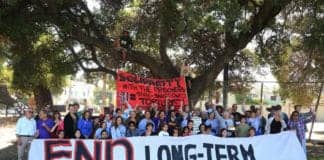
We are the prisoner class representatives of what’s become known as the PBSP SHU Short Corridor Collective Human Rights Movement. Last month we marked the first anniversary of the end of our historic 60-day Hunger Strike. Oct. 10 we mark the two-year anniversary of the Agreement to End Hostilities. This is an update on where things stand with our struggle to achieve major reforms beneficial to prisoners, outside loved ones and society in general.

Calipatria riots need to cease and unity needs to spread
Men at Calipatria on general population yards A, B and C can show the same courage as the hunger strikers, who are honored around the world, by pledging to respect the Agreement to End Hostilities and stop all fighting and riots between racial groups. The Agreement must continue to hold within all California prisons and unity needs to spread across the state. Only then can justice be won.
California prisoners suspend 60-day hunger strike – families, legislators respond
Representatives of the Short Corridor Collective at Pelican Bay State Prison’s Security Housing Unit have based their decision on a meeting with fellow prisoners at the prison, the growing international condemnation of California’s practice of solitary confinement, as well as the commitment of California Senate and Assembly Public Safety Committee Chairs Loni Hancock and Tom Ammiano to convene a series of hearings in response to the strikers’ demands that would “address the issues that have been raised to a point where they can no longer be ignored.”
Hunger striker responds to Corrections Secretary Beard’s op-ed demonizing hunger strikers
Today I read an op-ed from the L.A. Times by the new secretary of the California Department of Corruption. He gave a one sided view of prison violence by talking about the 11 murders of guards in the three years between 1970 and 1973. He failed to mention the 39 inmates murdered between January 1987 and December 1995 in the guard staged gladiator “game” fights.
Hunger strike rally at Corcoran Prison: The sound before the fury
It is hot enough in Corcoran, California, to melt people. That being said, it still wasn’t hot enough to keep upwards of 400 people from braving 103-degree weather to mobilize and rally at Corcoran State Prison in support of over 30,000 prisoners on hunger strike in California. The immediate goal is to stop the cruelty and torture that being held in isolation represents. The long-range objective is liberation.
If only you could see our beat up and emaciated bodies
Since the last hunger strike, the administration via the “Office of Corruptional Security” has instituted documented military torture tactics here at Pelican Bay State Prison in order to create hostile living conditions and attempt to turn prisoners on each other. But many of us have seen these tactics before, so we know how to deal with it.
They circle like vultures
The new draft Step Down Program allows for any CO (correctional officer) or staff member to have any prisoner placed in SHU for anything they deem necessary, citing safety and security and public safety, even without any disciplinary action. Many of us have seen first hand the abusive nature of sadistic, racist and misogynistic CO staff who fabricate information to “break” prisoners.
Open letter to Gov. Jerry Brown: Stop the torture now
We oppose CDCR’s policies and practices relating to our subjection to decades of “status”-based, indefinite isolation; this includes our opposition to CDCR’s proposed policy changes, entitled “Security Threat Group Prevention, Identification, and Management Strategy.” We would appreciate your supportive intervention on this issue.
California prisoners make historic call to end hostilities between racial groups...
Prisoners in Pelican Bay’s SHU have announced a push to end all hostilities between racial groups within California’s prisons and jails. The handwritten announcement, sent to prison advocacy organizations, is signed by the PBSP-SHU Short Corridor Collective. The statement calls for the cessation of all hostilities between groups to commence Oct. 10, 2012, in all California prisons and county jails. It also calls on prisoners throughout the state to set aside their differences and use diplomatic means to settle their disputes.
Without the federal overseer, deaths caused by inadequate medical care will...
As a prisoner at Pelican Bay’s Short Corridor, I had to laugh in disgust at the audacity of the Department of Corruption’s motion to rescind the medical receiver appointed by the federal court after decades of inadequate medical care. Here at Pelican Bay’s SHU, it is common knowledge that the Institutional Gang Investigation (IGI) Unit actually make the medical decisions by way of the chief medical officer.
Prisoners in solitary confinement petition United Nations: ‘CDCR destroys our minds,...
Comparing their conditions to a “living coffin,” 400 California prisoners held in long-term or indefinite solitary confinement petitioned the United Nations Tuesday to intervene on behalf of all of the more than 4,000 prisoners similarly situated. California holds more prisoners in solitary confinement than any other state in the United States or any other nation on earth. Conditions inside California’s SHUs and ASUs were at the center of two massive waves of hunger strikes last year that saw the participation of thousands of prisoners in at least a third of California’s 33 prisons.
Prisoners tell the world about the horrors of California prison isolation
The Center for Human Rights and Constitutional Law believes that the treatment of California prisoners placed in Administrative Segregation Units and Security Housing Units should be brought before the United Nations. Placing thousands of prisoners in segregation for long periods of time is one of the most serious mass human rights violations taking place in the United States today. On Tuesday, March 20, 10-11 a.m., at the Ronald Reagan State Building, 300 South Spring St., Los Angeles, join the press conference to release a petition calling for a United Nations investigation.
How the hunger strike started for me
I had never believed in hunger strikes, thinking that they’re counter-productive. However, when the gang unit began to work in concert with the chief medical officer, I decided to participate in this and the next hunger strike. Here's why.