



Tags M23
Tag: M23
DRC’s Virunga: Park, gorillas and rangers all under attack
The most violent and threatening predators are both foreign and native actors who want to get the rangers, people and wildlife, especially the gorillas, out of the way to ransack the park’s resources.
Congo: Millions die while the UN keeps the peace
“There’s been killed 8 million people and you say you’re making fictitious peace and you’re telling us that this is peace when aggressors are not named!” – Congolese Swiss historian Bénédicte Kumbi Njoko
Divide and rule: Balkanizing the Democratic Republic of Congo
Syria has long dominated international headlines while the big powers discuss the possibility of dividing it into smaller, more homogeneous states along ethnic or religious lines. The Democratic Republic of Congo is rarely if ever at the top of the Western headlines, but heads of state and so-called experts have long made similar proposals to carve out new, smaller, more homogeneous nations in Congo’s resource-rich eastern provinces. I spoke with Congolese scholar and activist Boniface Musavuli about the plans.
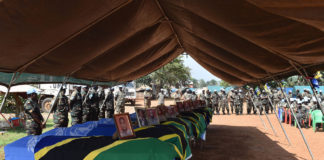
Uganda attacks Congo’s Beni Territory just in time for Christmas
The Congo crisis is now one of the greatest humanitarian emergencies in the world and the most underreported. An average of 5,500 people a day flee violence and insecurity, even more than in Iraq, Syria, and Yemen. Unlike Iraq, Syria, and Yemen, however, the Congo wars are undeclared and there’s no front line. There are instead many wars over many concentrations of resource wealth in this immensely resource-rich country, especially in the eastern provinces.
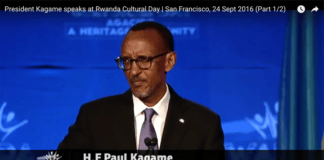
Rwanda Day San Francisco: Bay View journalists get the boot
Rwanda Day-San Francisco was a bad day for identity politics. Rwandan President Paul Kagame stepped to the podium and said that he was happy to be in San Francisco because it’s so diverse, seeming not to understand that his guest speaker, Rev. Rick Warren, champion of the 2008 Prop 8 ballot measure banning same sex marriage, wouldn’t appeal to San Francisco’s diverse population.
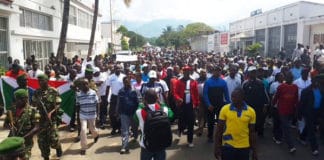
Burundi: Senate Foreign Relations Subcommittee hears testimony on political crisis
Burundian insurgents attacked three army bases early Friday morning. Fighting continued through the night and the dead in Burundi’s streets were estimated to be as high as 89 this morning. The government and opposition told conflicting stories about who the dead were and how they died. Two days before the latest attacks, a U.S. Senate Foreign Relations Subcommittee held a hearing on the situation in Burundi. KPFA’s Ann Garrison has this report.
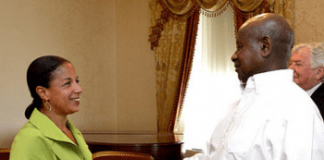
Rice and Museveni shake hands on crimes in Central Africa
During the first week of May, President Obama’s National Security Council (NSC) Advisor Susan Rice met with Ugandan President Yoweri Museveni in New York City. NSC spokesperson Bernadette Meehan then released a statement about their conversation. Ugandan American journalist Milton Allimadi, writing in the New York City-based Black Star News, called the NSC release “newspeak on steroids.” This is a conversation with Milton Allimadi.

Stop Rwanda and Uganda in DR Congo; implement Obama’s Congo bill
In accordance with President Obama’s Congo bill, the U.S. should withhold aid to Rwanda and Uganda and impose sanctions on its presidents and other government and military officials, whose culpability for cross border wars of aggression and illegal resource extraction in the Democratic Republic of the Congo have long since been documented.
Will the world remain silent with Rwanda and Uganda in DR...
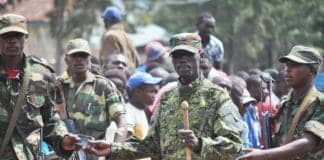
Rwandan and Ugandan troops have been reported in the Democratic Republic of Congo during the past two weeks, but reporting is scant and neither the U.S., the U.N. Security Council nor any other members of the international community have spoken to this, the latest Rwandan and Ugandan violation of Congo’s sovereignty. The international community has instead been focused on the constitutional crisis in Congo’s neighbor, Burundi.
Congo’s problems are Museveni, Kagame and Kabila, not the FDLR
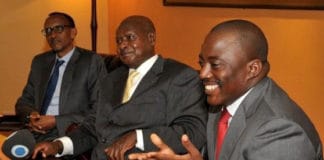
Potentially catastrophic military operations, authorized by the U.N. Security Council, may lie ahead soon for the Democratic Republic of the Congo. The U.N. Security Council has urged the Congolese army to join U.N. combat troops from South Africa, Tanzania and Malawi in hunting down the Democratic Forces for the Liberation of Rwanda, a Rwandan refugee militia commonly known as the FDLR.
Feingold dismisses fears of regional war in DR Congo
Former Wisconsin senator, now U.S. special envoy to the Great Lakes Region and the Democratic Republic of the Congo Russ Feingold held an online press conference with members of the African press in Africa earlier this week. He said that the FDLR had not surrendered enough of its troops to satisfy the U.N. Security Council’s requirement and that military action was therefore required.
Rwanda and Uganda deploy FDLR excuse, threaten cross-border war in Congo
Rwanda and Uganda are threatening to send troops across their borders with the Democratic Republic of the Congo yet again to, they say, eliminate the Hutu refugee militia known as the Democratic Forces for the Liberation of Rwanda, or FDLR. Going after the Hutu refugee militia has been Rwanda and Uganda’s excuse for crossing into Congo for the past 18 years, since the outset of the First Congo War in 1996.
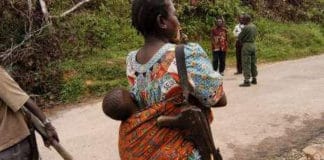
Tired of being gang raped, Congo mother takes up weapon
The Congolese woman in eastern Congo – the rape capital of the world – has gotten tired of being gang-raped, of being mutilated, of having 3-to-5-foot wooden sticks shoved through her genitals after being gang-raped, then being killed or buried alive. So she has taken up a weapon now in order to defend her baby, her own body, her humanity, her village, her community and her country, the Democratic Republic of the Congo.
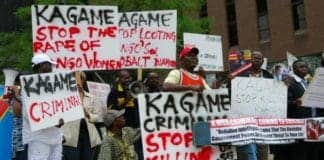
Kagame started the genocide in Rwanda, then Congo
President of Rwanda, Paul Kagame, is organizing what he calls Rwanda Day in the city of Atlanta. The United States, which takes pride in its democratic history, and the City of Atlanta, which played such a proud role in the American Civil Rights Movement led by Dr. Martin Luther King, cannot want to appear to the world as supporters of dictatorship and mass murder, but allowing Paul Kagame to organize “Rwanda Day” in Atlanta tells the world that they are.
Open letter to American universities that invited Kagame to speak
As a coalition of Africa-focused human rights and peace organizations representing a broad range of individuals, we write to express our dismay at your decision to welcome President of Rwanda Paul Kagame to your universities. We regret to inform you that your invitation of Paul Kagame to your institution co-signs his repressive practices inside Rwanda and his aggressive interventions in neighboring Democratic Republic of the Congo.
Rwanda: Absolute power at any price
Gen. Paul Kagame ordered the shooting down of the plane in which President Habyarimana and President Cyprien Ntaryamira of Burundi, French citizens, and all others on board were killed on April 6, 1994. This assassination triggered the genocide. Since then President Kagame has imposed a reign of terror to keep himself and the ruling party in absolute power.
Kagame visit should not go without scrutiny
Rwandan President Paul Kagame visited Tufts April 22 to speak on his country’s recovery from genocide, but it’s important to remain aware of the darker parts of Kagame’s tenure. On Friday, April 25, he’s coming to Stanford, and students of Stanford STAND are calling a protest for 11 a.m., prior to Kagame’s speech at the Stanford Graduate School of Business 12-1 p.m. in CEMEX Auditorium. Join them!
M23’s creators and commanders are in Rwanda and Uganda
The Congolese army, with the help of the UN Force Intervention Brigade, decisively defeated the M23 militia in the Democratic Republic of the Congo’s eastern Kivu Provinces this week, but many Congolese, Rwandans, and Ugandans, are asking why the Democratic Republic of the Congo is now engaged in peace talks with the M23, and not with Rwandan President Paul Kagame and Ugandan President Yoweri Museveni.
Letter to my Rwandan, Ugandan and Congolese brothers and sisters celebrating...
Rwanda’s M23 has finally been defeated in DR Congo, but what are we to make of DR Congo negotiating with M23, not Rwanda’s Kagame and Uganda’s Museveni? M23 was commanded by Rwanda’s top military officers and officials, but its collaboration with Uganda is clear to anyone who gives the Great Lakes Region any attention, as is Rwanda and Uganda’s collaboration with the Western powers.
Negotiate? For whose land? Congo, Rwanda and Rwanda’s M23
The Congolese army has pushed Rwanda’s M23 back by about four miles in recent days, and U.N. envoy says that their success makes this a good time to negotiate. Jean-Mobert N’senga, an activist lawyer in Goma, and his group, Fight for Change, agree but say the Democratic Republic of the Congo needs to negotiate with Rwanda, not M23.