



Tags Kinshasa
Tag: Kinshasa
Rwanda and Zaire (DRC) 1990 to 1997, where the US blocked...
What the US wanted, according to what the evidence shows much later, was for Kagame to seize power. It wanted to let his military campaign proceed and it wanted Tutsi genocide to serve as justification for that regime change.
DRC’s Virunga: Park, gorillas and rangers all under attack
The most violent and threatening predators are both foreign and native actors who want to get the rangers, people and wildlife, especially the gorillas, out of the way to ransack the park’s resources.
Congolese protest election delay: ‘Non Kabila Rwandais’
A widely feared and anticipated military attack by U.N. and Congolese troops on the FDLR has not materialized, despite U.N. Special Envoy Russ Feingold’s repeated urgings. Instead, this week, the people of the Democratic Republic of Congo rose up in the streets to demand that their Parliament not pass legislation allowing Congolese President Joseph Kabila to extend his stay in office beyond constitutional term limits. KPFA’s Ann Garrison has the story.

From Burkina Faso to the Congo: Challenging the quest for president...
The dominant challenge facing Congolese people is the lengths to which President Joseph Kabila will go to maintain a stranglehold on power. This unresolved question represents the greatest threat to peace and stability in the Democratic Republic of Congo. It will continue to dominate the political landscape through 2016, when Kabila is Constitutionally mandated to leave office.
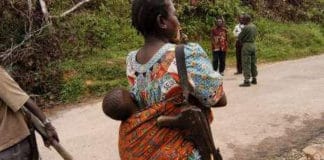
Tired of being gang raped, Congo mother takes up weapon
The Congolese woman in eastern Congo – the rape capital of the world – has gotten tired of being gang-raped, of being mutilated, of having 3-to-5-foot wooden sticks shoved through her genitals after being gang-raped, then being killed or buried alive. So she has taken up a weapon now in order to defend her baby, her own body, her humanity, her village, her community and her country, the Democratic Republic of the Congo.
Negotiate? For whose land? Congo, Rwanda and Rwanda’s M23
The Congolese army has pushed Rwanda’s M23 back by about four miles in recent days, and U.N. envoy says that their success makes this a good time to negotiate. Jean-Mobert N’senga, an activist lawyer in Goma, and his group, Fight for Change, agree but say the Democratic Republic of the Congo needs to negotiate with Rwanda, not M23.
Britain’s involvement in assassination of Congo’s Lumumba confirmed
A senior British politician has revealed Britain’s involvement in the 1961 assassination of Patrice Lumumba, the Congo’s first prime minister. The leader of the Congolese independence struggle from Belgium was brutally murdered just seven months after taking office on the direct orders of the U.S. and Belgium. Britain, whose involvement had long been suspected, also had a hand in it.
Obama administration official provides insights on U.S. Congo policy
On Monday, Feb. 11, outgoing Assistant Secretary of State for African Affairs Johnnie Carson presented an outline of the Obama administration’s policy position on the situation in the Democratic Republic of the Congo. The purpose of Ambassador Carson’s presentation was twofold: discussing why efforts should be redoubled to bring stability to the Congo and laying out a framework for “moving forward.”
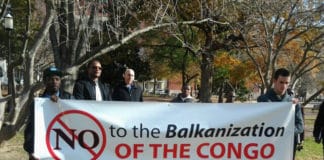
Six million dead since 1996? It’s time to break the silence...
Congolese problems should have Congolese solutions. We ask that the United States of America and the United Kingdom immediately withdraw all forms of financial and military aid to Rwanda that is a state sponsor of terrorism in Africa. We must pledge to ourselves that we will never again betray our people and ourselves by staying quiet and passive.
M23 tragedy manufactured by Rwanda and Uganda
Joseph Kabila was in Kampala Nov. 20 meeting with Rwanda’s Gen. Paul Kagame and Uganda’s Gen. Yoweri Museveni as the Congo city of Goma fell. Why would Kabila be in Uganda when the UN in a report by a group of experts found that M23, the army that seized Goma, was created, trained, financed and is sustained and commanded by Rwandan and Ugandan officers?
A young man set himself on fire in Boma, Democratic Republic...
On Dec. 10, 2011, in the Democratic Republic of Congo, a young man named Cedrick Nianza self-immolated by pouring gas on himself and setting the fuel alight. He continually shouted, “Congo na nga, Congo na nga” (“My Congo, my Congo”), while the flames consumed him.
Congo: Elections, democracy and the Diaspora awakening
Congo’s Nov. 28 presidential and legislative elections were fraught with tremendous irregularities and widespread charges of fraud. The opposition categorically rejected the results as fraudulent. Nonetheless, Joseph Kabila was sworn into office on Tuesday, Dec. 20.
Resource sovereignty: Congo, Africa and the Global South
Congolese youth are not going to give up. They’re fighting day and night, educating their peers, their communities and mobilizing throughout the country to bring about change, whether it comes today or tomorrow. They’re clear that they have to be organized to protect their interests, and no one, no one, can protect their interests like they can.
Who benefits from sexual violence in eastern Congo? Cui bono?
Are the so-called rebels furthering the aims of heads of state by shattering communities in eastern Congo, driving people into refugee camps and thus separating them from the vast resources that corporations and the major world powers are so determined to control?
50 years after Lumumba: The burden of history
It wasn’t just Patrice Lumumba his assassins wanted to kill, it was the genuine self-determination, dreams and aspirations of African people, writes Horace Campbell, reflecting on the murder of the first prime minister of the Democratic Republic of Congo (DRC) on Jan. 17, 1961. Two poems by Lumumba follow the story.
Questions about Congolese human rights defender’s murder
Floribert Chebeya Bahizire, the Democratic Republic of Congo’s leading human rights defender, was found murdered on Wednesday, June 2. On the evening of June 1, Chebeya was en route to a meeting with John Numbi, inspector general of the Congolese National Police, in response to a summons. The next day his body was found in his car.
A different lens in Denmark: WOMEX and Staff Benda Bilili
After two years of researching paraplegic street musicians, I found out that Staff Benda Bilili of Kinshasa, Congo, released their album and were invited to perform at the annual WOMEX Festival – World Music Expo. WOMEX has moved to Copenhagen, Denmark, which is also home to my sister, Pamela Juhl, and the Copenhagen Voice, which she founded. Yes, both my sister and I are journalists for the people!
Letter to Hillary Clinton from Congolese elected officials
One is hard pressed to find media accounts of what the Congolese people want or how they believe that the United States could best play a constructive role in ending the suffering in the Congo. Considering that the United States has played a significant historical role in the stifling of the democratic aspirations of the Congolese people and the backing of the 1996 and 1998 invasions of the Congo by its allies, Rwanda and Uganda, which unleashed what the United Nations say is the deadliest conflict in the world since World War II, it is important to hear directly from the Congolese people regarding U.S. engagement in the Congo.
The beauty and poetry of it
For the past seven years, filmmakers Renaud Barret and Florent de La Tullaye have been filming Staff Benda Bilili, a revolutionary and politically active Congolese band made up of disabled musicians.